


A pineapple price is a fruit, a case or a kilogram
Old prices are usually for one fruit, sometimes for a case of unknown count. Canners quoted per case of cans, farmers are paid per kilogram or per ton, and customs data give the declared value of fresh or dried pineapples divided by their weight. Shops sell by the fruit or by the pound. None of these can be turned into another without knowing the size and grade of the fruit.
A hothouse luxury, 1493–1764
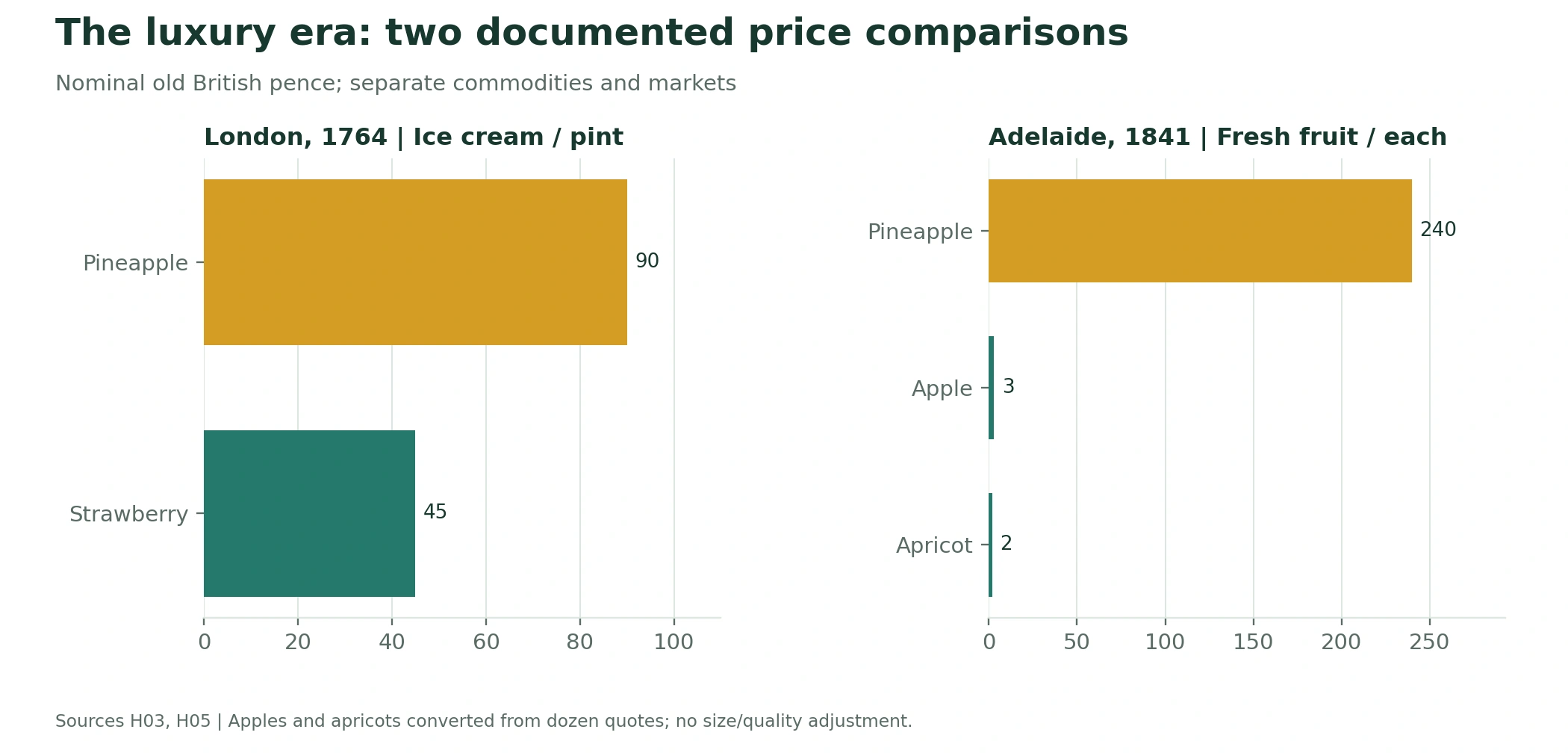
Europeans met the pineapple on Columbus’s second voyage, in Guadeloupe in 14931; see The Columbian Exchange. It was grown in the Netherlands by 1685 and in Britain from about 1714–1716, though accounts of who was first differ2. In 1721 the gardener Richard Bradley estimated that a home-grown pineapple cost £80 to produce, an estimate rather than a price paid3. In 1764 a London trade card priced a pint of pineapple ice cream at 7 shillings 6 pence, against 3 shillings 9 pence for strawberry4.
Imports for the street, 1840s–1908
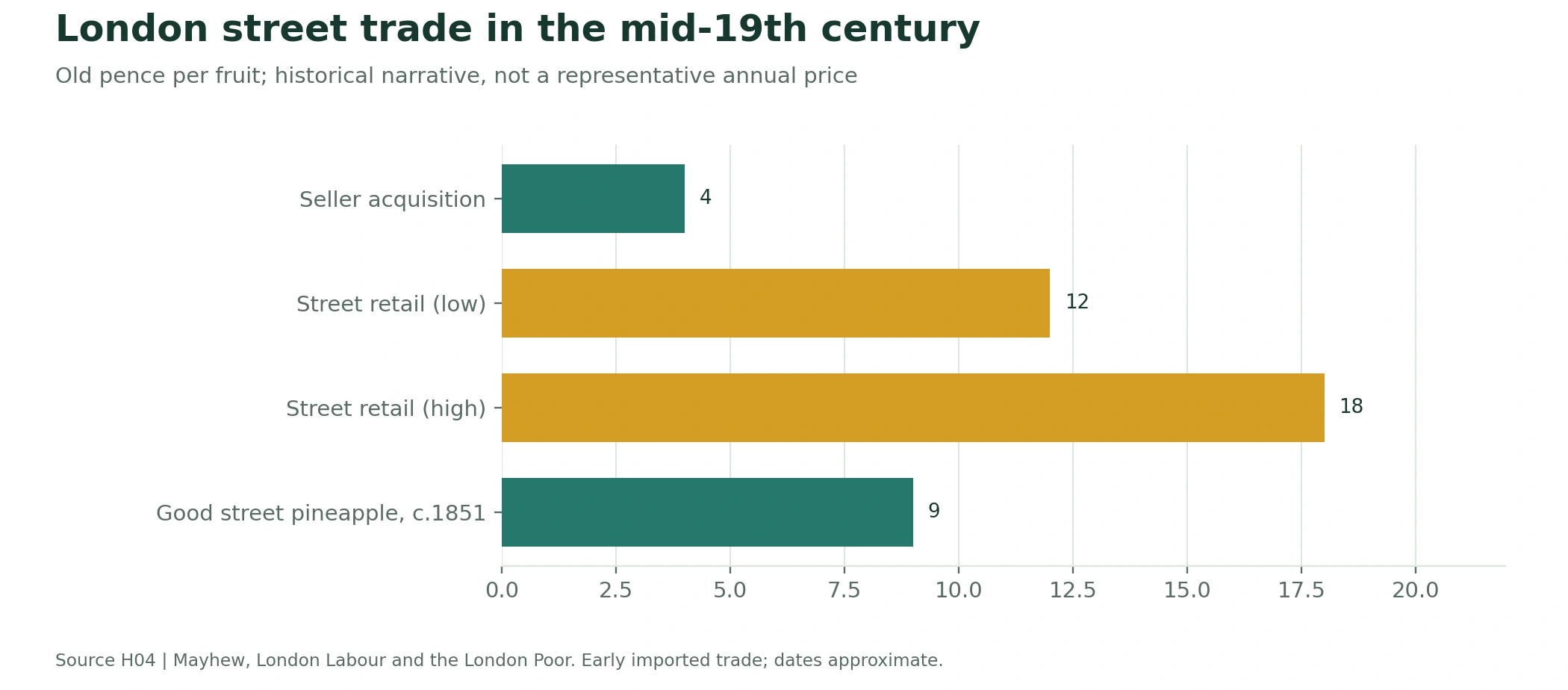
By the 1840s imports by sea had brought the fruit within reach of city crowds. Henry Mayhew’s London street sellers bought imported pineapples at about 4 pence each and sold them whole for 12 to 18 pence, or at a penny a slice; around 1851 a good street pineapple cost 9 pence5. In the colonies prices were higher: in December 1841 Adelaide quoted a pineapple at 20 shillings, when an apple cost about 3 pence, and Sydney asked 6 to 12 shillings in January 18446. In New York in May 1896 street sellers asked 15 cents and fruit stands 10 to 30 cents, apparently per fruit7; a Salt Lake City market column of January 1907 gave 30 cents a fruit8.
| Date | Place | Price | Unit |
|---|---|---|---|
| December 1841 | Adelaide | 20s | each |
| January 1844 | Sydney | 6s–12s | each |
| 1840s | London, street | 12d–18d | each |
| c. 1851 | London, street | 9d | each, good fruit |
| 8 May 1896 | New York, street | 15 cents | each, implied |
| 19 January 1907 | Salt Lake City | 30 cents | each |
| January 1908 | Queensland | 5s–6s | case of Queen fruit, count unknown |
12 pence (d) to the shilling (s). Individual quotations from narratives and newspapers, not averages; fruit size and grade are rarely stated.
The canned era, 1948–1973
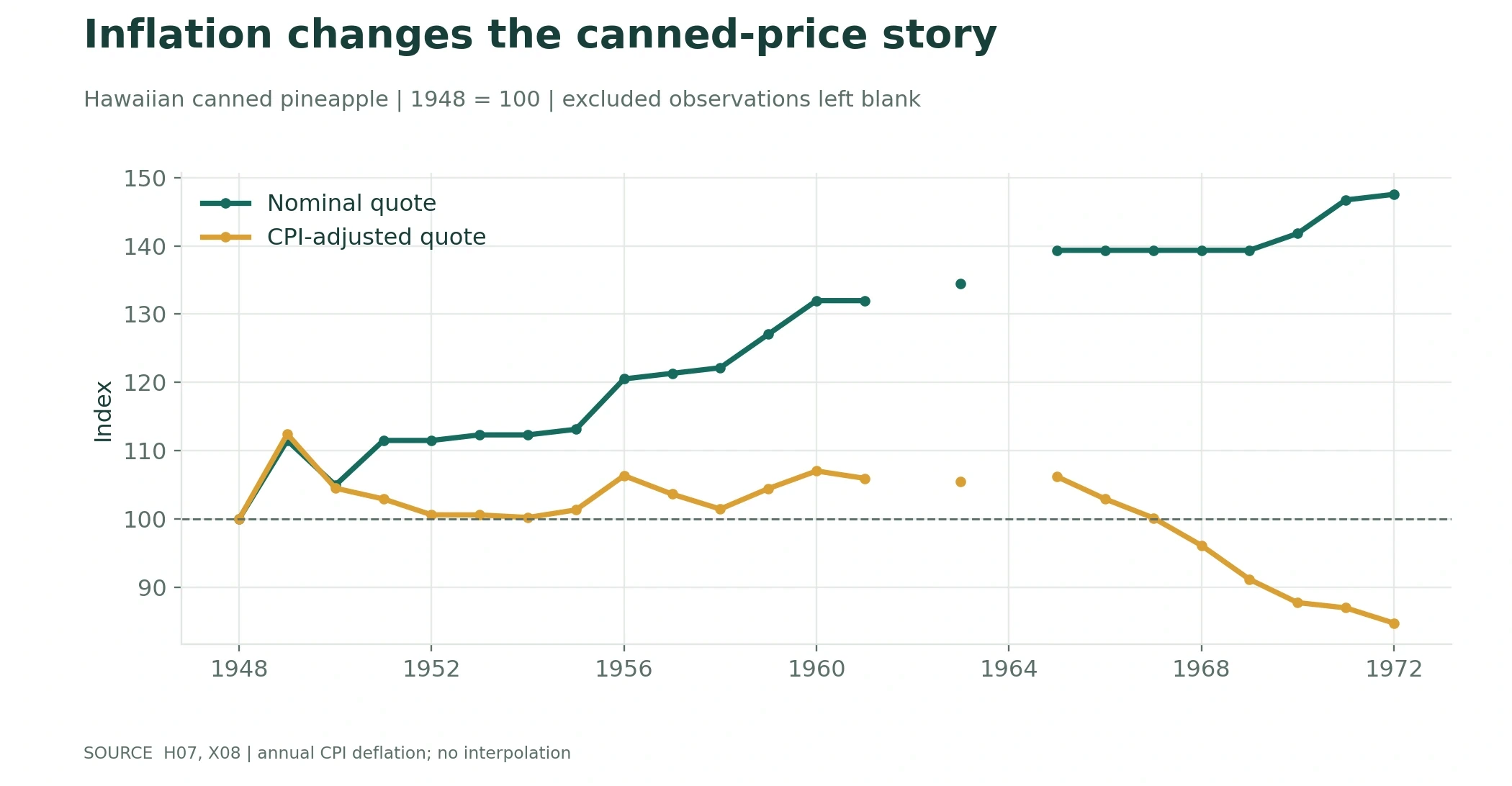
After the Second World War the US Tariff Commission followed the price of canned fruit. A case of Hawaiian sliced pineapple was quoted free on board in San Francisco at $6.10 in 1948 and $9.00 in 1972, 47.5% more; Californian cling peaches rose 23.4%9. After US inflation the pineapple quote fell 15.3%, from $81.82 to $69.31 in dollars of 2025910.
Competition came from cheaper canneries. In April 1973 a case of 24 cans of sliced fruit cost $7.03 from Hawaii, $5.60 from Taiwan, $5.50 from Malaysia and $4.75 from Mexico, 32.4% less than Hawaii; the Hawaiian fruit was of fancy grade and the imports of choice grade9.
Hawaii turns to fresh fruit, 1999–2006
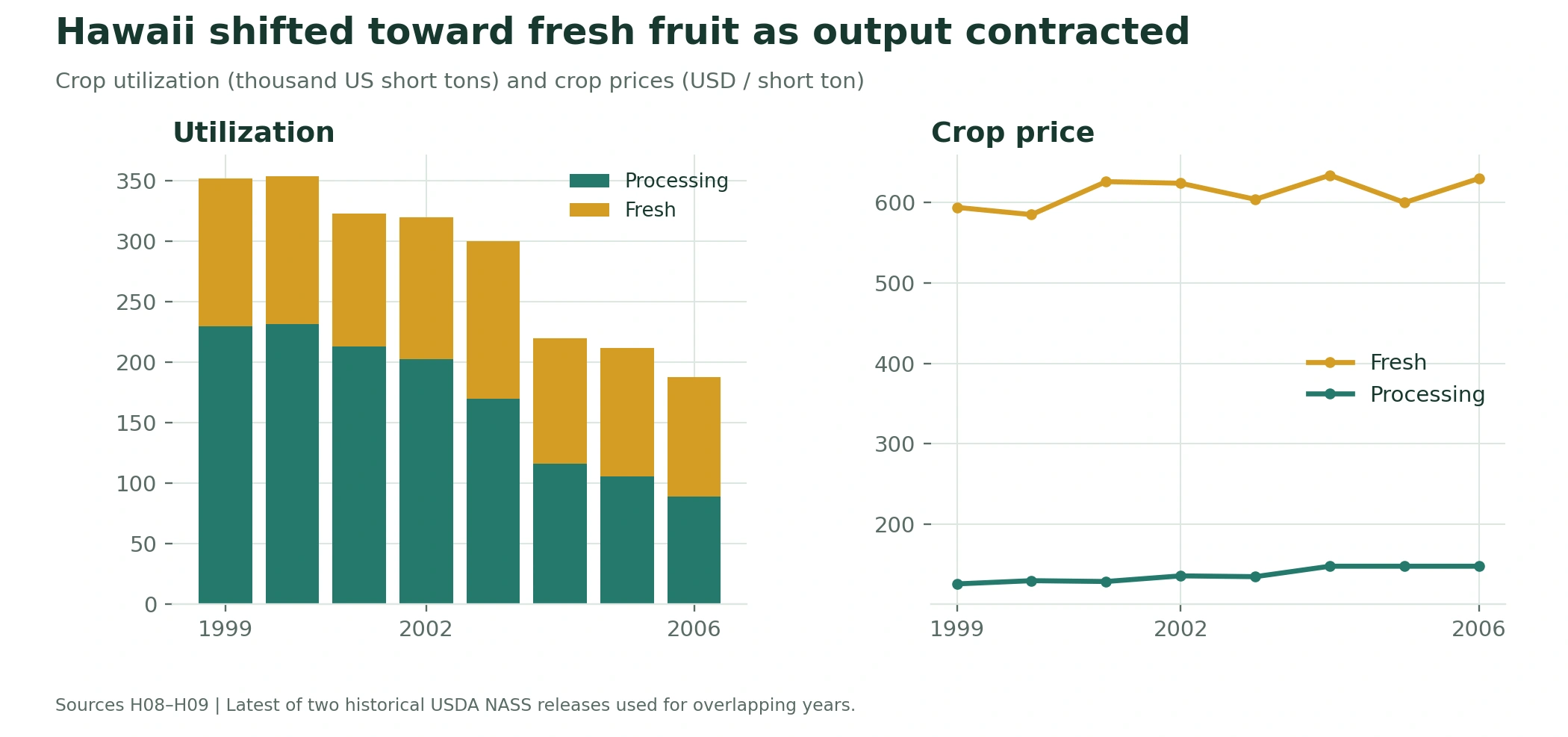
Hawaii later turned from canning to fresh fruit. Its crop fell from 352,000 short tons in 1999 to 188,000 in 2006, while the share sold fresh rose from 34.7% to 52.7%. Fresh fruit fetched $594 a short ton in 1999 and $630 in 2006, and fruit for processing $126 and $148, at different points of sale1112.
| Year | Crop, 000 short tons | Share sold fresh | Fresh, $ per short ton | Processing, $ per short ton |
|---|---|---|---|---|
| 1999 | 352 | 34.7% | 594 | 126 |
| 2002 | 320 | 36.6% | 624 | 136 |
| 2004 | 220 | 47.3% | 634 | 148 |
| 2006 | 188 | 52.7% | 630 | 148 |
Fresh fruit valued at local wholesale or shipper’s dock, processing fruit at the plant door. A short ton is 907.18 kg.
A crop that grew almost eightfold
Recorded world production rose from 3.83 million tonnes in 1961 to 29.37 million in 2024. The harvested area almost tripled, from 0.37 to 1.06 million hectares, and the yield per hectare rose from 10.4 to 27.8 tonnes13.
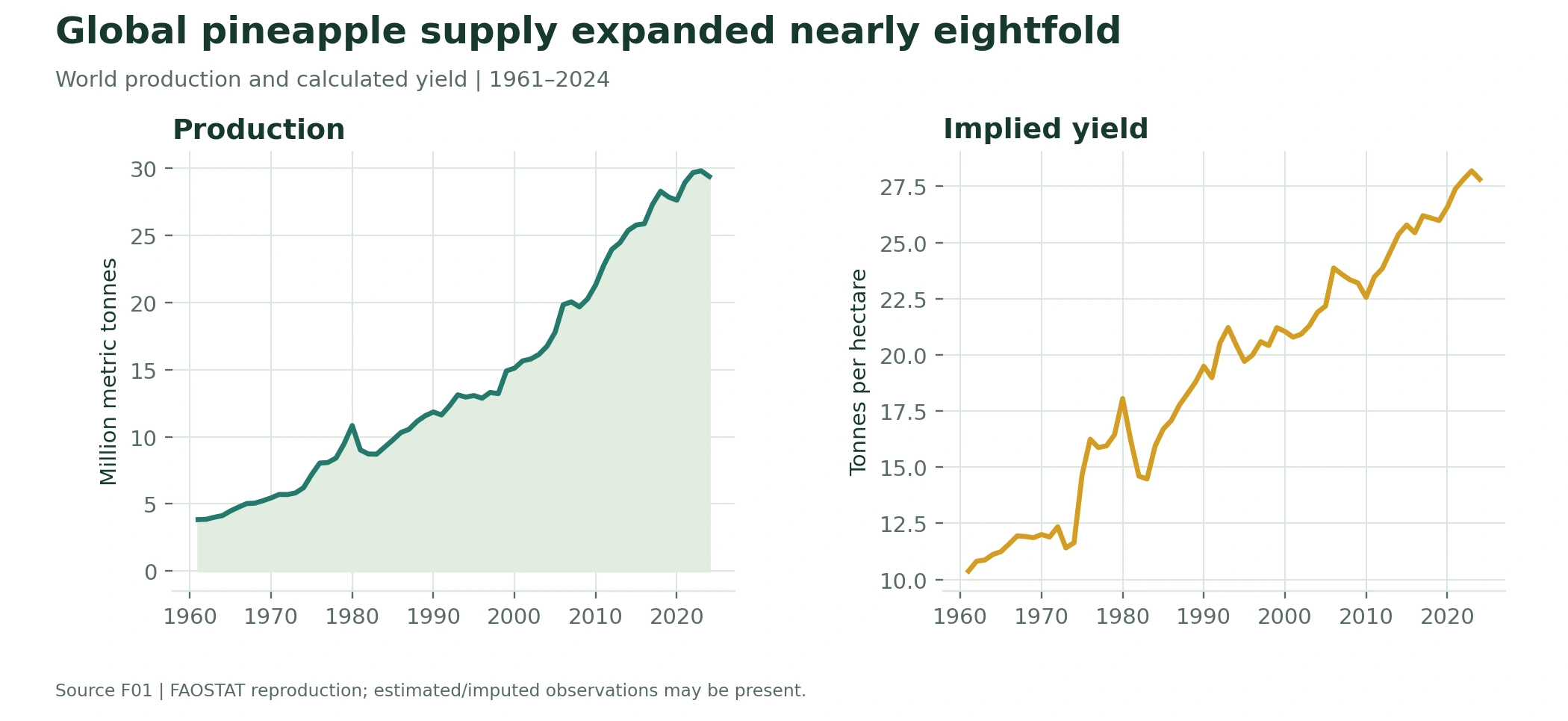
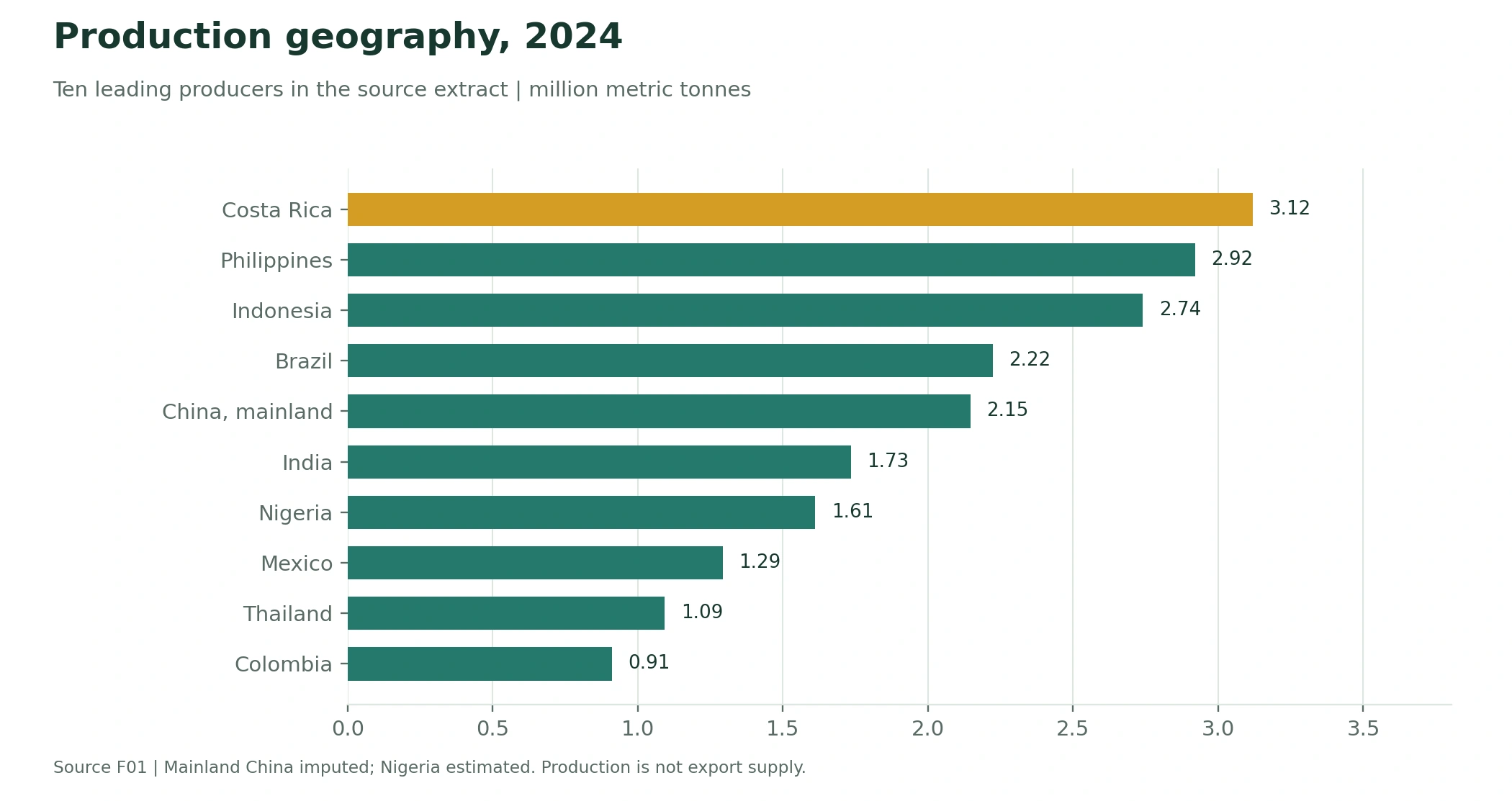
In 2024 Costa Rica grew 10.6% of the world crop, the Philippines 9.9%, Indonesia 9.3%, Brazil 7.6%, mainland China 7.3% (imputed by FAO) and India 5.9%13. Home consumption and processing can absorb much of a crop, so production says little about what reaches world markets.
World trade: Costa Rica and the Philippines
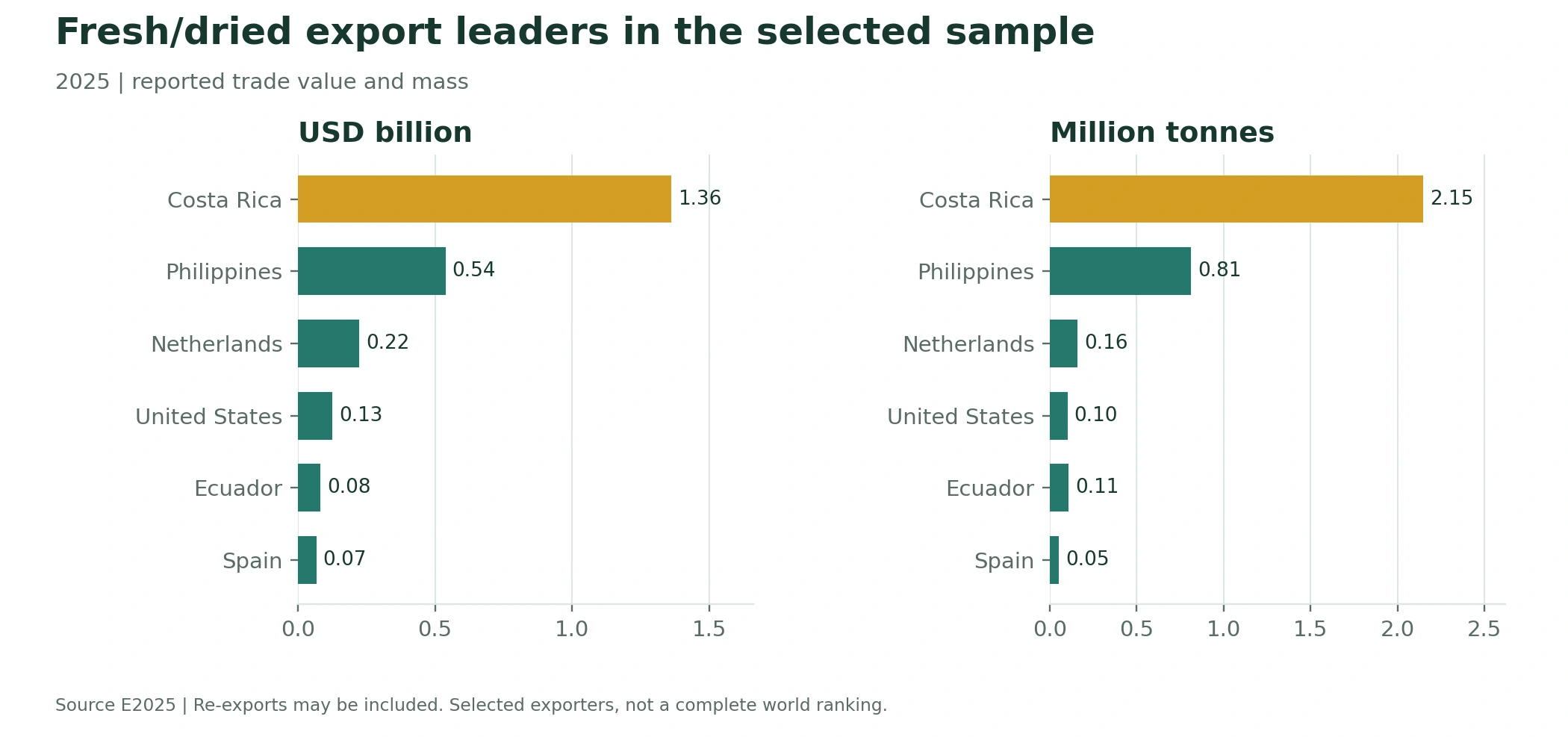
Two countries dominate exports. In 2025 Costa Rica shipped 2.15 million tonnes of fresh or dried pineapples worth $1,362 million, 63 cents a kilogram, and the Philippines 813,000 tonnes worth $538 million, 66 cents a kilogram14. Preliminary OECD–FAO estimates put world fresh exports at 3.4 million tonnes in 2025, about 5% fewer than in 2024, with supply difficulties in Costa Rica and growth in the Philippines15.
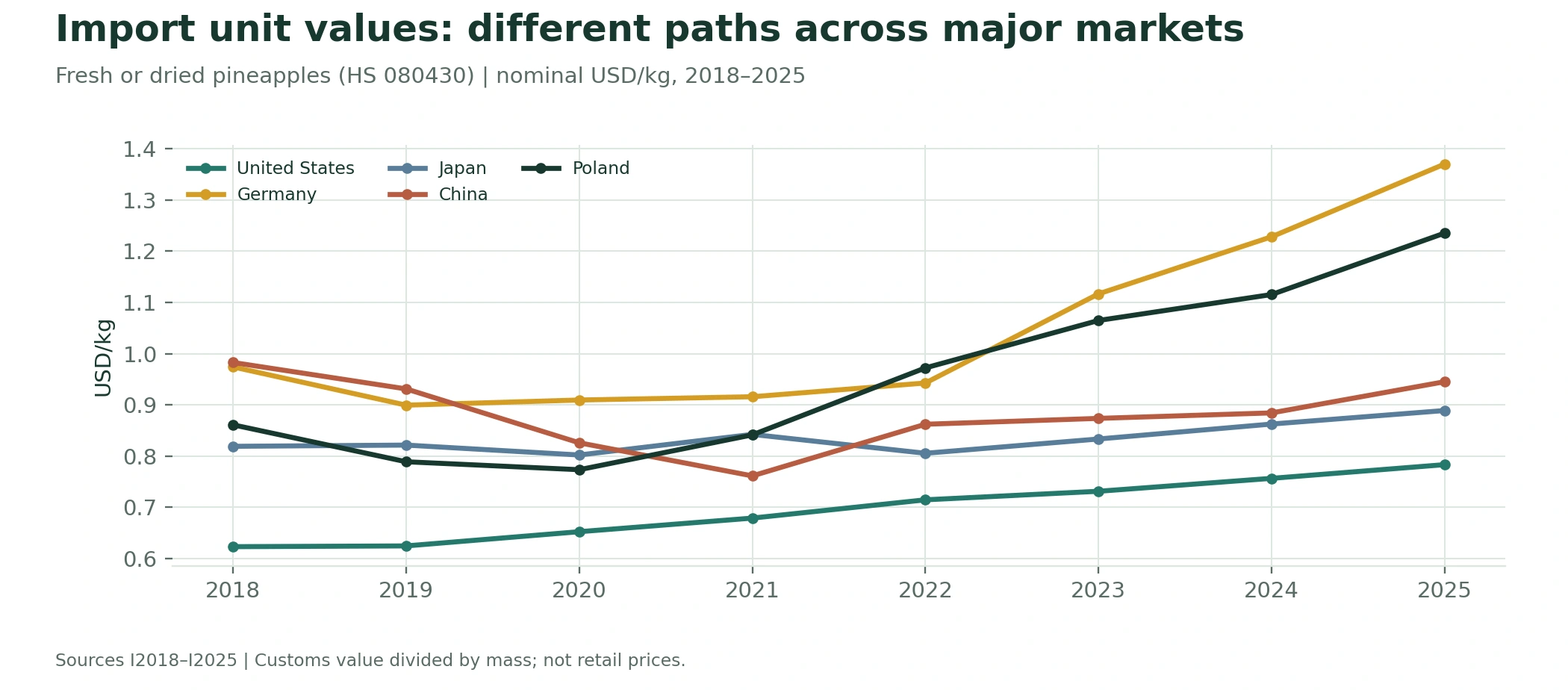
Import prices diverged after 2018. The average value of German imports rose 40.7%, to $1.370 a kilogram in 2025, and that of US imports 25.7%, to $0.783; in China it fell 3.8%, to $0.9451617. Switzerland paid $1.76 a kilogram in 202517, and Poland $1.235, 10.8% more than a year earlier1817.
| Importer | 2018 | 2025 | Change |
|---|---|---|---|
| United States | 0.623 | 0.783 | +25.7% |
| Germany | 0.974 | 1.370 | +40.7% |
| Japan | 0.819 | 0.889 | +8.5% |
| China | 0.983 | 0.945 | −3.8% |
| European Union | 0.807 | 1.132 | +40.2% |
Declared customs value divided by declared weight, HS 080430; the EU figure covers imports from outside the bloc and is not added to member states.
One supplier per market
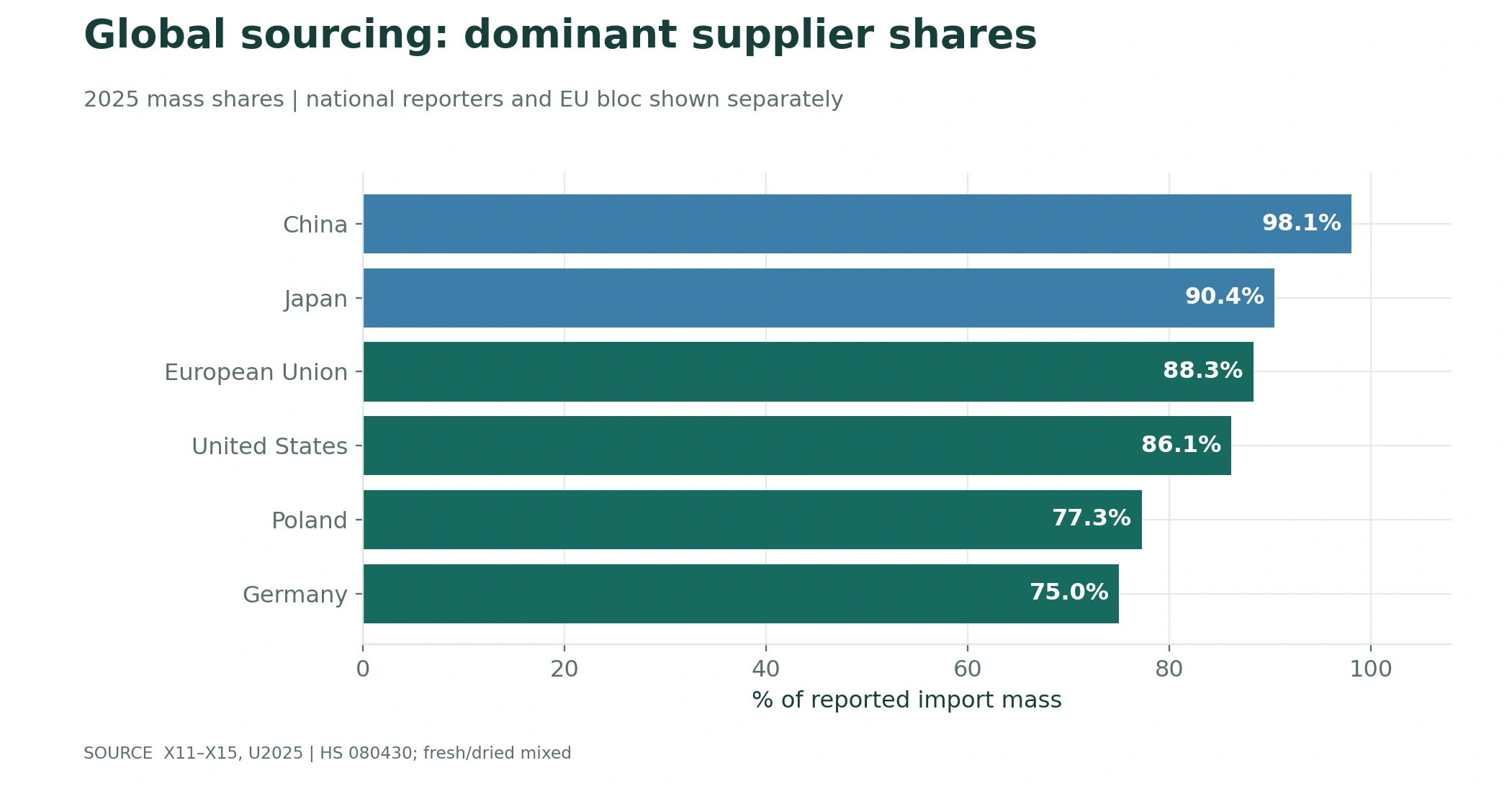
Most importers rely on one origin. In 2025 Costa Rica supplied 86.1% of US imports by weight, down from 89.4% in 20241920, and 88.3% of the EU’s; the Philippines supplied 98.1% of China’s and 90.4% of Japan’s212223.
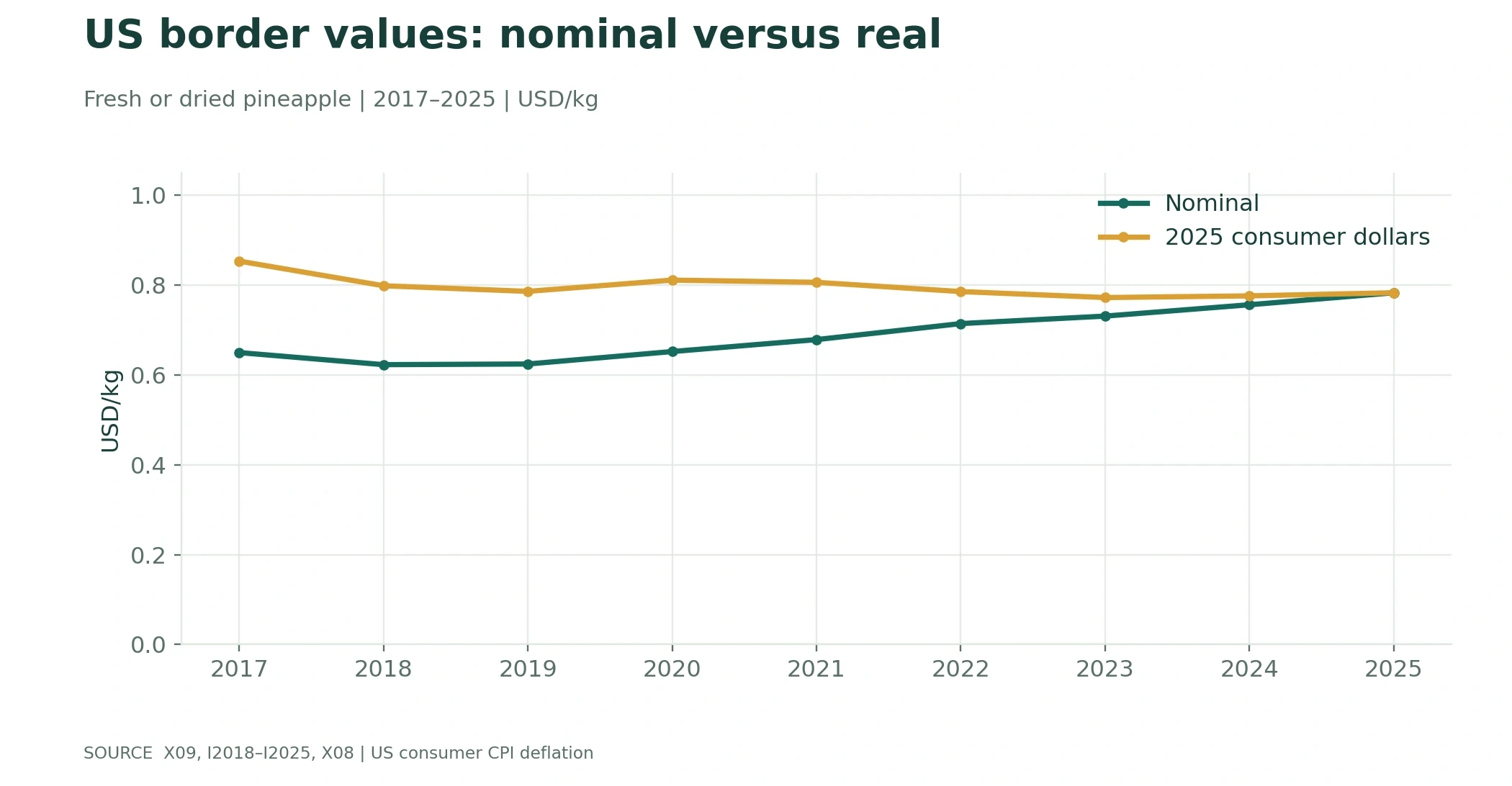
The average US import value rose from $0.650 a kilogram in 2017 to $0.783 in 2025, 20.5% more, but in dollars of 2025 it fell 8.3%242010. Fresh pineapple available to Americans rose from about 2 pounds a person a year in 1995–97 to 8.5 pounds in 202425. In the USDA retail report of 9 June 2023 advertised prices averaged $2.94 a fruit in 2,979 stores and $0.69 a pound in 196 stores26.
Farm gate and wholesale: Asia and Brazil
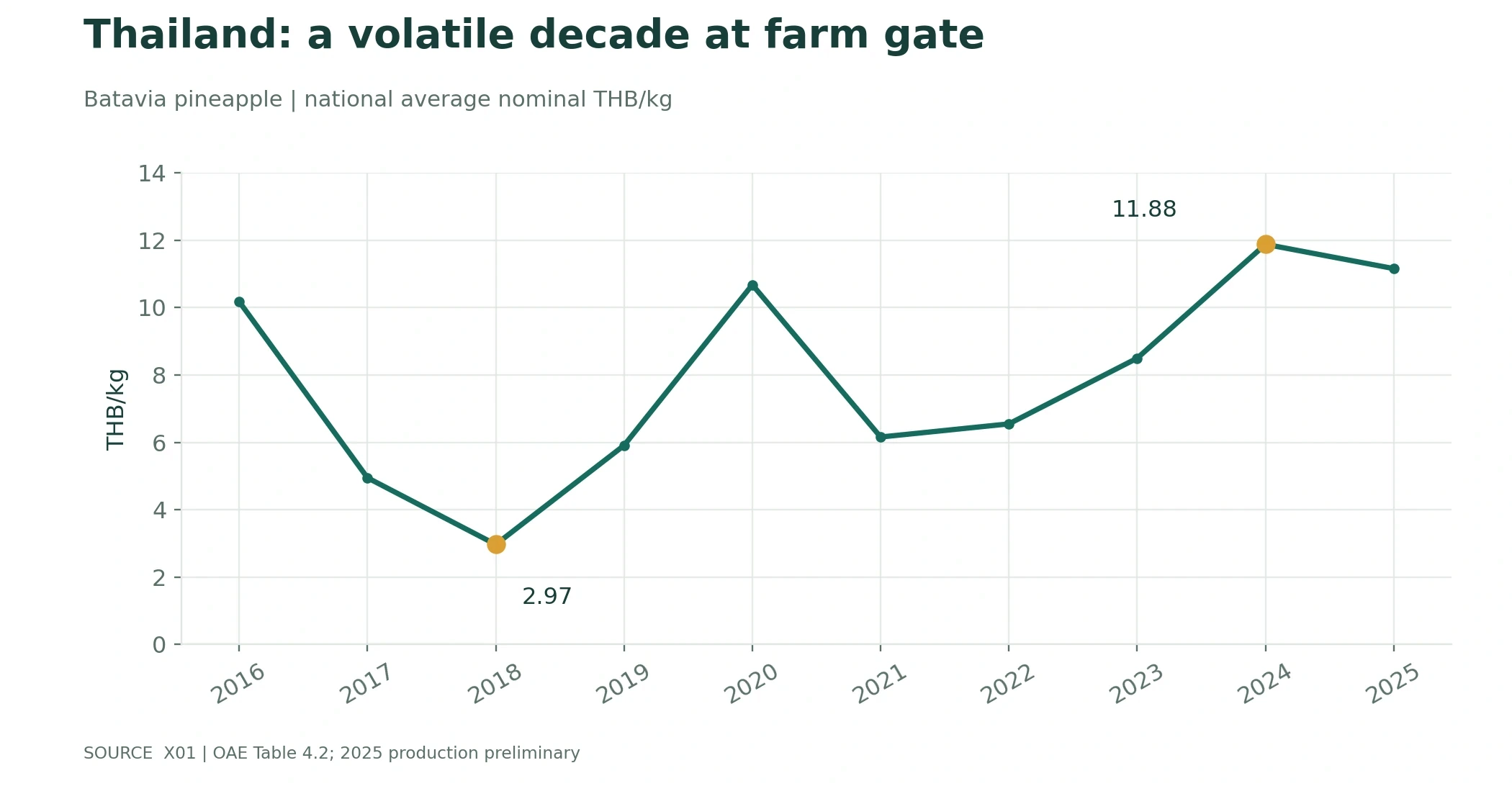
Thai growers of the Batavia variety saw their price fall from 10.18 baht a kilogram in 2016 to 2.97 in 2018 and rise to 11.88 in 2024, four times the low. Output shrank from 2.01 million tonnes in 2016 to 1.07 million in 2024; in 2025, on preliminary figures, it recovered to 1.25 million and the price eased to 11.16 baht27.
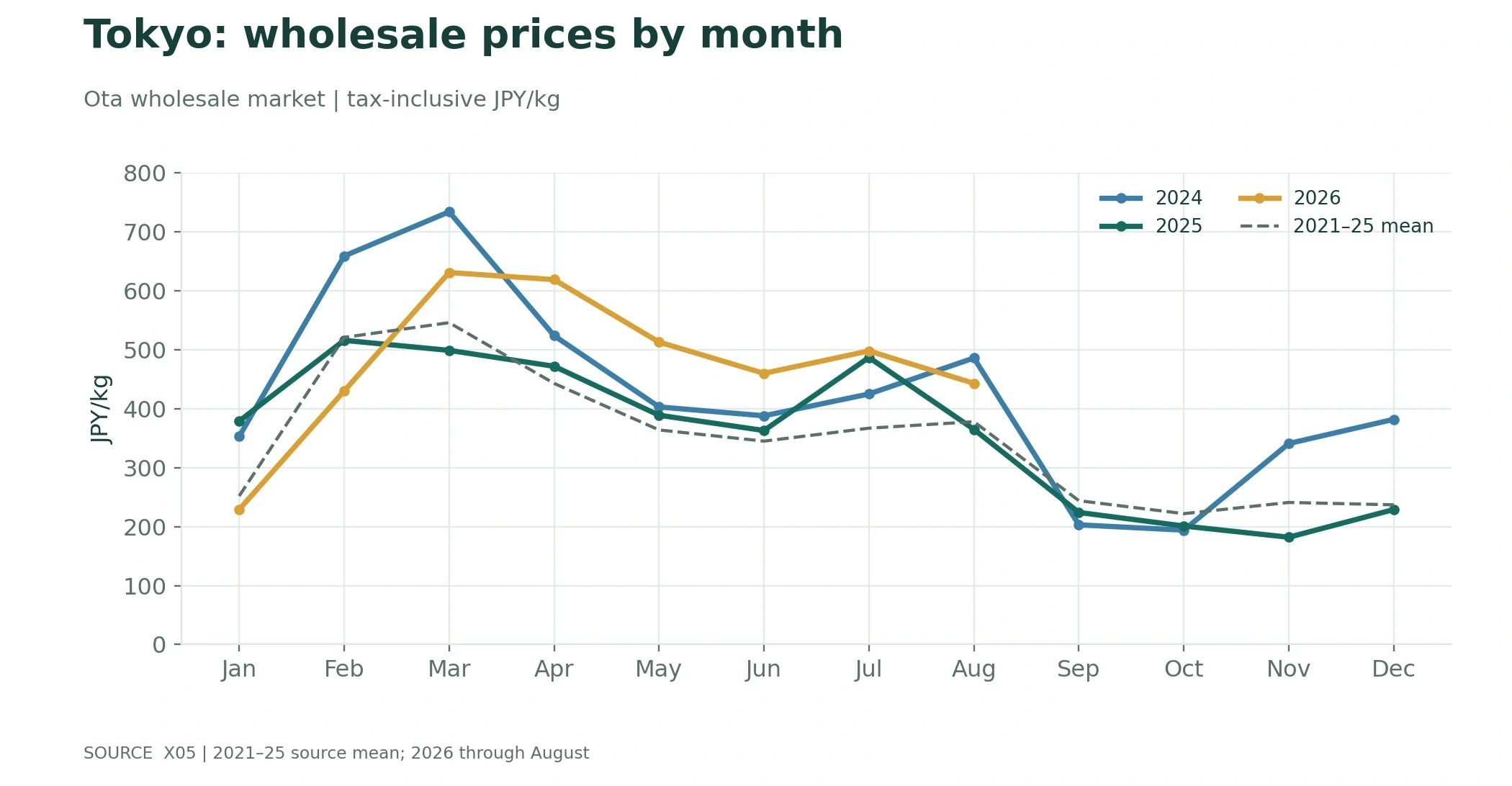
In 2021 China restricted imports of Taiwanese pineapples, citing pests; Taiwan had shipped 41,661 tonnes there in 202028. In 2021 Taiwan exported 28,000 tonnes, 18,000 of them to Japan29. In January–October 2026 Golden Diamond pineapples traded on Taiwanese wholesale markets at an average 26.03 New Taiwan dollars a kilogram, 13.7% less than a year earlier30. Tokyo moved the other way: at the Ota market January–August 2026 averaged 477.88 yen a kilogram, 10.2% more31.
In the Philippines the gap between farm and retail prices for Hawaiian pineapples widened from 39.78 pesos in 2021 to 58.71 in 202532. At the CEASA wholesale market of Rio Grande do Sul pineapples averaged 5.75 reais a kilogram in 2024, more than bananas at 4.41 and oranges at 4.2933.
November 2026 and the outlook
Official monitors in Asia quote by the piece or the kilogram. On 22 November 2026 the Philippine Department of Agriculture recorded 140.44 pesos a piece in Metro Manila34, and on 24 November the Meghalaya marketing board in India quoted Giant Kew pineapples at 50 to 60 rupees a kilogram35. In Kerala medium fruit at farm wholesale cost 37.00 rupees a kilogram in April 2025, 30.2% less than in April 202436. The OECD and FAO project about 37 million tonnes of world production and 3.8 million tonnes of fresh exports in 2035, volumes rather than prices15. For a recent shock see Cold weather reduces Ivorian pineapple quality.
Latest pineapple prices on Husfarm
Updated automatically from wholesale markets in several countries, each in its own currency and unit. Each price links to its history and source.
| Price series | Market | Latest | Change | Date |
|---|---|---|---|---|
| Pineapple Africa B (1100-1500g) boat | Lyon-Corbas MarketFrance | 1.00–1.33 EUR/kg | ± 0.0% | 12 Nov 2026 |
| Pineapples, Golden Sweet | MercalicanteSpain | 1.40 EUR/kg | — | 22 Oct 2026 |
| Pineapple | Central Market of ThessalonikiGreece | 1.40–1.70 EUR/kg | — | 23 Oct 2026 |
| Pineapples | Taipei MarketTaiwan | 26.1 TWD/kg | — | 29 Oct 2026 |
| Perola pineapples, Large | CEASA CampinasBrazil | 4.17 BRL/kg | — | 28 Oct 2026 |
| Pineapple medium class I loose Oaxaca | Centro Comercial Agropecuario de AguascalientesMexico | 16.0–20.0 MXN/kg | — | 23 Oct 2026 |
| Golden pineapples | Bucaramanga Centroabastos Wholesale MarketColombia | 3,600 COP/kg | −2.7% | 31 Oct 2026 |
| Pineapple (maurituis) ripe (kerala) | Alappuzha Wholesale MarketIndia | 58.0 INR/kg | — | 26 Oct 2026 |
Pineapple prices today Pineapple production by country The price of bananas
How to read pineapple prices
- Name the unit: one fruit, a slice, a case of cans, a kilogram or a short ton are not interchangeable without the fruit’s weight.
- Name the form: fresh, dried, canned and juice are different products with different prices.
- Name the stage: farm gate, cannery, customs value, wholesale quote or shop price.
- Read customs values as averages: HS 080430 mixes fresh and dried fruit, origins and grades.
- Name the variety: Batavia, Golden Diamond, Queen and MD-2 types are priced separately.
Price changes are 100 × (last ÷ first − 1). Customs unit values are declared value divided by declared weight. Real US prices use annual averages of the US consumer price index. Historical prices stay in their original currencies and units.
Questions and answers
Why were pineapples so expensive in the eighteenth century?
In Britain they had to be grown in heated hothouses. In 1721 Richard Bradley estimated the cost of growing one at £80. In 1764 a pint of pineapple ice cream cost 7 shillings 6 pence in London, twice the price of strawberry.
When did pineapples become cheap?
Imports by sea brought them to city streets in the nineteenth century. In 1840s London street sellers bought pineapples at about 4 pence and sold them for 12 to 18 pence, or a penny a slice. By 2024 the world grew 29.37 million tonnes a year.
Which country exports the most pineapples?
Costa Rica. In 2025 it exported 2.15 million tonnes of fresh or dried pineapples worth $1.36 billion, and supplied 86.1% of US imports by weight. The Philippines is second and supplies most of the fruit sold in China and Japan.
Are pineapples dearer than they used to be?
At the US border, not after inflation. The average import value rose from $0.650 a kilogram in 2017 to $0.783 in 2025, but that is 8.3% less in dollars of 2025. In Germany the average rose 40.7% between 2018 and 2025.
Which country grows the most pineapples?
In 2024 Costa Rica grew 10.6% of the world crop of 29.37 million tonnes, ahead of the Philippines with 9.9% and Indonesia with 9.3%.
What do Thai farmers get for pineapples?
Growers of the Batavia variety were paid an average 11.88 baht a kilogram in 2024 and 11.16 in 2025. In 2018 the price fell to 2.97 baht.
Sources
Links to other websites open in a new tab.
- National Trust for Scotland. Pineapples. From Columbus’s voyage of 1493 to Scottish hothouses
- Royal Botanic Garden Edinburgh (2008). Pineapple growing. Sibbaldia 6: cultivation in the Netherlands and Britain
- Fitzwilliam Museum. Richard Bradley, A General Treatise of Husbandry and Gardening (1721). Estimated cost of growing a pineapple
- Fitzwilliam Museum. Pineapple ice cream. A London confectioner’s trade card of 1764
- Henry Mayhew (1851). London Labour and the London Poor, vol. 1. Street sellers of pineapples, via Project Gutenberg
- Compost Sydney (2023). Pineapple with the lot. pp. 2–3: Adelaide 1841, Sydney 1844 and Brisbane 1908 newspaper quotations
- The Journal, New York, via Library of Congress (1896). Market column, 8 May 1896. Image 14: street and stand prices
- The Salt Lake Tribune, via Library of Congress (1907). Market column, 19 January 1907. Page 9: pineapples each
- US Tariff Commission (1973). Canned Pineapple and Pineapple Juice, publication 581. Table 9, p. A-44, and p. A-32: prices per case
- Federal Reserve Bank of Minneapolis (2026). Consumer Price Index, 1913–. Annual averages used for prices in 2025 dollars
- USDA National Agricultural Statistics Service (2004). Hawaii Pineapples, annual summary 2003. 1999–2001 crop prices and utilisation
- USDA National Agricultural Statistics Service (2007). Hawaii Pineapples, annual summary 2006. 2002–2006 crop prices and utilisation
- FAOSTAT, via GrowEarth (2026). Pineapples: production, area and yield, 1961–2024. FAO item 574, with estimated and imputed values flagged
- World Bank WITS, UN Comtrade data (2026). Exports of fresh or dried pineapples, HS 080430, 2025. Value and quantity by exporter
- OECD and FAO (2026). OECD-FAO Agricultural Outlook 2026–2035. Chapter 10: fresh pineapple exports in 2025 and projections to 2035
- World Bank WITS, UN Comtrade data (2026). Imports of fresh or dried pineapples, HS 080430, 2018. Value and quantity by importer
- World Bank WITS, UN Comtrade data (2026). Imports of fresh or dried pineapples, HS 080430, 2025. Value and quantity by importer
- World Bank WITS, UN Comtrade data (2026). Imports of fresh or dried pineapples, HS 080430, 2024. Value and quantity by importer
- World Bank WITS, UN Comtrade data (2026). United States imports of pineapples by partner, 2024. HS 080430
- World Bank WITS, UN Comtrade data (2026). United States imports of pineapples by partner, 2025. HS 080430
- World Bank WITS, UN Comtrade data (2026). China imports of pineapples by partner, 2025. HS 080430
- World Bank WITS, UN Comtrade data (2026). Japan imports of pineapples by partner, 2025. HS 080430
- World Bank WITS, UN Comtrade data (2026). European Union imports of pineapples by partner, 2025. HS 080430
- World Bank WITS, UN Comtrade data (2026). United States imports of pineapples by partner, 2017. HS 080430
- USDA Economic Research Service (2025). Pineapple availability pivots from processed to fresh. Chart of Note: fresh availability per person, 1995–97 and 2024
- USDA Agricultural Marketing Service (2023). National Retail Report: Fruits and Vegetables. 9 June 2023, p. 5: advertised pineapple prices
- Office of Agricultural Economics, Thailand (2026). Agricultural Statistics of Thailand 2025. Tables 4.1–4.2, pp. 78–79: Batavia pineapple, 2016–2025
- FFTC Agricultural Policy Platform (2021). China to ban Taiwan pineapples. Exports to mainland China in 2020
- Ministry of Agriculture, Taiwan (2022). Pineapple exports to Japan. Exports in 2021
- Taiwan Data Radar (2026). Golden Diamond pineapple wholesale transactions. Monthly prices and volumes, January 2025–October 2026
- GD Freak, from Tokyo Metropolitan Central Wholesale Market data (2026). Pineapple wholesale price at the Ota market. Monthly prices, 2024–August 2026, tax included
- Philippine Statistics Authority (2026). Farm to retail price gap. Hawaiian pineapple, 2021–2025
- Rio Grande do Sul Department of Agriculture (2025). Radiografia da Agropecuária Gaúcha 2025. p. 31: CEASA/RS wholesale prices, 2024
- Department of Agriculture, Philippines, via eAgri (2026). Pineapple: Bantay Presyo price monitoring. Metro Manila, 22 November 2026
- Meghalaya State Agricultural Marketing Board (2026). Market prices. Giant Kew pineapple, 24 November 2026
- Department of Economics and Statistics, Kerala (2025). Farm wholesale prices. Medium pineapple, Kunnathunad, April 2024 and April 2025
About this price history
The Husfarm editorial team prepared this price history from the sources listed above, from an eighteenth-century treatise and Victorian street accounts to the latest UN Comtrade, FAOSTAT, OECD–FAO, USDA and national statistics. Calculations (price changes, unit values, shares and prices in 2025 dollars) are our own and use the published observations at their own precision.
Charts: Husfarm, from the sources listed. Cover illustration: Husfarm.
Prices are nominal, in the currency and unit of each source, unless a base year or a wage measure is stated. Figures checked on 24 November 2026. To report an error, write to us through the contact page.
Cite as: Husfarm editorial team (2026). The price of pineapples: from Georgian hothouses to Costa Rica’s container trade. Husfarm, 24 November 2026. https://husfarm.com/price-histories/pineapples/