

A tomato price is a stage, a unit and a season
Tomatoes are sold fresh and sent for processing, and the two are priced as different goods. The US shop series covers field-grown tomatoes per pound1; the producer price index measures growers’ selling prices on a base of 1982 = 100, not in dollars2. FAOSTAT publishes national producer prices per tonne3, customs data give an average value per kilogram, and much of the long record concerns cans rather than fresh fruit. Tomatoes keep for days, not months, so the season and the week matter more than for grain.
From the Americas to Italian kitchens
The wild ancestors of the tomato grew in western South America, and genomic research describes a domestication that involved both South America and Mexico rather than a single date4. In Europe Pietro Andrea Mattioli described the plant in 1544, and the oldest surviving specimens and pictures date from the following decade5. Recipes in a Naples cookbook of 1692–1694 and purchases in Genoese household accounts of 1765 show tomatoes as food, but give no usable price6. How American crops crossed the Atlantic is told in The Columbian Exchange.
A quotation from 1811 and a dozen cans
The earliest price comes from the Statistica Murattiana, the survey of the Kingdom of Naples: in 1811 tomatoes cost 3 grana per rotolo, about 890 grams. The historian David Gentilcore reports the figure; place, quality and season are not given, and no conversion into modern money is attempted6.
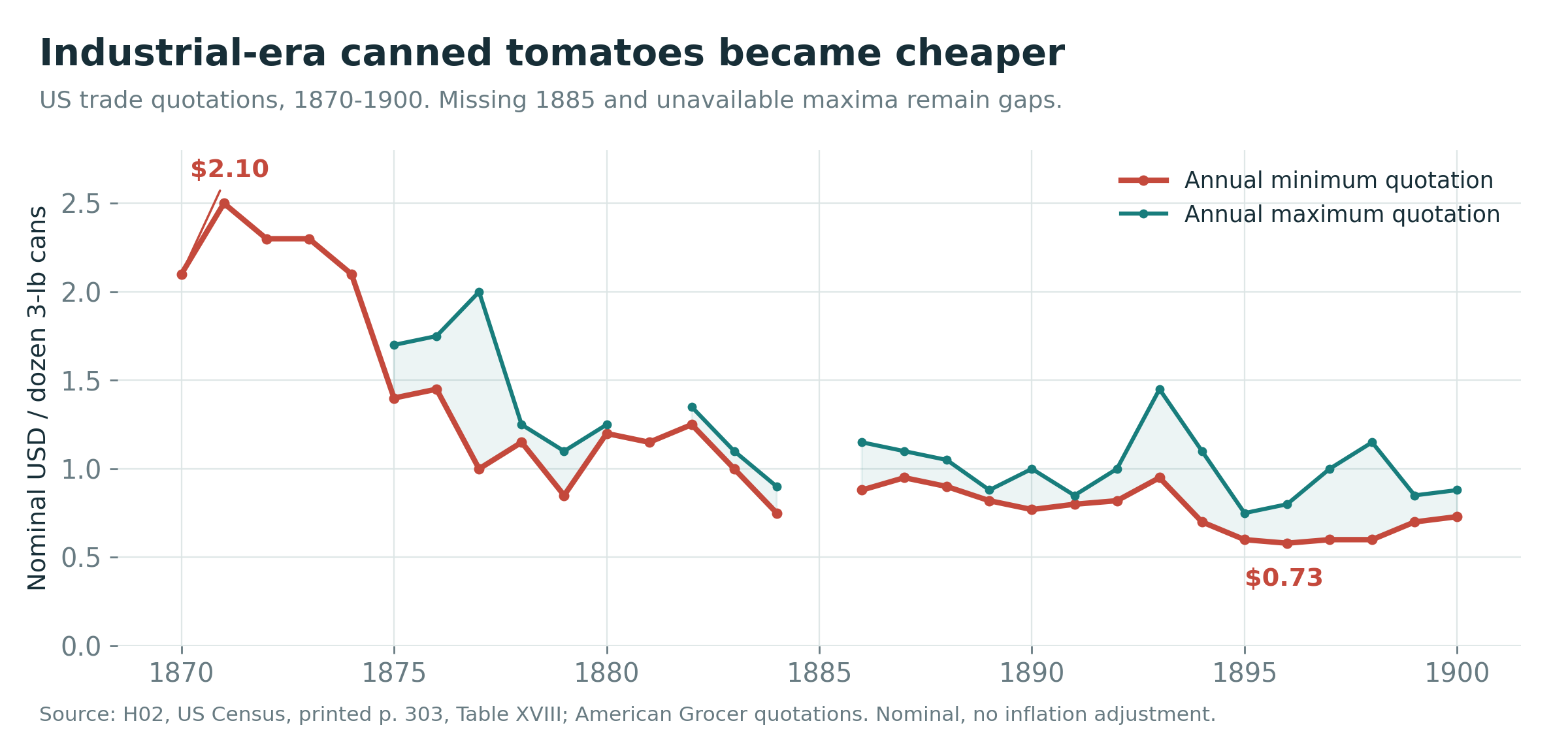
In the nineteenth century the best record is for a processed product. American Grocer quotations reproduced by the US Census put the minimum price of a dozen 3-pound cans at $2.10 in 1870 and $0.73 in 1900, 65.2% lower; the average of 1896–1900 was 71.6% below that of 1870–18747. The minimum was close to what canners received under contract. Canning itself grew from the method described in Nicolas Appert and food preservation.
Seasons and origins, 1912–1960
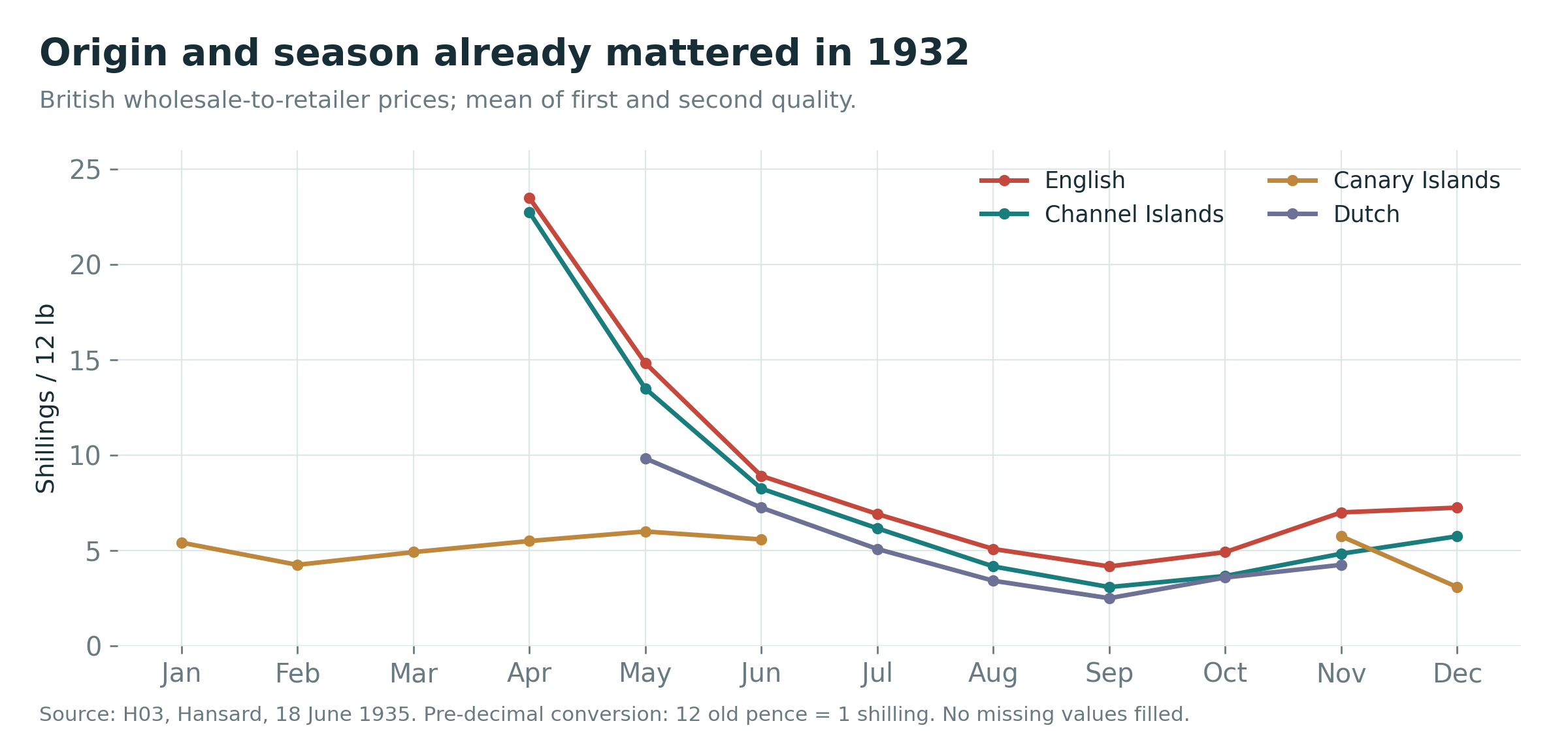
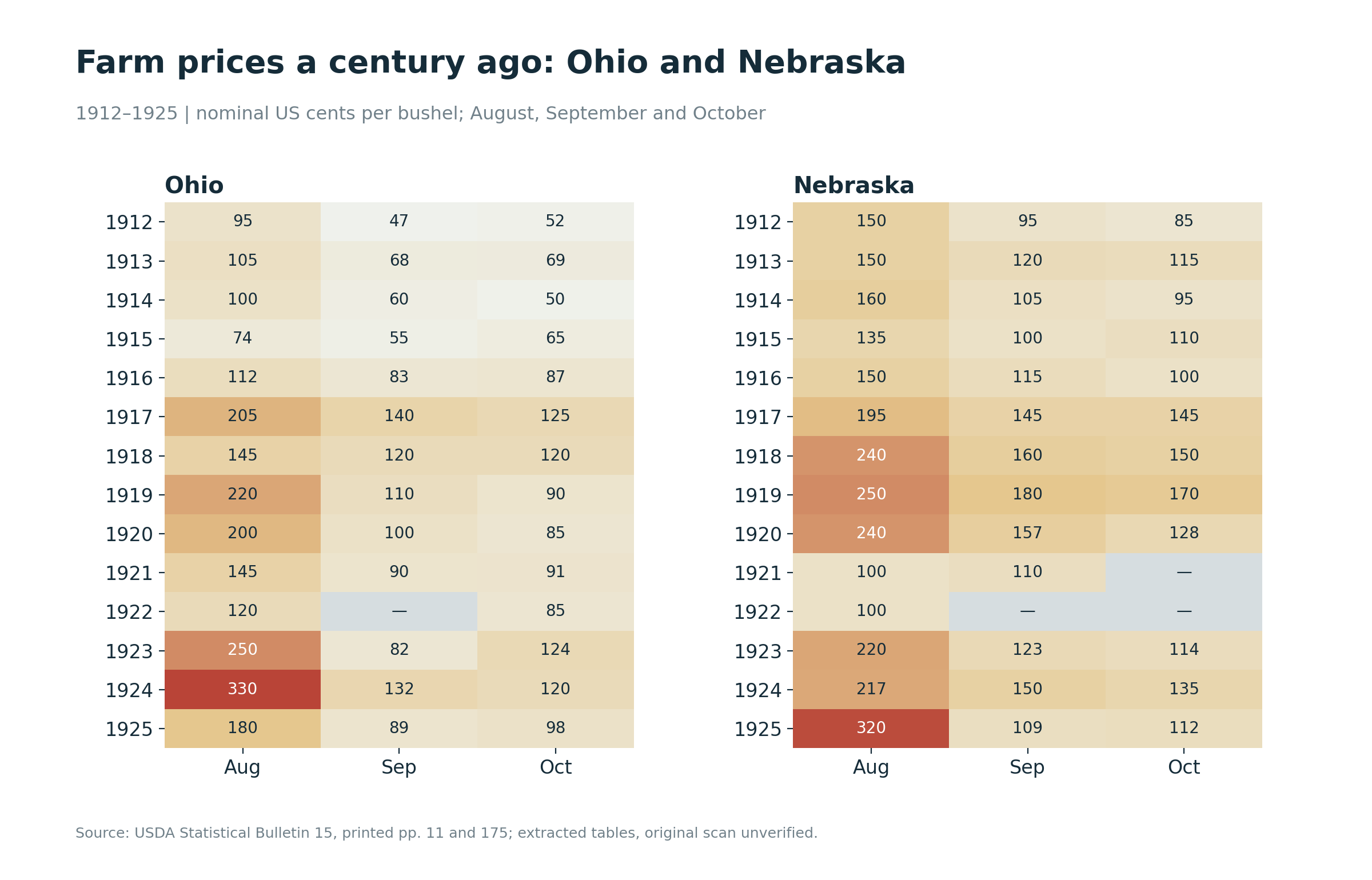
Before year-round supply, the calendar set the price. On American farms the median October price was 42.1% below August in Ohio over fourteen years between 1912 and 1925, and 37.6% below in Nebraska over twelve years8. In London in 1932 English tomatoes sold to retailers at 23 shillings 6 pence per 12 lb in April and 4 shillings 2 pence in September, a 5.64-fold difference; the record already separated English, Channel Islands, Canary Islands and Dutch fruit9.
Shop prices followed the same rhythm. American farm households paid 3.45 cents a pound for fresh tomatoes in September 1935 and 17.3 cents in September 1960, and in both years September was the cheapest of the four months recorded10. A No. 2 can cost 14.8 cents in 1920, 9.3 cents in 1932, 8.6 cents in 1939 and 19.3 cents in 194711.
| Date | Market | Price | Unit |
|---|---|---|---|
| 1870 | New York, canned | $2.10 | dozen 3-lb cans, minimum |
| 1900 | New York, canned | $0.73 | dozen 3-lb cans, minimum |
| April 1932 | London wholesale, English | 23s 6d | 12 lb |
| September 1932 | London wholesale, English | 4s 2d | 12 lb |
| 1932 | US shops, canned | 9.3 cents | No. 2 can |
| September 1935 | US farm households, fresh | 3.45 cents | pound |
| 1947 | US shops, canned | 19.3 cents | No. 2 can |
| September 1960 | US farm households, fresh | 17.3 cents | pound |
Different products, stages and samples; the rows are not one series. The 1935–1960 figures come from a text transcription not yet checked against the scan.
The United States: a farm index since 1947, a shop price since 1980
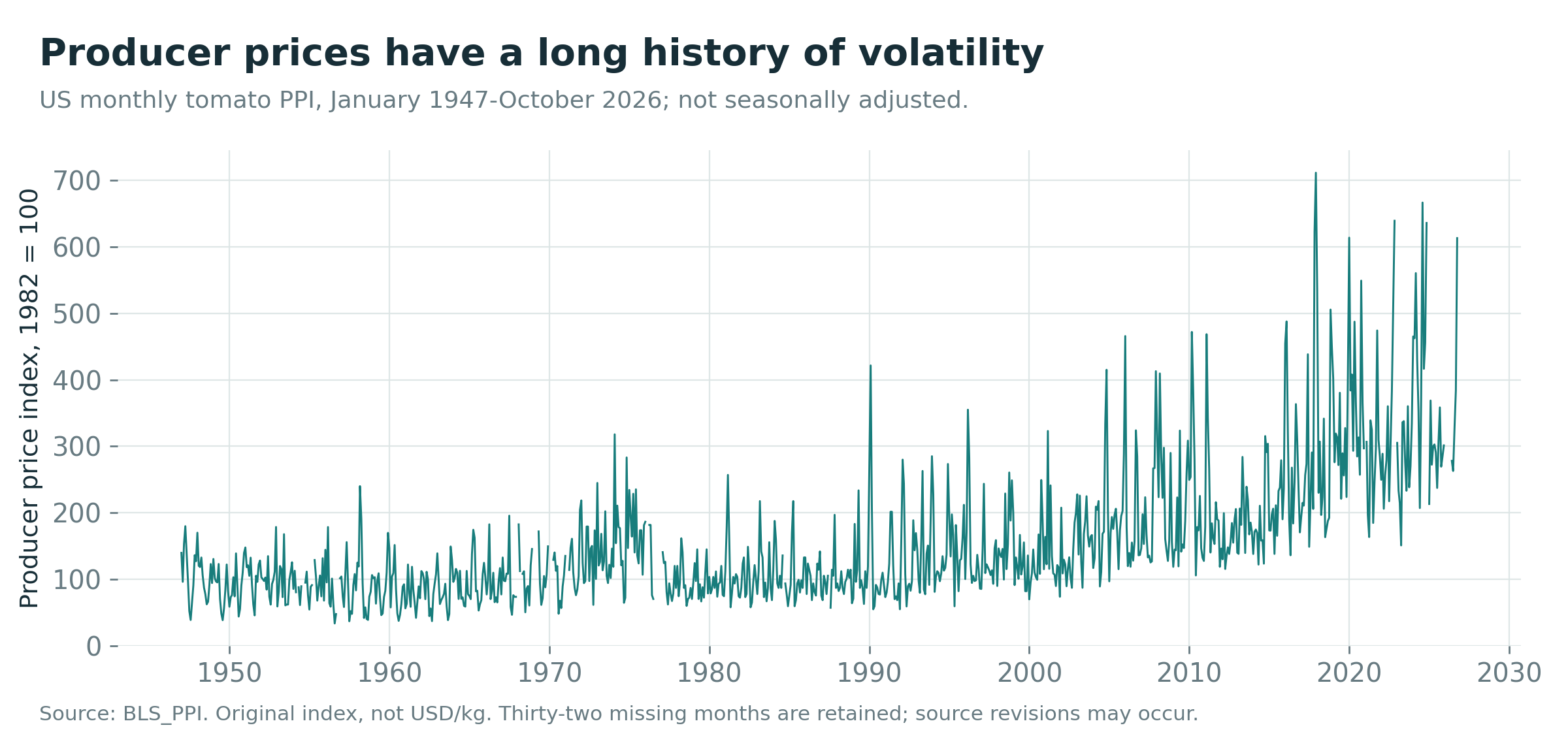
The producer price index for tomatoes swings more within a year than most farm prices over a decade. In 1947 it stood at 179.9 in April and 38.9 in August; in 2024 it went from 207.2 in June to 666.4 in August. The highest month was December 2017, at 711.2, and the highest complete-year average 385.0, in 2020. In October 2026 the index was 612.9, against 269.4 a year earlier2.
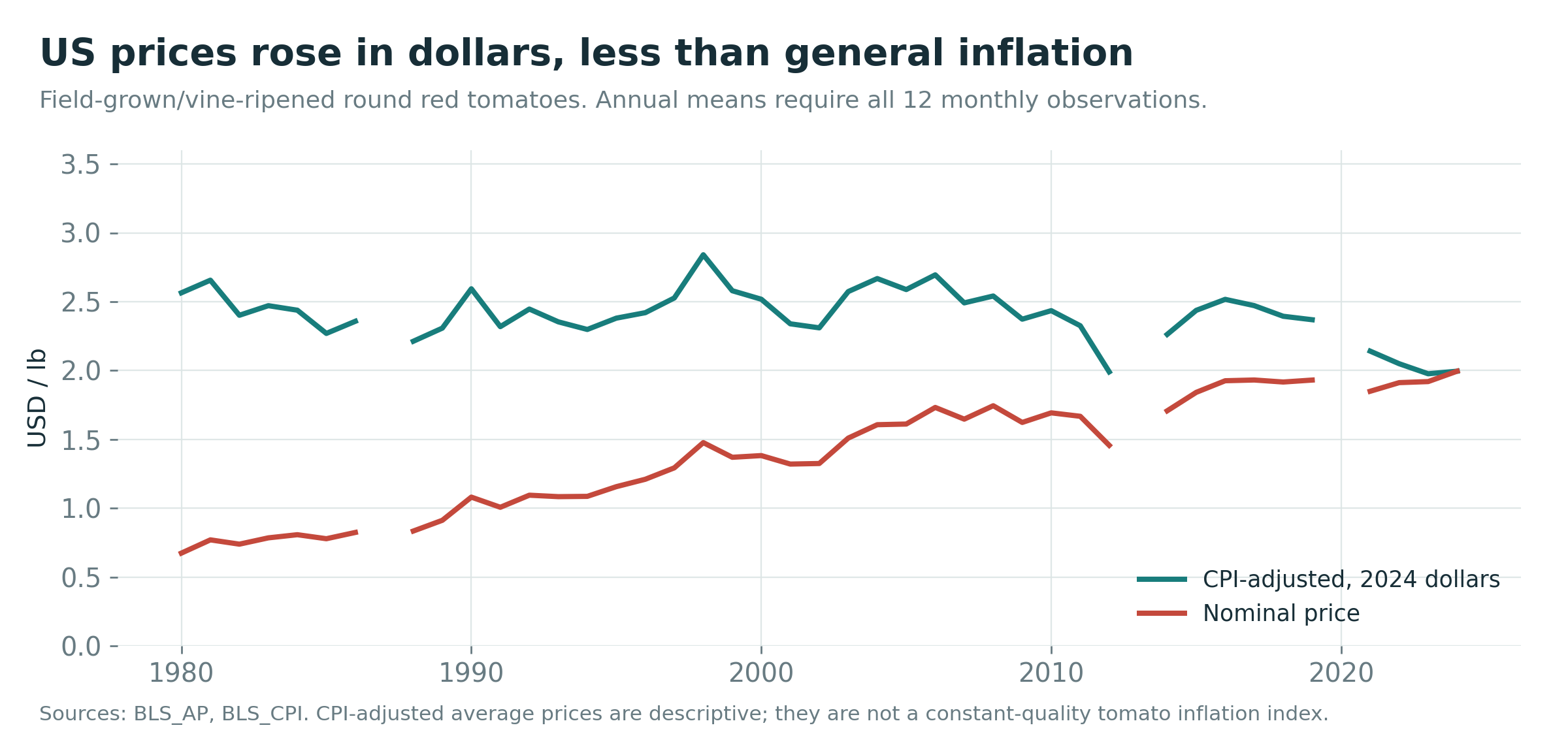
In the shops a pound of field-grown tomatoes cost $0.674 on average in 1980 and $1.995 in 2024, 196.1% more; in 2024 dollars the 1980 price was $2.564, so tomatoes became 22.2% cheaper in real terms112. BLS treats these averages as price levels rather than a constant-quality index13. The largest yearly rise was 124.6% in February 1990, followed by a 64.4% fall in February 1991. In 2026 the price climbed from $1.791 in January to $2.689 in April, the highest month in the series, and stood at $2.084 in October1.
| Year | Nominal | In 2024 dollars |
|---|---|---|
| 1980 | 0.674 | 2.56 |
| 1990 | 1.080 | 2.59 |
| 2000 | 1.382 | 2.52 |
| 2010 | 1.692 | 2.43 |
| 2024 | 1.995 | 2.00 |
| April 2026 | 2.689 | — |
| October 2026 | 2.084 | — |
Annual means of twelve monthly averages; deflated by the CPI for all urban consumers. No complete annual mean exists for 2025.
Growers’ prices: fresh, processing and fourteen countries
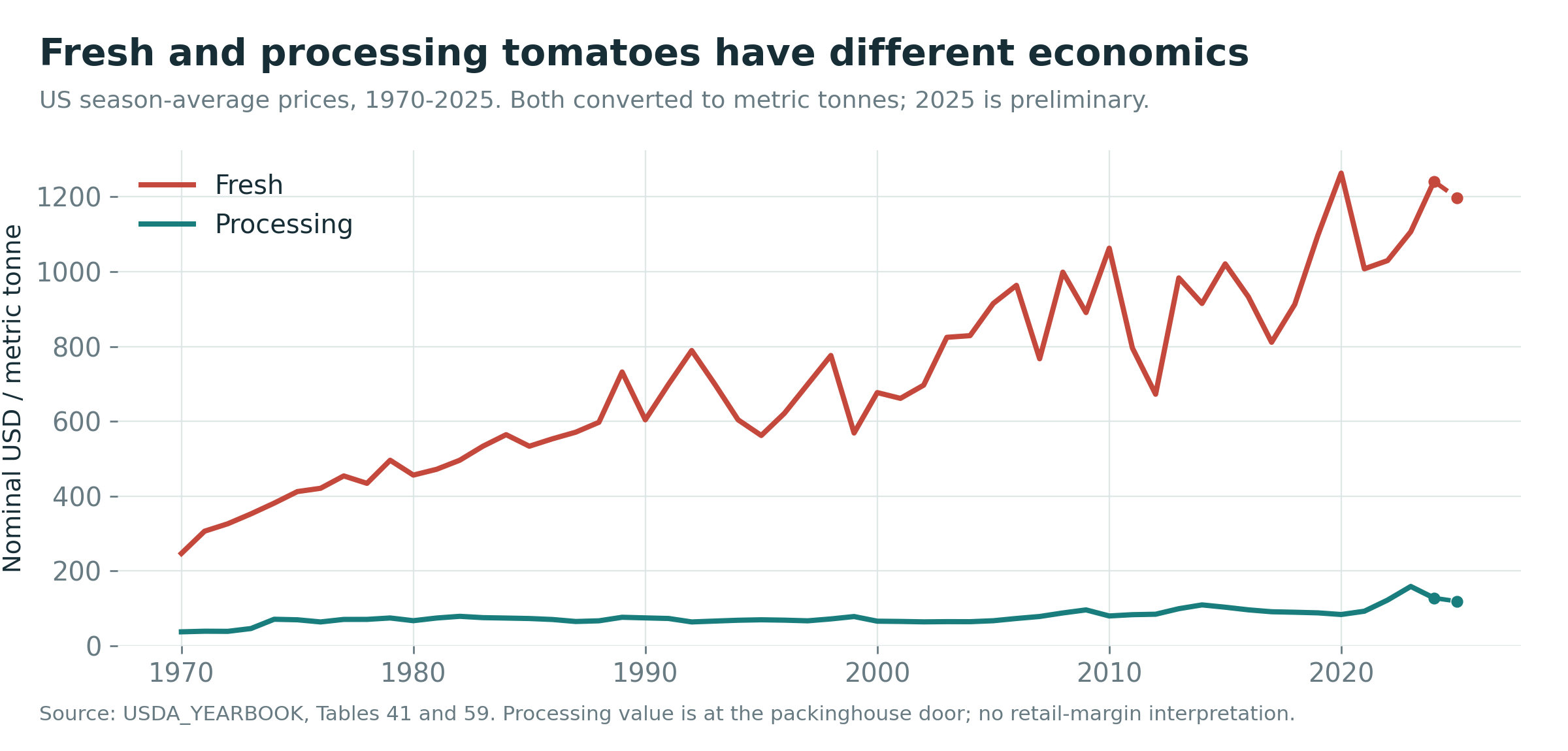
One crop earns two very different prices. USDA’s 2024 season average for fresh-market tomatoes was $56.30 per hundredweight, about $1,241 a tonne, while tomatoes for processing fetched $116 a short ton at the packing house, about $128 a tonne: 9.7 times less. Preliminary 2025 figures were $54.30 and $10814.
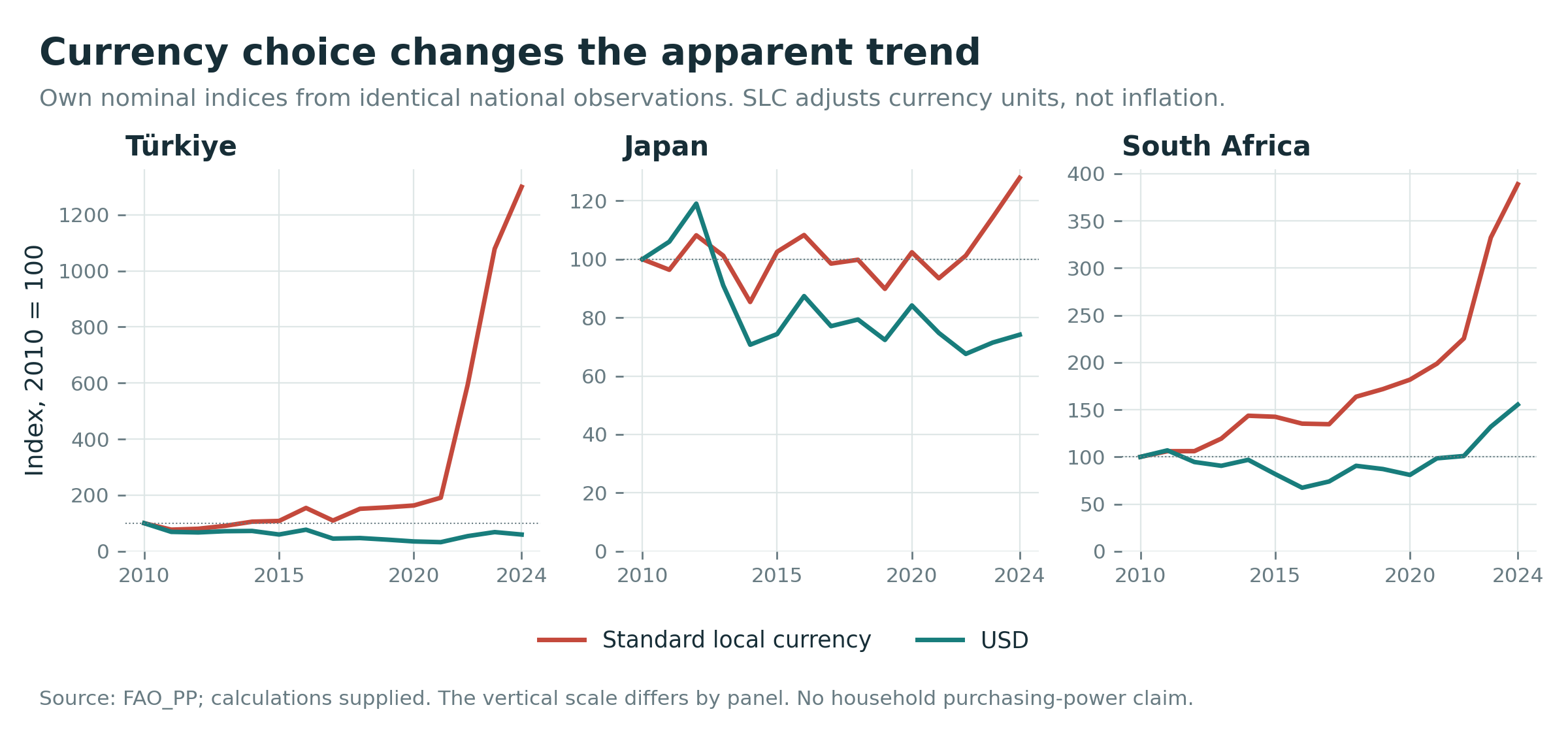
National producer prices reported to FAOSTAT ranged in 2024 from $205.8 a tonne in Morocco to $2,394.9 in Japan. They are collected at different stages: FAO’s archived country notes describe China’s figures as wholesale prices and Japan’s as a mix of producer and wholesale prices15, so the list is not a ranking of cheap and dear countries. Currencies can reverse the story: between 2010 and 2024 Türkiye’s tomato price rose almost thirteenfold in lira and fell 40.4% in dollars3. Across 70 areas reporting every year, the median price rose from $728.60 a tonne in 2015 to $1,033.05 in 2024, 41.8% more.
| Country | 2010 | 2024 |
|---|---|---|
| Morocco | 238.8 | 205.8 |
| Spain | 930.4 | 363.7 |
| Türkiye | 662.7 | 394.7 |
| Mexico | 517.2 | 549.7 |
| South Africa | 392.4 | 609.6 |
| Italy | 814.5 | 944.0 |
| Mainland China | 485.9 | 1,058.7 |
| United States | 1,067.0 | 1,243.4 |
| Japan | 3,229.7 | 2,394.9 |
Official values, each on its own national reporting basis; not identical tomatoes or stages of sale.
A 6.8-fold harvest
FAOSTAT estimates the world tomato crop at 27.6 million tonnes in 1961 and 188.5 million in 2024, 6.83 times as much. Mainland China grew 32.7% of the 2024 crop, India 11.3%, Türkiye 7.8% and the United States 5.7%, together about 57.4%16. A big harvest does not make a big exporter: Mexico, the leading exporter, grew 2.3%.
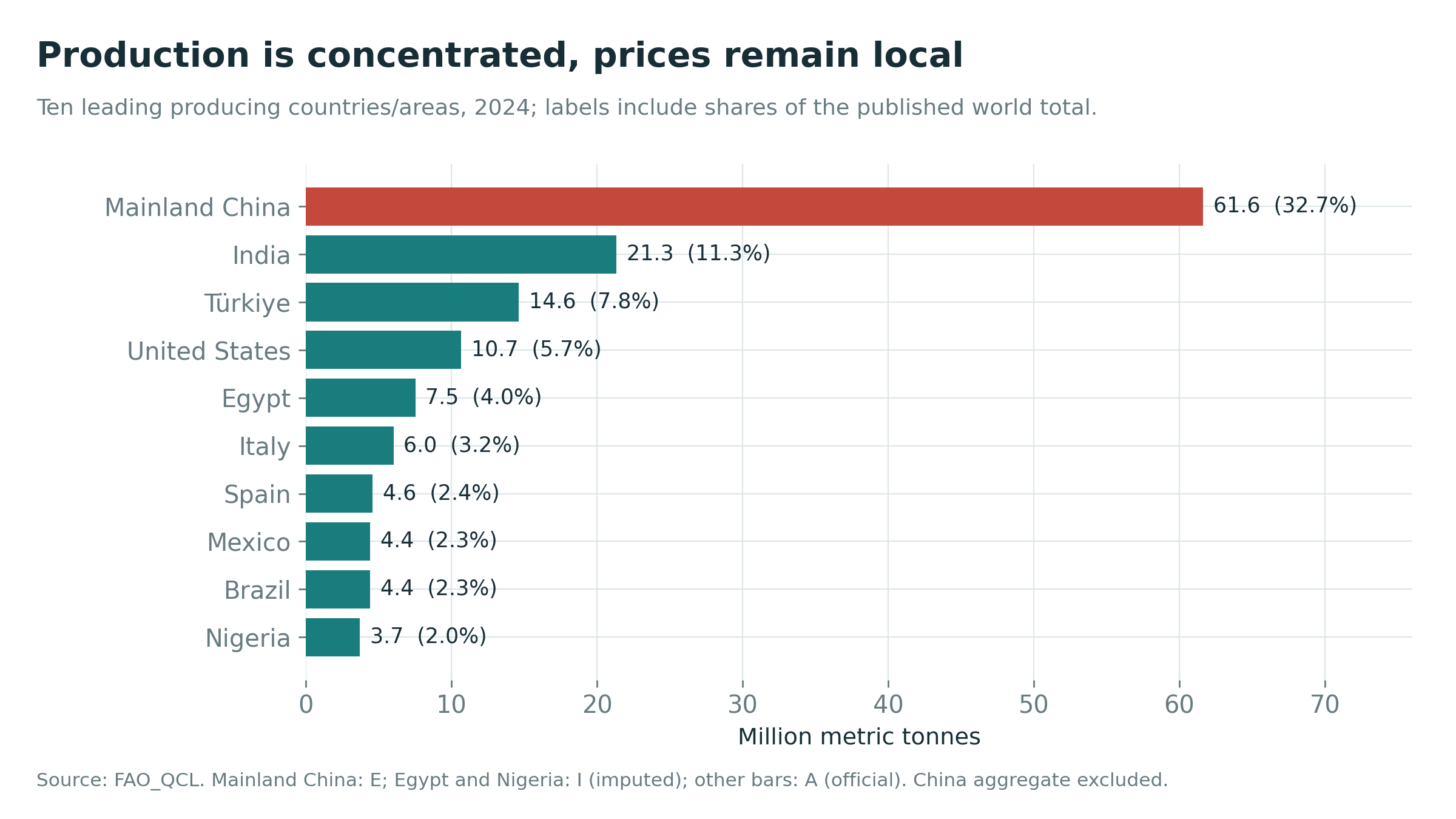
More on the growers is in Tomato production by country.
Mexico, the Netherlands and the 2025 turn
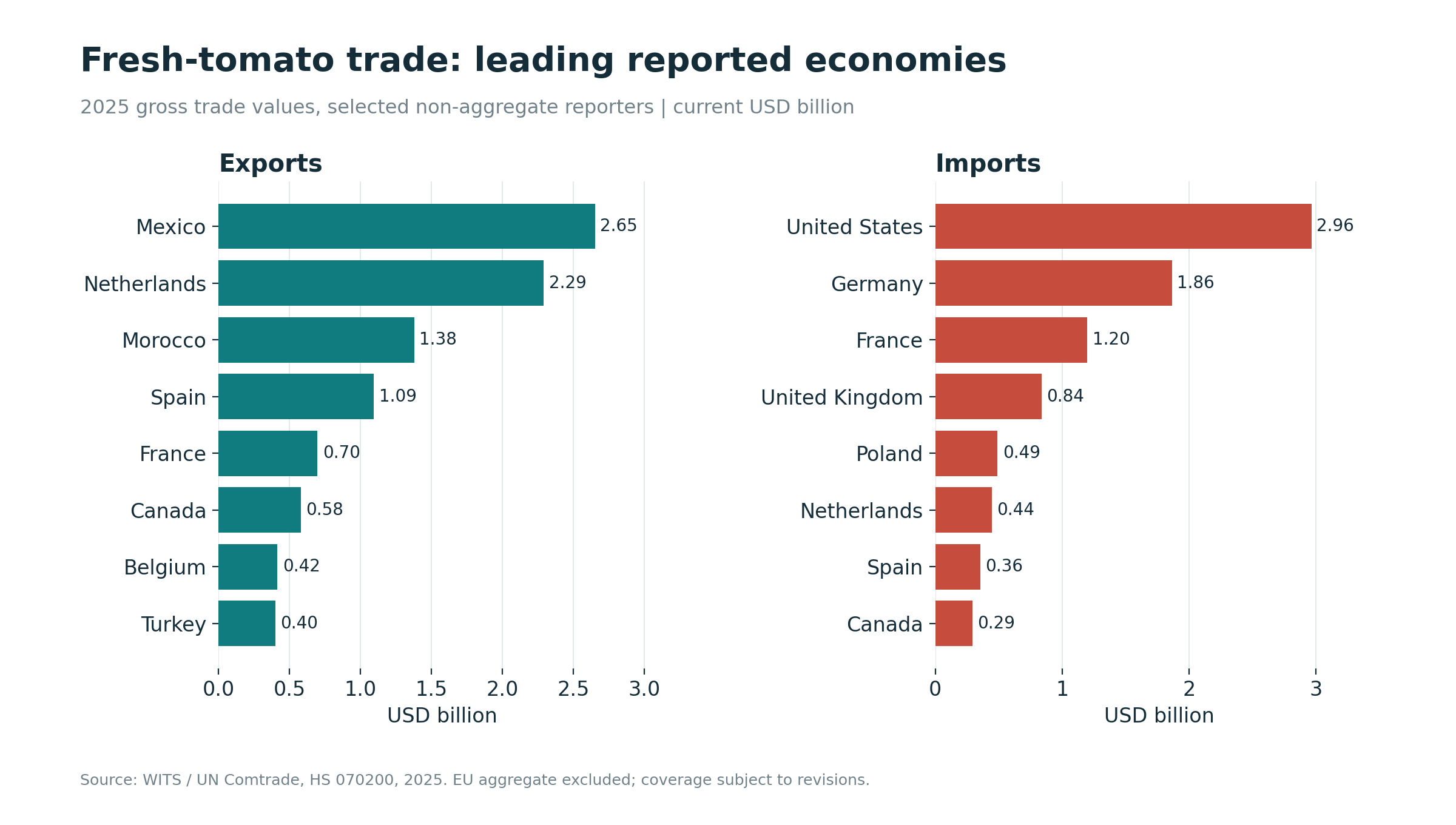
In 2024 Mexico exported $3.343 billion of fresh tomatoes, 2.061 million tonnes at about $1,622 a tonne, ahead of the Netherlands, Morocco and Spain17. Nearly all of it, 99.90% of the value, went to the United States18, while France took 56.5% of Morocco’s exports19.
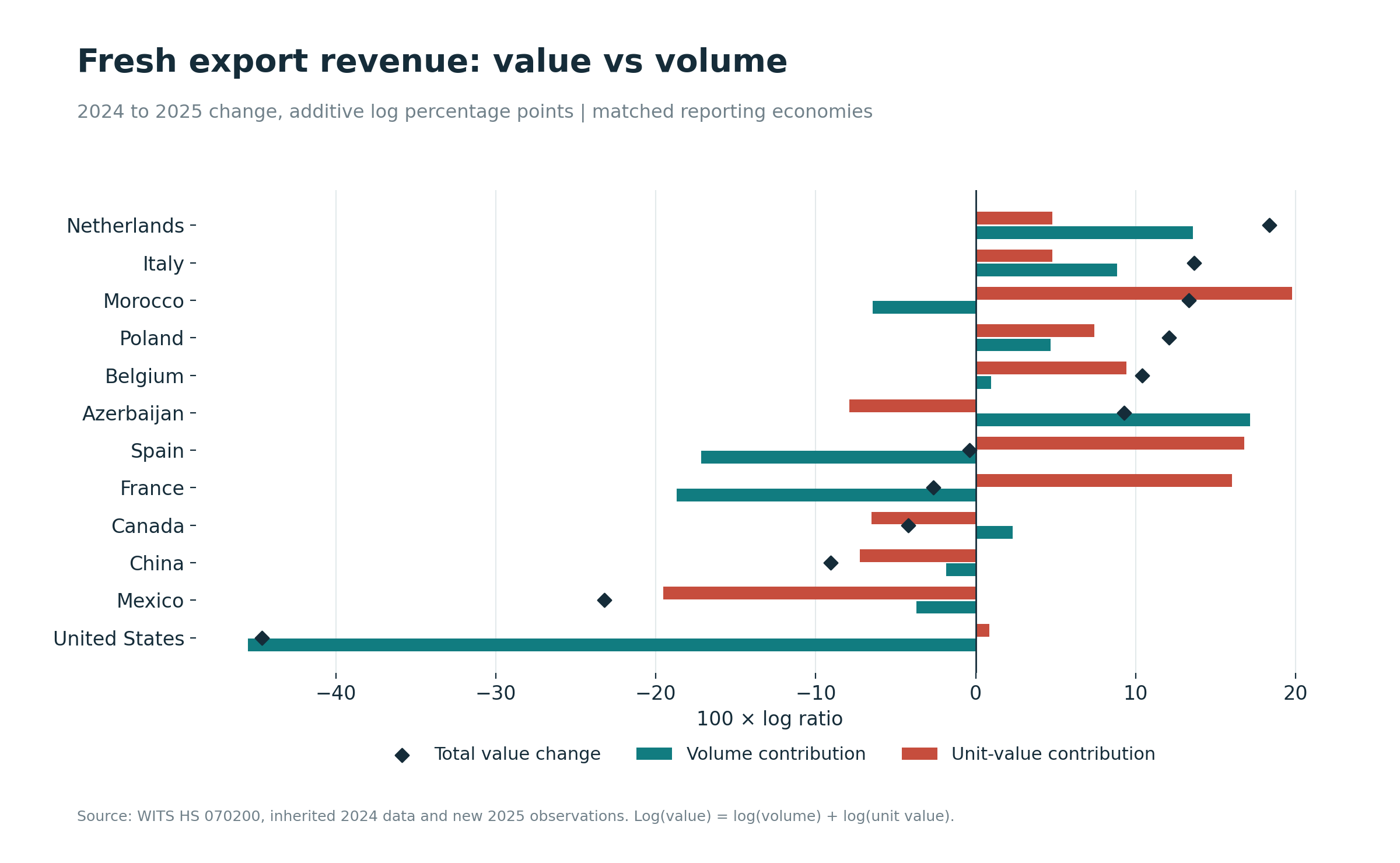
In 2025 the leaders went different ways. Mexico’s export value fell 20.7% to $2.65 billion, mostly because the value per kilogram fell 17.7% while volume fell 3.6%. The Netherlands rose 20.2% to $2.29 billion and Morocco 14.3% to $1.378 billion, with 6.2% less volume20. Among importers the United States spent $2.965 billion, Germany $1.865 billion and France $1.198 billion; the average US import value fell from $1.76 to $1.46 a kilogram, while Germany’s rose from $2.31 to $2.4721. Mexico supplied about 81.0% of US import value, and its tomatoes entered at $1.34 a kilogram against $1.68 a year earlier22.
| Exporter | $ billion | Value change | Volume change | Value per kg change |
|---|---|---|---|---|
| Mexico | 2.650 | −20.7% | −3.6% | −17.7% |
| Netherlands | 2.290 | +20.2% | +14.6% | +4.9% |
| Morocco | 1.378 | +14.3% | −6.2% | +21.9% |
| Spain | 1.094 | −0.4% | −15.8% | +18.3% |
Changes from 2024 to 2025. Customs values per kilogram mix varieties, grades and seasons; Dutch exports can include re-exports.
Trade rules changed in the same period. Under the 2019 suspension agreement, conventional round and Roma tomatoes from Mexico could not be sold in the United States below a reference price of $0.31 a pound23. The agreement ended on 14 July 2025 and an antidumping order took effect, with an all-others cash deposit rate of 17.09% and separate rates for some companies24. The data show lower values per kilogram from Mexico in 2025 and record US shop prices in spring 2026, but neither series isolates the effect of the duty.
Paste and cans: a separate market
Processed tomatoes have their own leaders. In 2024 Italy exported $1.44 billion of tomato paste, purées and similar products and China $1.20 billion, at $1.78 and $1.00 a kilogram of product25. In 2025 Italy added $1.76 billion of whole and chopped tomatoes26, while China’s paste exports lost 29.6% of their value on 2.6% less weight, so the value per kilogram fell 27.8% to $0.7327. A kilogram of paste is not a kilogram of fresh tomatoes, so these prices cannot be set beside fresh ones.
Shocks: India 2023, Nigeria 2024, New Zealand and Europe
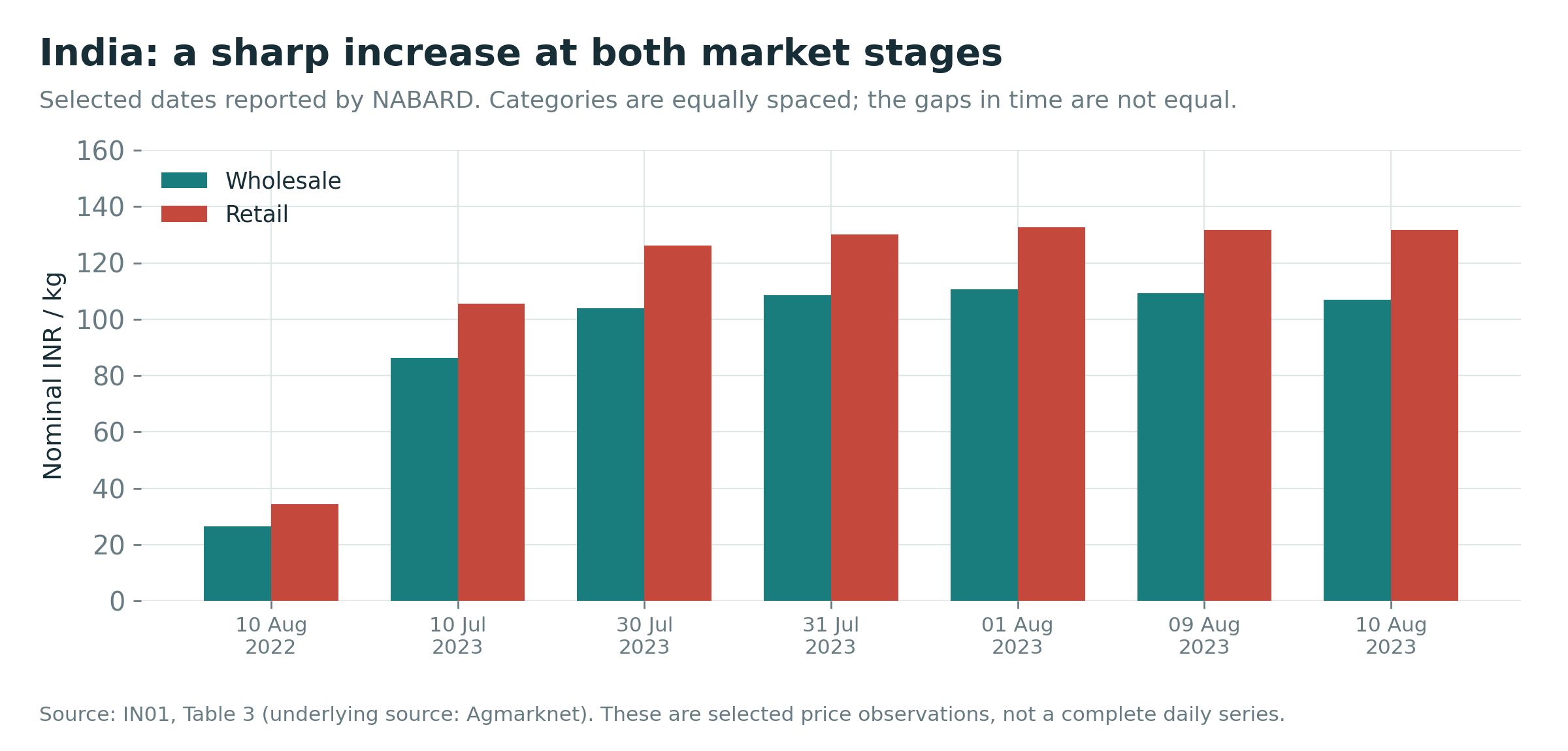
Tomatoes cannot be stored for long, so a lost harvest reaches the shops at once. In India a retail price reported by NABARD rose from INR 34.24 a kilogram on 10 August 2022 to INR 131.69 on 10 August 2023, 284.6% more, and the wholesale price 305.0%28. The Reserve Bank of India recorded tomato inflation of 202.1% in July 2023 and attributed it to crop damage from heavy rain, floods and pests29; government outlets sold tomatoes at INR 90, then 80 and 70 a kilogram that July30. See also Monsoon disruption and Indian tomato prices.
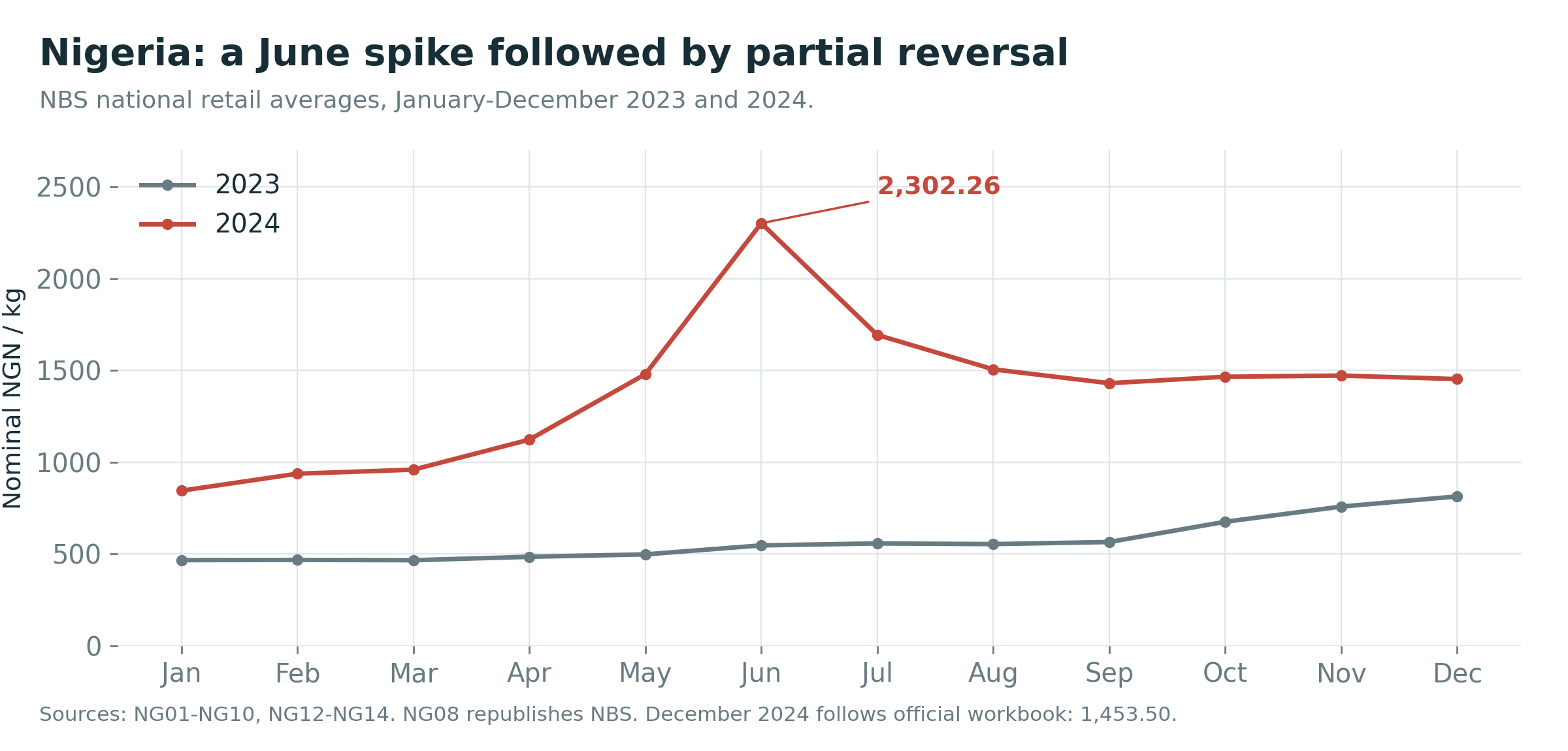
In Nigeria the national average reached NGN 2,302.26 a kilogram in June 2024, 320.7% above June 2023, before falling 26.4% to NGN 1,693.83 in July. In June it ranged from NGN 3,992.61 in Abuja to NGN 1,200 in Kebbi3132. The tomato leaf miner had already raised prices in northern Nigeria in 201633, but no source ties the 2024 spike to the pest.
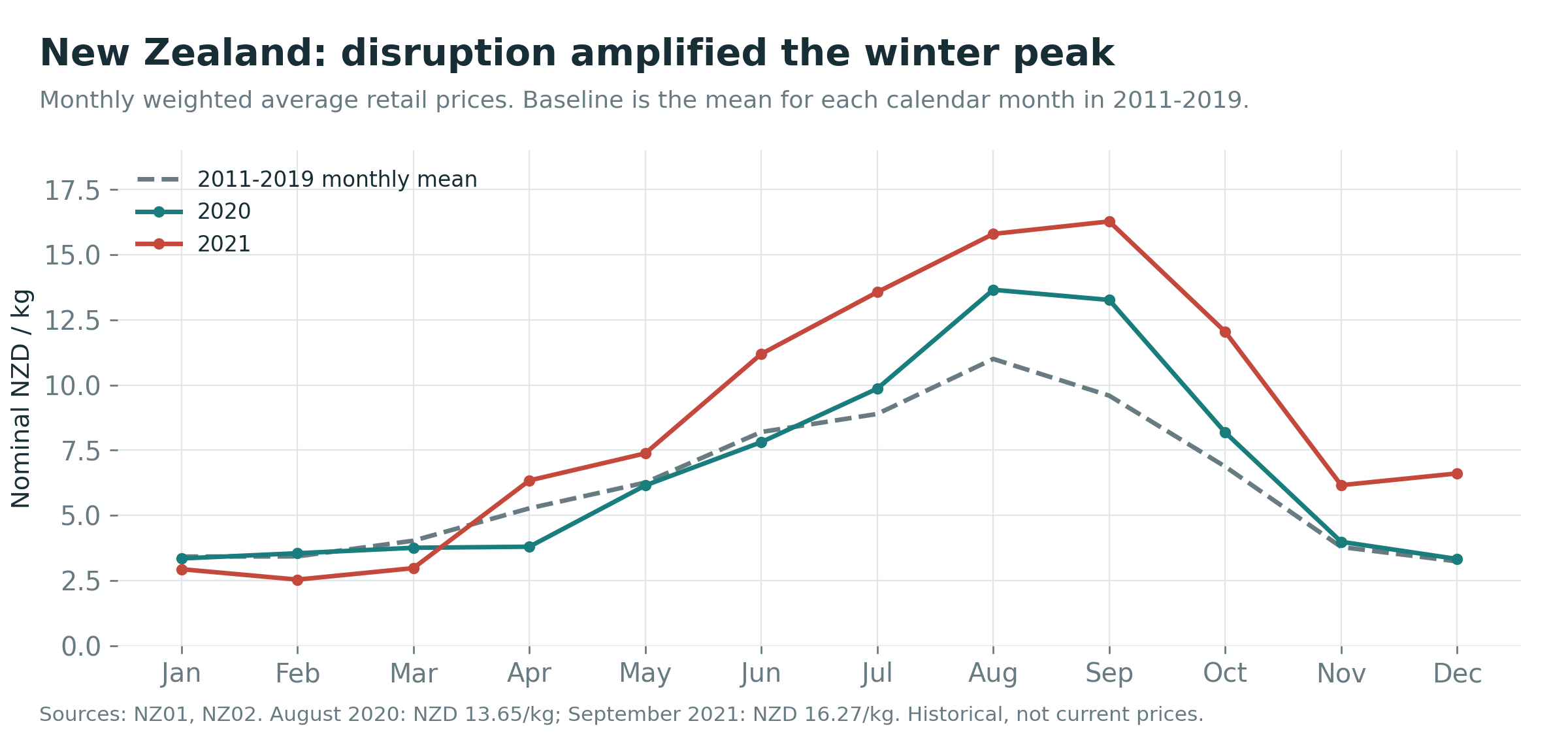
In New Zealand tomatoes averaged NZ$13.65 a kilogram in August 2020, about 38% above July and 37% above August 2019, after growers delayed or cut planting during the April lockdown and greenhouse heating added to costs34; in September 2021 the price reached NZ$16.2735. In Britain, where home production equalled 15% of tomato supply in 2023, early 2023 brought temporary shortages as greenhouses planted less or later because of energy costs and weather hurt crops in Spain and North Africa36. A European Commission expert group heard that Spanish round tomatoes fetched €0.85 a kilogram at the farm in summer 2023, while French shoppers paid €3.42 in January–August37. Other episodes are described in Virus and weather constraints raise New Zealand tomato prices in 2021 and The 2004 hurricane season raises Georgia tomato prices.
On the shelf: Britain, Canada, Japan and South Africa
Britain’s official average began at 28 pence a kilogram in 1968. It was £1.27 in 1988 and £3.06 in 2024, 140.9% more in pounds of the day but 10.7% less after inflation3839. In Canada a kilogram cost C$6.95 in May 2026 and C$4.71 in September, 32.2% less, yet 0.9% more than in September 202540. Japan’s weekly survey of 470 shops found an average of JPY 1,050 a kilogram in the week of 2 November 202641, and South Africa’s urban food basket priced tomatoes at ZAR 26.59 a kilogram in September 2026, almost unchanged on a year earlier42.
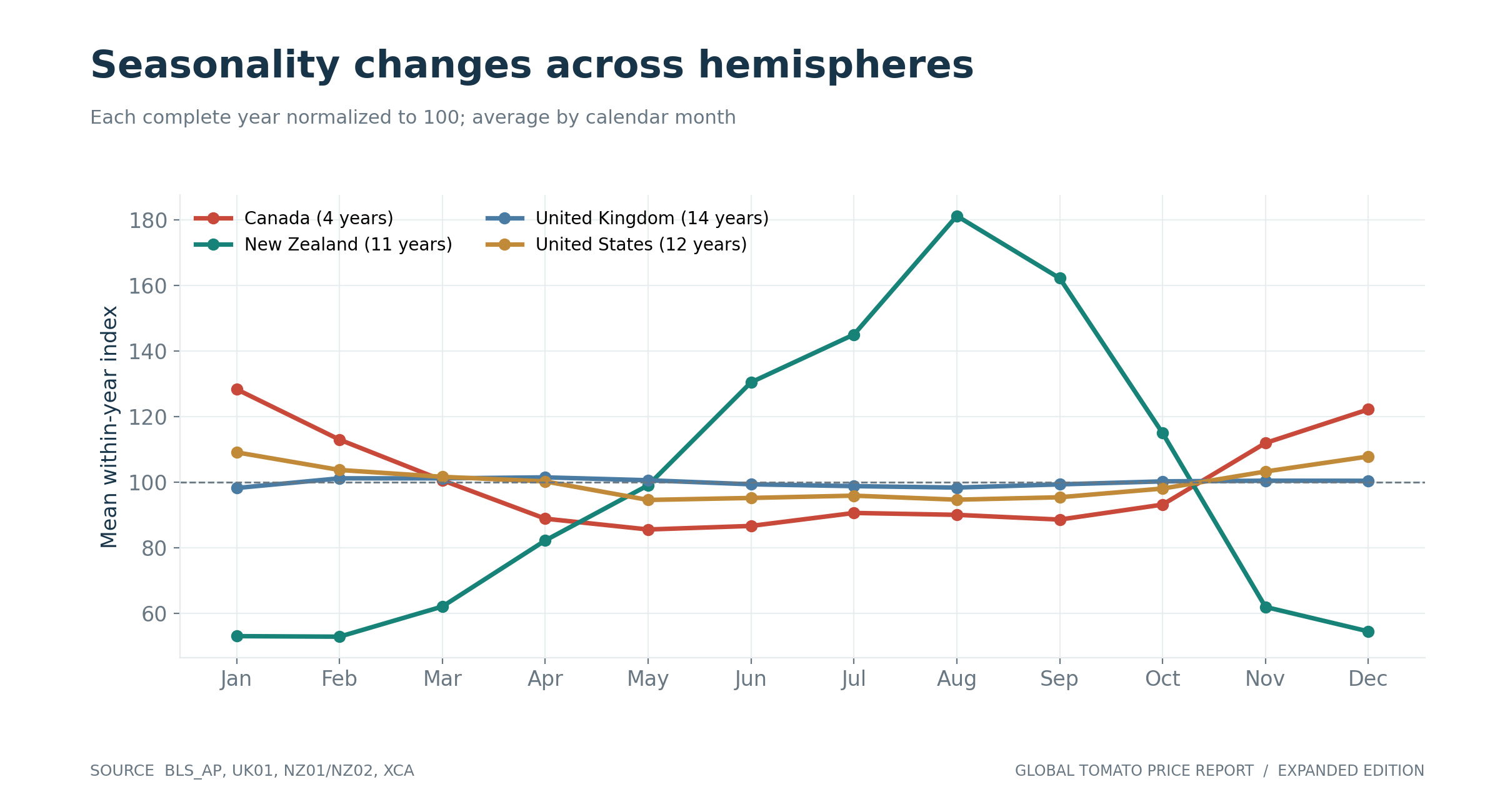
Seasons differ by hemisphere. On average over complete years, US and Canadian shop prices peaked in January and bottomed in May, with a gap of 15.4% in the United States and 50.0% in Canada, while New Zealand’s peak came in August, 242.7% above its February low14034.
Autumn 2026 in context
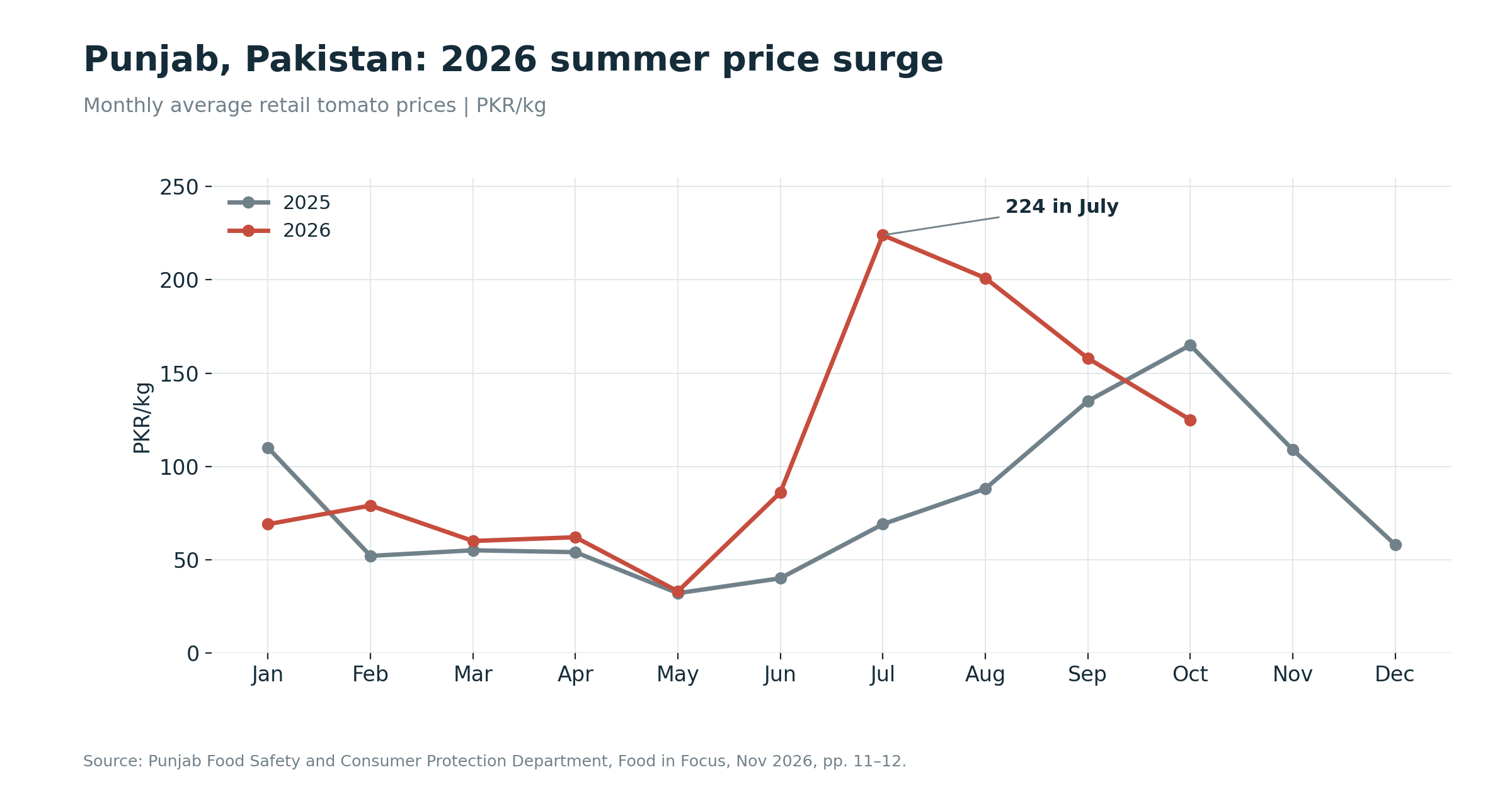
Prices in 2026 moved sharply and not together. In Punjab, Pakistan, the retail average rose from PKR 33 a kilogram in May to PKR 224 in July and was PKR 125 in October, 24.2% below October 202543. Brazil’s wholesale average fell 15.85% in June to BRL 5.59 a kilogram44; in late August prices jumped from BRL 3.67 to BRL 6.23 in São Paulo within a week and from BRL 2.78 to BRL 6.67 in Rio de Janeiro within eleven days45, and in October tomatoes were dearer than a year before in all 27 state capitals, by up to 117.12% in Cuiabá46. In the United States the producer index in October was 127.5% above October 2025, while the shop price, at $2.084 a pound, was well below April’s record21.
Latest tomato prices on Husfarm
Updated automatically from wholesale markets in several countries, each in its own currency and unit. Each price links to its history and source.
| Price series | Market | Latest | Change | Date |
|---|---|---|---|---|
| Vine tomatoes | CASI auction, AlmeríaSpain | 1.75–2.48 EUR/kg | — | 3 Nov 2026 |
| Tomatoes round Morocco Class I 67-82mm | MIN RungisFrance | 1.80–2.40 EUR/kg | +16.7% | 3 Nov 2026 |
| Tomatoes, grade 1M | Cape Town MarketSouth Africa | 20.0–150 ZAR/6 kg b6 carton | — | 30 Oct 2026 |
| Tomato big (nepali) | Kalimati Fruits and Vegetable MarketNepal | 60.0–70.0 NPR/kg | ± 0.0% | 3 Nov 2026 |
Tomato prices today Tomato production by country The price of maize
How to read tomato prices
- Name the product: fresh, for processing, canned, paste or purée are different markets with different prices.
- Name the stage: farm, packing house, wholesale market, border or shop shelf.
- Compare the same weeks or months: tomatoes cannot be stored for long, so seasonal swings are large.
- Check the base: a 300% rise on a year when prices had collapsed says less than it seems.
- Keep currencies apart: a price can rise in local money and fall in dollars.
Price changes are 100 × (last ÷ first − 1). Customs unit values are reported value divided by reported weight. Real prices use each country’s own all-items consumer price index. Historical prices stay in their original currencies and units, and missing months are not filled in.
Questions and answers
When were tomatoes most expensive?
In US shops the highest monthly average since 1980 was $2.689 a pound in April 2026. After inflation, prices in the 1980s and 1990s were higher: in 2024 dollars a pound cost $2.56 in 1980 and $2.59 in 1990, against $2.00 in 2024. The US producer price index peaked at 711.2 in December 2017.
Why do tomato prices change so quickly?
Fresh tomatoes keep only for days, so a lost harvest reaches the market at once. Weather, pests, energy costs and planting decisions have all moved prices: India’s retail price rose 284.6% in the year to 10 August 2023, and Rio de Janeiro’s wholesale price more than doubled in eleven days in August 2026.
Are tomatoes more expensive than in the past?
In dollars of the day, yes: the US shop price rose 196.1% from 1980 to 2024. After inflation it fell 22.2%. In Britain the price rose 140.9% from 1988 to 2024 in pounds of the day and fell 10.7% in real terms.
Which country grows the most tomatoes?
Mainland China, with 61.6 million tonnes in 2024, 32.7% of the world crop of 188.5 million tonnes, followed by India, Türkiye and the United States. Mexico is the largest exporter: $2.65 billion of fresh tomatoes in 2025.
Why are tomatoes cheaper in some months?
Outdoor harvests come in summer and autumn. In Britain in 1932 English tomatoes cost 5.64 times as much in April as in September, and on Ohio farms in 1912–1925 October prices were typically 42.1% below August. Today New Zealand prices peak in its winter, in August.
Did the US duty on Mexican tomatoes raise prices?
An antidumping order on Mexican tomatoes took effect on 14 July 2025, with an all-others cash deposit rate of 17.09%. US shop prices reached a record $2.689 a pound in April 2026, but the available data do not separate the duty from weather, seasons and other changes.
Sources
Links to other websites open in a new tab.
- US Bureau of Labor Statistics, via FRED (2026). Average price: tomatoes, field grown, per pound, US city average (APU0000712311). January 1980–October 2026
- US Bureau of Labor Statistics, via FRED (2026). Producer price index by commodity: farm products, tomatoes (WPU01130217). Index 1982 = 100, January 1947–October 2026, not seasonally adjusted
- FAOSTAT (2026). Producer prices: tomatoes. Release of 9 October 2026; annual prices in US dollars and local currency per tonne, 1991–2024
- Hamid Razifard et al. (2020). Genomic Evidence for Complex Domestication History of the Cultivated Tomato in Latin America. Molecular Biology and Evolution 37, pp. 1118–1132
- Tinde van Andel, Rutger A. Vos, Ewout Michels and Anastasia Stefanaki (2022). Sixteenth-century tomatoes in Europe: who saw them, what they looked like, and where they came from. PeerJ 10:e12790
- David Gentilcore (2010). La purpurea meraviglia. Storia del pomodoro in Italia. Garzanti; author’s manuscript, pp. 72–73 and 86–89: recipes, household records and the 1811 price
- US Census Office (1902). Twelfth Census of the United States, vol. VI, Agriculture, part II. Printed p. 303, table XVIII: canned tomatoes in New York, 1870–1900
- US Department of Agriculture (1927). Prices of Farm Products Received by Producers, 2: The North Central States, 1866–1926. Statistical Bulletin 15, tables 1 and 71: tomatoes in Ohio and Nebraska, cents per bushel
- UK Parliament, Hansard (1935). Tomato prices, House of Commons, 18 June 1935. HC Deb vol. 303 c. 173: monthly wholesale prices by origin, 1932–1934
- USDA Statistical Reporting Service (1962). Prices Paid by Farmers for Commodities and Services, United States, 1910–60. Statistical Bulletin 319, table 12, printed p. 19: fresh tomatoes bought in stores
- US Census Bureau (1948). Statistical Abstract of the United States 1948. Printed p. 307, table 335: retail canned tomatoes, No. 2 can, 1920–1947
- US Bureau of Labor Statistics, via FRED (2026). Consumer price index for all urban consumers, all items (CPIAUCNS). Not seasonally adjusted; annual means used for 2024 dollars
- US Bureau of Labor Statistics (2026). CPI average price data. Average prices are levels, not constant-quality price indexes
- USDA Economic Research Service (2026). Vegetables and Pulses Yearbook Tables. Release of 10 September 2026, tables 41 and 59: fresh-market and processing tomato prices, 1970–2025
- FAO (2016). Producer prices: country notes. Archived definitions of national producer prices
- FAOSTAT (2025). Crops and livestock products: tomatoes. Release of 31 December 2025; production in tonnes, 1961–2024
- UN Comtrade, via World Bank WITS (2026). Fresh or chilled tomato exports (HS 070200), 2024. Reporter to world
- UN Comtrade, via World Bank WITS (2026). Mexico: fresh tomato exports by partner (HS 070200), 2024. Partner shares of export value
- UN Comtrade, via World Bank WITS (2026). Morocco: fresh tomato exports by partner (HS 070200), 2024. Partner shares of export value
- UN Comtrade, via World Bank WITS (2026). Fresh or chilled tomato exports (HS 070200), 2025. Reporter to world; value and weight
- UN Comtrade, via World Bank WITS (2026). Fresh or chilled tomato imports (HS 070200), 2025. Reporter from world; value and weight
- UN Comtrade, via World Bank WITS (2026). United States: fresh tomato imports by partner (HS 070200), 2025. Value, weight and value per kilogram by origin
- US Department of Commerce (2019). Fresh Tomatoes From Mexico: Suspension of Antidumping Duty Investigation. Federal Register 84 FR 49987, 24 September 2019, appendix A: reference prices
- US Department of Commerce (2025). Fresh Tomatoes From Mexico: Termination of Suspension Agreement and Antidumping Duty Order. Federal Register 90 FR 33363, 17 July 2025, effective 14 July 2025
- UN Comtrade, via World Bank WITS (2026). Exports of preserved tomatoes other than whole or in pieces (HS 200290), 2024. Pastes, purées and similar products
- UN Comtrade, via World Bank WITS (2026). Exports of preserved tomatoes, whole or in pieces (HS 200210), 2025. Reporter to world
- UN Comtrade, via World Bank WITS (2026). Exports of preserved tomatoes other than whole or in pieces (HS 200290), 2025. Reporter to world
- NABARD (2023). Spiralling Tomato Prices: Issues and Concerns. August 2023, table 3: retail and wholesale prices from Agmarknet
- Reserve Bank of India (2024). Annual Report 2023–24. Chapter II.3, price situation, paragraph II.3.15
- Press Information Bureau, Government of India (2023). Centre further slashes price of tomato; to be sold at Rs 70/kg. Release of 19 July 2023
- National Bureau of Statistics, Nigeria (2024). Selected Food Price Watch, June 2024. Executive summary and state averages
- National Bureau of Statistics, Nigeria (2024). Selected Food Prices Watch, July 2024. Executive summary
- Bala et al. (2019). Determination of Insecticide Susceptibility of Field Populations of Tomato Leaf Miner (Tuta absoluta) in Northern Nigeria. Agriculture 9(1), 7
- Stats NZ (2020). Tomato shortage follows lockdown. News release of 11 September 2020
- Stats NZ (2022). Annual food price increase the highest in a decade. News release of 20 January 2022: tomato weighted average prices
- Defra (2024). United Kingdom Food Security Report 2024, theme 2: UK food supply sources. Fruit and vegetables: domestic production and imports
- European Commission, DG AGRI (2023). Minutes of the expert group for the fruit and vegetables market observatory: tomatoes. Meeting of 26 October 2023, sections 4.2.1–4.2.5
- Office for National Statistics (2026). RPI: average price of tomatoes, per kg (CZNJ). Annual 1968–2024; monthly to January 2025
- Office for National Statistics (2026). CPI index 00: all items, 2015 = 100 (D7BT). Annual 1988–2025
- Statistics Canada (2026). Monthly average retail prices for selected products (18-10-0245-01). Tomatoes per kg, January 2022–September 2026
- Ministry of Agriculture, Forestry and Fisheries of Japan (2026). Food price trend survey: vegetables. Week of 2 November 2026, 470 stores
- National Agricultural Marketing Council, South Africa (2026). Food Basket Price Monthly, issue 131. October 2026, table 2: urban food basket, data from Stats SA
- Punjab Food Safety and Consumer Protection Department (2026). Food in Focus, November 2026. Printed pp. 11–12: monthly average retail tomato prices in Punjab
- Conab (2026). Tomato wholesale prices fall 15.85% in Brazil’s main supply centres. Release of 22 July 2026: June 2026 weighted average
- Conab (2026). Prohort weekly executive summary no. 33. 31 August 2026: tomato prices in São Paulo and Rio de Janeiro
- Conab and DIEESE (2026). National survey of basic food basket prices, October 2026. Published 10 November 2026
About this price history
The Husfarm editorial team prepared this price history from the sources listed above, from an 1811 Neapolitan survey and nineteenth-century trade quotations to the latest BLS, USDA, FAOSTAT, UN Comtrade and national statistics. Calculations (price changes, prices in 2024 dollars, unit values and seasonal patterns) are our own and use the published observations at their own precision.
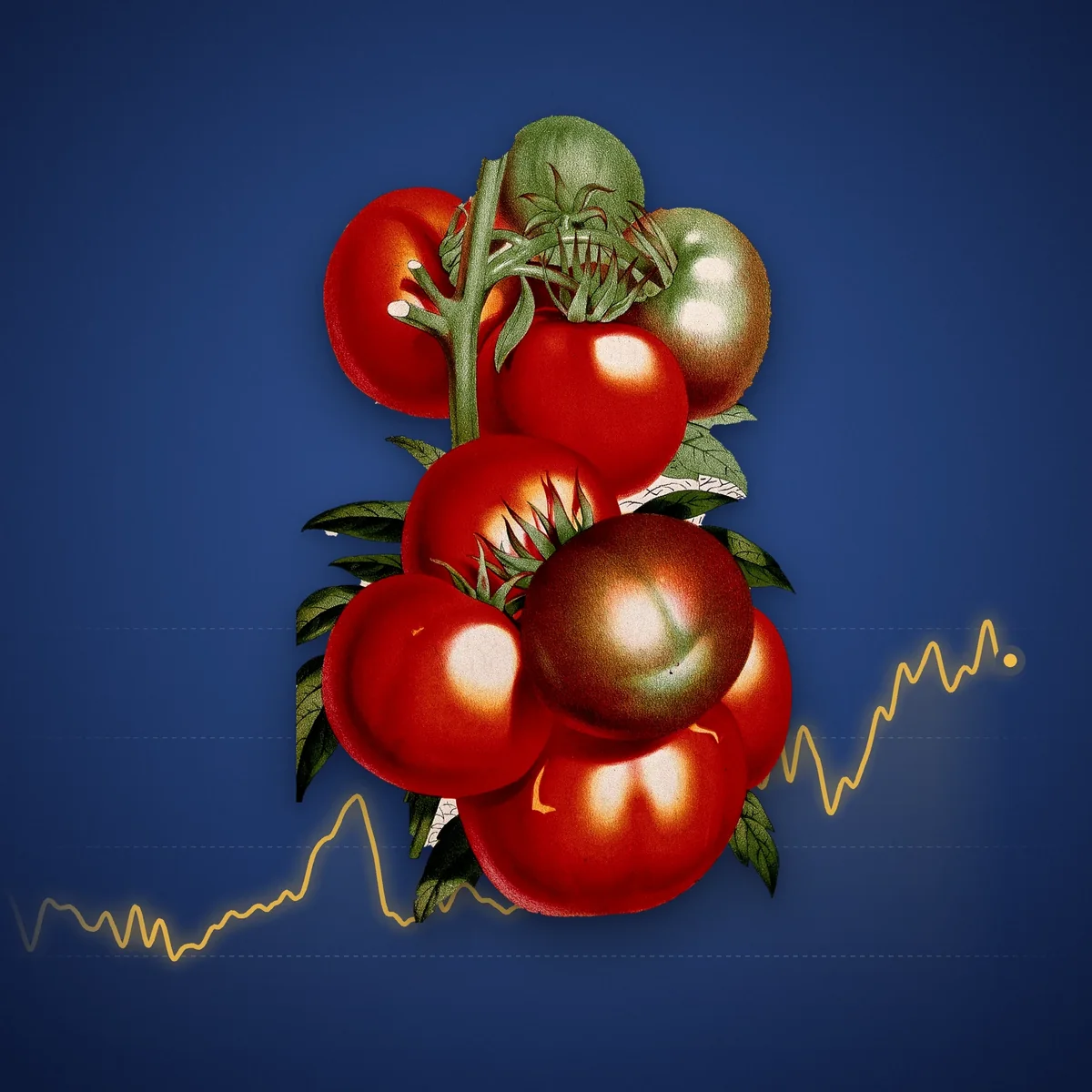
Charts: Husfarm, from the sources listed. Cover: chromolithograph by P. de Pannemaeker (c. 1854), Wellcome Collection, CC BY 4.0; gold line: US producer price index for tomatoes, 1947–2026.
Prices are nominal, in the currency and unit of each source, unless a base year or a wage measure is stated. Figures checked on 24 November 2026. To report an error, write to us through the contact page.
Cite as: Husfarm editorial team (2026). The price of tomatoes: from three grana in 1811 to America’s 2026 record. Husfarm, 24 November 2026. https://husfarm.com/price-histories/tomatoes/