

What changed after 1492?
The year 1492 is a conventional reference point for the sustained expansion of connections between the Americas and Africa and Eurasia. It does not mean that people or plants had never moved before. What changed was the scale and continuity of routes associated with European colonial expansion. Repeated voyages enabled species to be transported again and cultivation to be established in new regions.
Not every movement was intended. Seed for sowing and livestock travelled deliberately, while some weeds and microorganisms moved without the travellers’ planning. Change also proceeded at different speeds. A plant’s arrival in a port, its successful reproduction and its integration into everyday farming could be widely separated stages. A single arrival date therefore cannot substitute for the history of adoption. The chronology of a voyage and the chronology of agricultural change answer different questions.12
Crops travelled both ways — not simply as a gift from Europe
Maize, potatoes, cassava, tomatoes, peppers and cacao were among the American crops that spread beyond the Americas. Plants already cultivated in Africa and Eurasia, including wheat, barley and sugarcane, moved in the opposite direction. Listing these directions is useful, but describing the entire second group as “European plants” obscures much older and geographically wider histories.
A crop’s place of domestication, the port through which it travelled and a later centre of production are three different pieces of information. Potatoes may be strongly associated with Europe, or peppers with an Asian regional cuisine, although these cultural relationships developed after the plants moved. A historical map of agriculture should therefore distinguish origins from subsequent networks of cultivation. Modern familiarity is not reliable evidence of where a crop first entered human farming systems.32
Indigenous cultivators created the foundations of later exchange
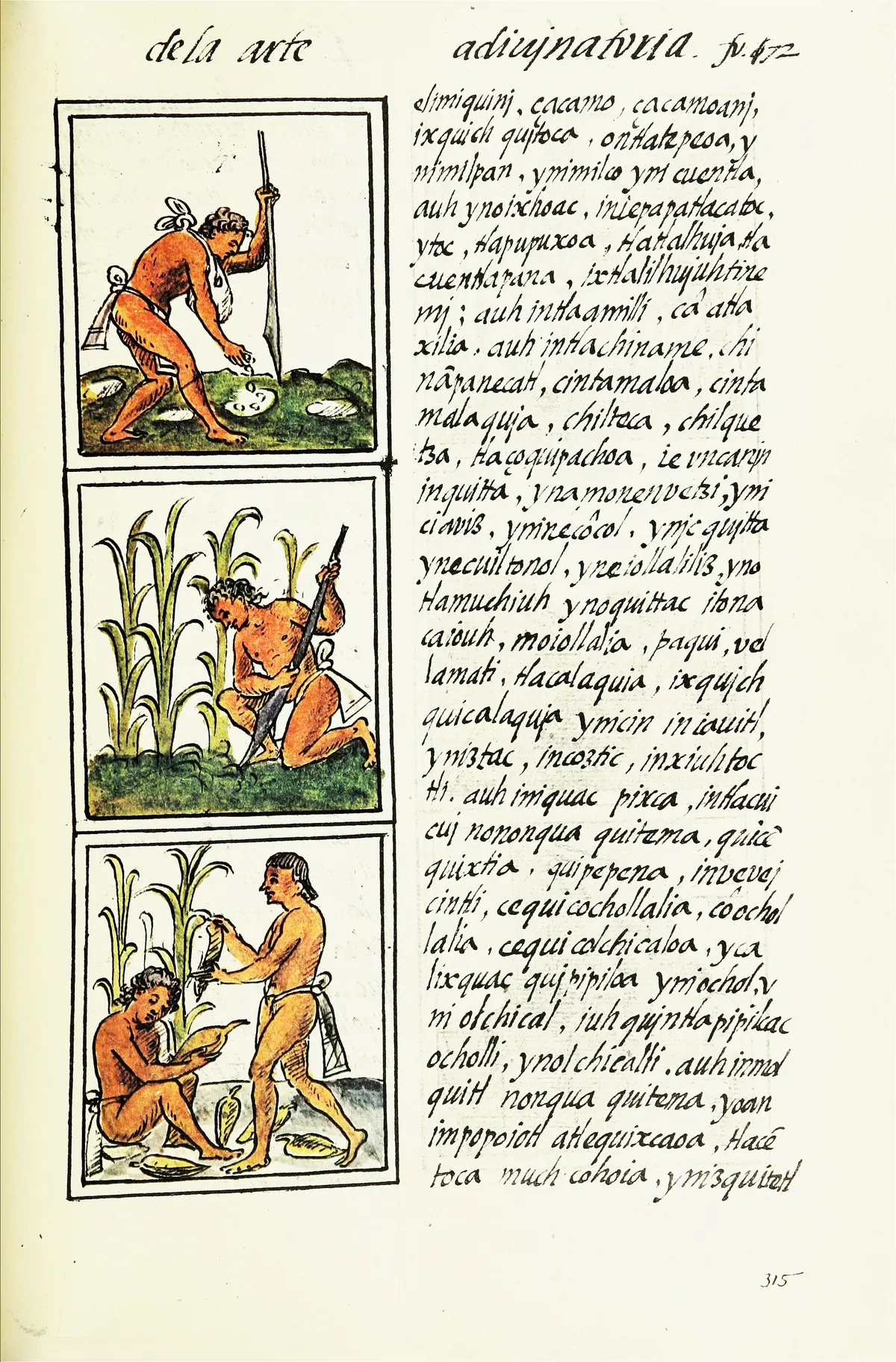
American crops were not ready-made resources waiting to be discovered by newcomers. Their forms and diversity resulted from generations of work by local communities. Farming involved seed selection, field organisation, storage, food preparation and cultural knowledge. Transporting a seed did not reproduce this entire body of experience.
The cultivation of maize, beans and squash, known in some communities as the Three Sisters, is a useful example. It represents more than a list of three species: it is a practice connected with social life and tradition. An identical method should not be attributed to every community across two continents. Its history nevertheless reminds us that Indigenous farmers created food systems and remain their custodians. They are participants and innovators in agricultural history, not merely a background to accounts of European travel.4
The potato in Europe: transportation was only the beginning
The potato’s history illustrates the distinction between introduction and adaptation. A crop originating in the Andes reached Europe in the sixteenth century, but its subsequent development involved adjustment to different growing seasons and day lengths. Research comparing genomes from modern cultivars, older landraces and herbarium specimens reconstructs this transformation more precisely than a list of voyages can.
For a cultivator, the practical question was whether the plant would produce a useful harvest within local weather patterns. Households also needed ways to prepare and store the food. Successful adoption therefore required work after arrival: multiplication, selection, learning and incorporation into an existing economy. The global movement of species was simultaneously a multitude of local experiments. This distinction helps explain why transportation should not be confused with immediate agricultural success.5
African knowledge and people forcibly displaced
The Columbian Exchange cannot be understood without Africa. People enslaved and forcibly taken to the Americas possessed skills in areas including animal husbandry, rice cultivation and industrial crops. Their expertise helped shape colonial agriculture, although owners appropriated the profits from their work. Reducing their contribution to anonymous “labour” removes the experience and agency of particular communities from the historical account.
Along the southeastern coast of the present-day United States, agricultural knowledge carried by people from West African rice-growing regions was especially significant. Gullah Geechee heritage recalls both this expertise and the brutality of plantation conditions. Recognising the contribution of enslaved people does not diminish the coercion they faced. It allows a more accurate account of how wealth was produced and how traditions were retained under circumstances designed to deny autonomy.76
Sugarcane and the plantation economy
A sugar plantation connected fields with processing, transport and distant markets. Cane had to be grown and harvested, then processed in facilities requiring equipment and intensive work. Slavery underpinned this arrangement on many Caribbean estates. Surviving sites such as Annaberg on St. John reveal the material relationship between an agricultural landscape and coercion.
A valuable commodity did not necessarily create prosperity for the people producing it. Assessing agricultural change requires questions about who decided how land would be used, who controlled trade and who received food for their own subsistence. Plantations matter because they show how production could expand alongside extreme inequalities of rights. Export volumes cannot replace the history of work. Nor can technical descriptions of mills and fields explain the system without the people compelled to operate them.89
Animals, disease and the remaking of landscapes
The movement of cattle, horses, sheep and pigs altered opportunities for transport, husbandry and land use. Introduced plants and animals interacted with local ecosystems, with consequences extending beyond individual holdings. Within the same world of contact, diseases including smallpox spread with catastrophic effects for many Indigenous communities.
These developments should not be presented as one identical event everywhere in the Americas. Epidemics accompanied warfare, dispossession, forced labour and disrupted supplies. For agricultural history, their interaction is crucial: illness could limit the ability to sow and harvest, while violence obstructed the rebuilding of community life. Describing this merely as a “biological exchange” would leave the colonial context unexplained. Regional studies are needed to establish how these forces combined in specific places rather than assuming a uniform continental experience.310
How can the consequences be studied without a simplistic balance sheet?
Evidence includes colonial documents, botanical collections, archaeology, food history and modern genetic research. Each kind addresses different questions. A cargo list can establish that a product was transported without demonstrating widespread cultivation. A herbarium specimen helps identify a past plant but does not automatically describe the labour that produced it. Comparing sources prevents the history of trade from being mistaken for the whole history of everyday life.
The Columbian Exchange remains visible in varied cuisines and the global interdependence of agriculture. Its legacy cannot responsibly be reduced to a single balance of benefits and losses for “humanity”. Questions must concern a particular region, period and group of people. Only then can new food possibilities, the endurance of local traditions and the inequalities accompanying an interconnected world be examined together. This approach provides a more useful explanation than either a celebration of new crops or a narrative that overlooks the creativity of the people who cultivated them.510
Questions and answers
Did the Columbian Exchange begin precisely in 1492?
1492 is a conventional turning point associated with sustained transatlantic expansion after Columbus’s voyage. Different species were introduced and adopted at different times over subsequent centuries. It is not a single date when all farming systems changed.1
Which crops spread from the Americas to other regions?
Prominent examples include maize, potatoes, cassava, tomatoes, peppers and cacao. Their later cultivation elsewhere built on the earlier selection and knowledge of Indigenous communities, followed by further local adaptation.34
Why must crop history include the history of people?
Moving a species does not explain who grew it, whether they controlled land or who received the profit. Indigenous and African expertise, colonial coercion and slavery were part of the mechanism of change, not an optional addition to agricultural history.768
Sources
- Alfred W. Crosby · National Humanities Center (2001). The Columbian Exchange: Plants, Animals, and Disease between the Old and New Worlds
- National Park Service · Castillo de San Marcos (2015). The Columbian Exchange
- Alfred W. Crosby · National Humanities Center (2001). The Columbian Exchange, part 2: crops, livestock and disease
- USDA · National Agricultural Library (n.d.). The Three Sisters of Indigenous American Agriculture
- Rafal M. Gutaker et al. (2019). The origins and adaptation of European potatoes reconstructed from historical genomes
- National Park Service · Fort Frederica (n.d.). Gullah Geechee Culture
- Library of Congress (n.d.). Africans in America · Immigration and Relocation in U.S. History
- National Museums Liverpool (n.d.). Sugar plantations · The archaeology of slavery
- National Park Service · Virgin Islands (2021). Annaberg Sugar Plantation
- History of Science in Latin America and the Caribbean · University of New Hampshire (n.d.). Columbian Exchange (1492–1800)
Approximate dates (c.) describe the nature of the evidence: archaeology dates settlements, layers and remains, not single moments of invention.