


A lemon price is a stage, a unit and a season
The long lemon series each price something different. The US producer index measures what American growers receive, on a base of 1982 = 100 rather than in dollars1. The European Commission records lemons as they leave packing stations in Spain, Italy and Greece2. Customs statistics give an average value per kilogram and, like FAOSTAT’s harvest figures, count lemons and limes together34. Shops sell by the pound, the kilogram or the fruit. The two hemispheres also harvest at different times, so the EU imports most lemons in its own summer5.
Before the first price
Lemon remains found at the Roman Forum date from the late first century BCE or the early first century CE, and their setting suggests a luxury fruit. Lemons appear in western Islamic texts of the tenth century and in a twelfth-century Egyptian treatise6, and documents from medieval Cairo record trade in lemon juice and merchants’ orders for lemons7. None of these sources gives a price. How crops crossed the Atlantic after 1492 is told in The Columbian Exchange.
Per thousand, per box, per dozen: 1582–1809
The oldest figure is an official valuation, not a sale: the English book of rates of 1582 assessed lemons for customs at 6 shillings 8 pence per thousand8. In March 1650 a witness before the High Court of Admiralty estimated that a thousand Galician lemons arriving on time would have fetched 50 shillings in London9. On 6 October 1702 a household in Taunton paid 4 old pence for a single lemon10.
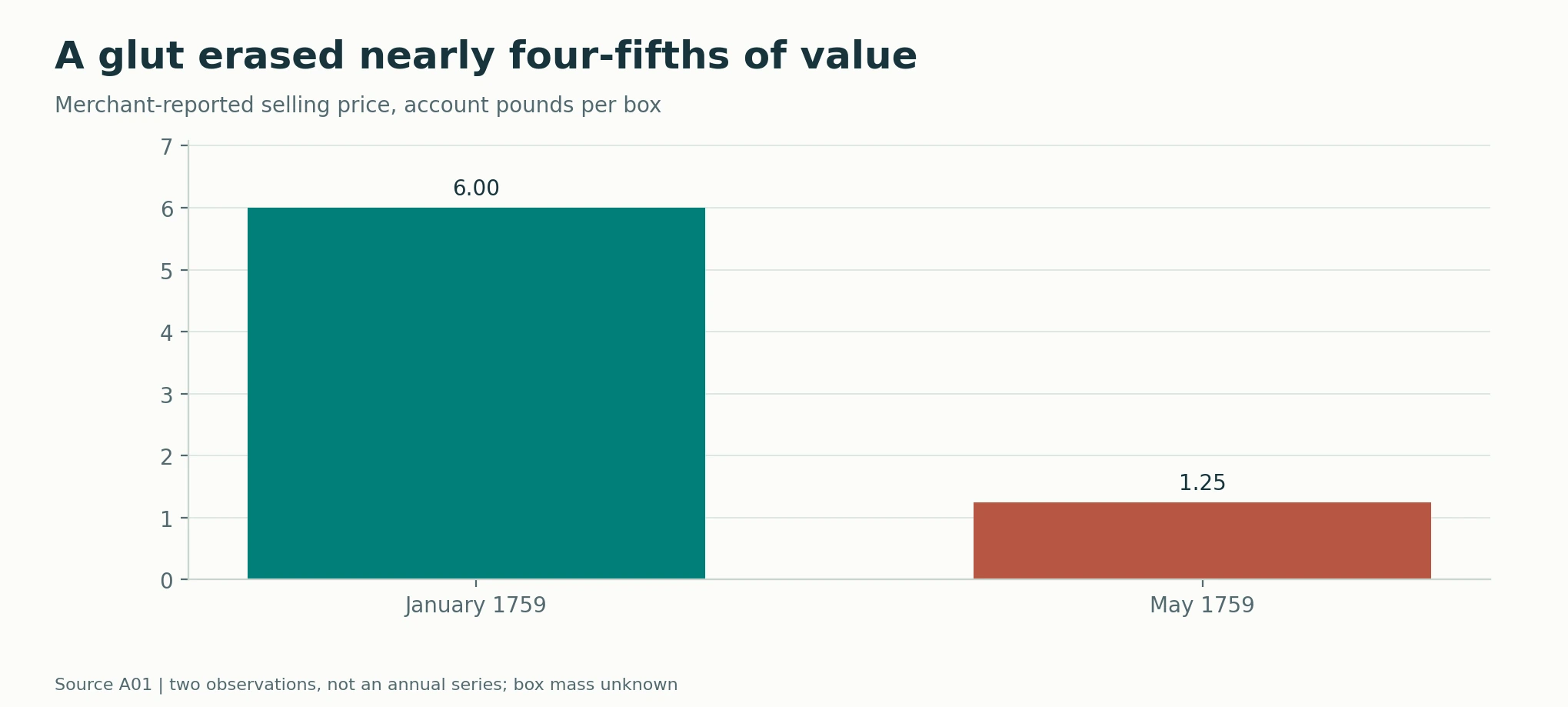
Gluts could be as sharp as shortages. In Louisbourg, in present-day Canada, merchants’ letters put the selling price at 6 pounds a box in January 1759 and 1 pound 5 shillings in May, a fall of 79.2%. Boston merchants had bought lemons to resell at a profit, and their shipments arrived at the same time11. In London, The Times reported in January 1797 that lemons were selling at 6 to 8 old pence each wholesale and 9 pence singly while Portuguese ships were awaited12. In New South Wales in 1809 a dozen lemons cost 6 pence, a quarter of the price of a dozen apples13.
| Date | Place | Price | Kind of record |
|---|---|---|---|
| 1582 | England | 6s 8d per 1,000 | Customs valuation |
| March 1650 | London | 50s per 1,000 | Witness estimate |
| 6 October 1702 | Taunton | 4d per lemon | Household purchase |
| January 1759 | Louisbourg | £6 per box | Merchant’s selling price |
| May 1759 | Louisbourg | £1 5s per box | Merchant’s selling price |
| 2 January 1797 | London | 6–8d per lemon | Wholesale, newspaper report |
| 1809 | New South Wales | 6d per dozen | List of provision prices |
Pounds (£), shillings (s) and old pence (d): 12 pence to the shilling, 20 shillings to the pound. Louisbourg prices are in local account pounds and the size of the box is unknown. Nothing is converted into modern money.
Sicily, New York and California, 1898–1909
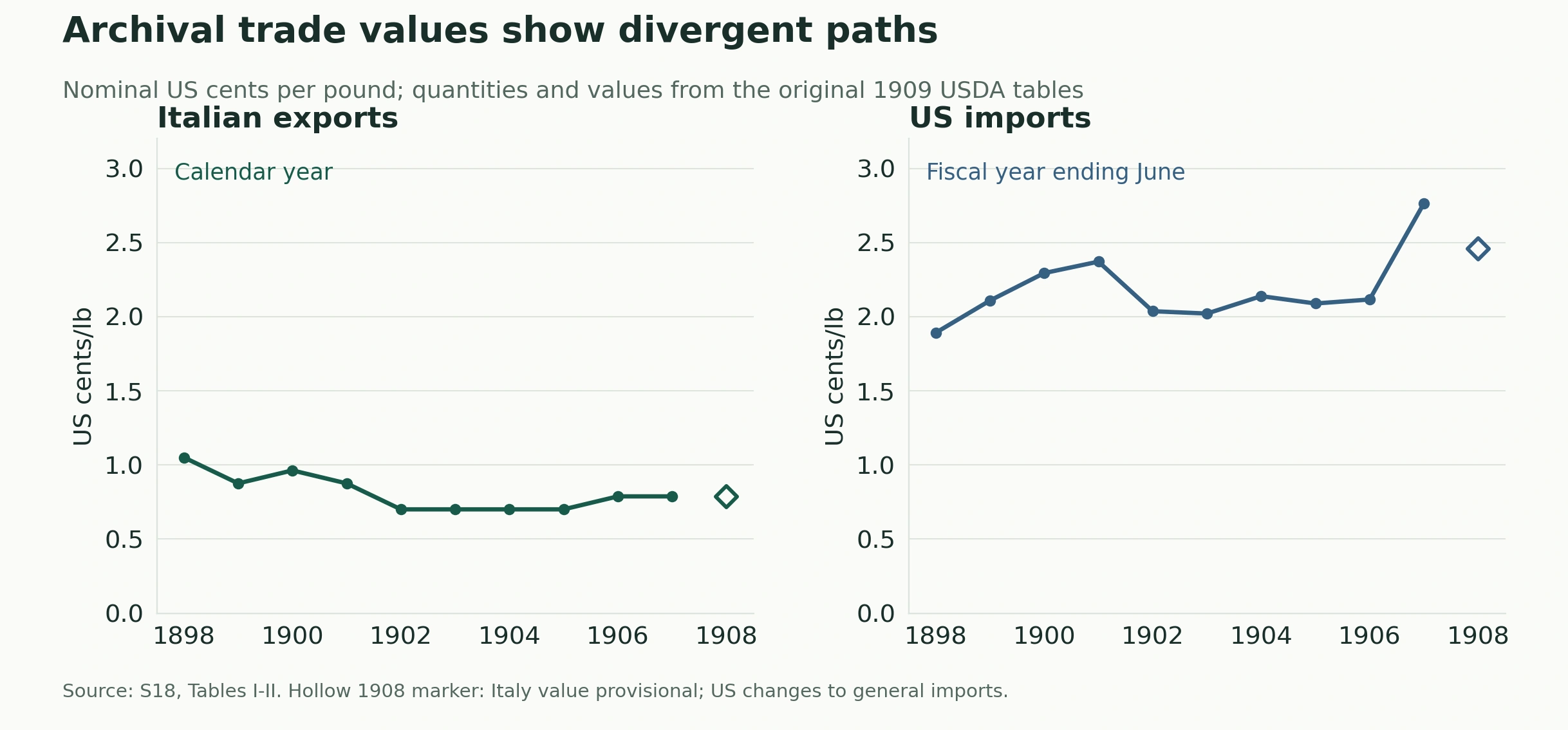
A USDA bulletin of 1909 gives annual trade figures that allow a price per pound. The average value of Italy’s fresh lemon exports fell from 1.05 US cents a pound in 1898 to 0.79 cents in 1907, 25.0% less, while the weight exported rose 71.9%. Lemons entering the United States were valued at 1.89 cents a pound in the year to June 1898 and 2.76 cents in 1907. Italian growers were paid $1.50 to $3.50 per commercial thousand, 1,040 lemons or about 120 kg, in the years before the authors’ visit in 190818. The two trade series use different years and coverage, so the gap between them is not a measure of freight or margins.
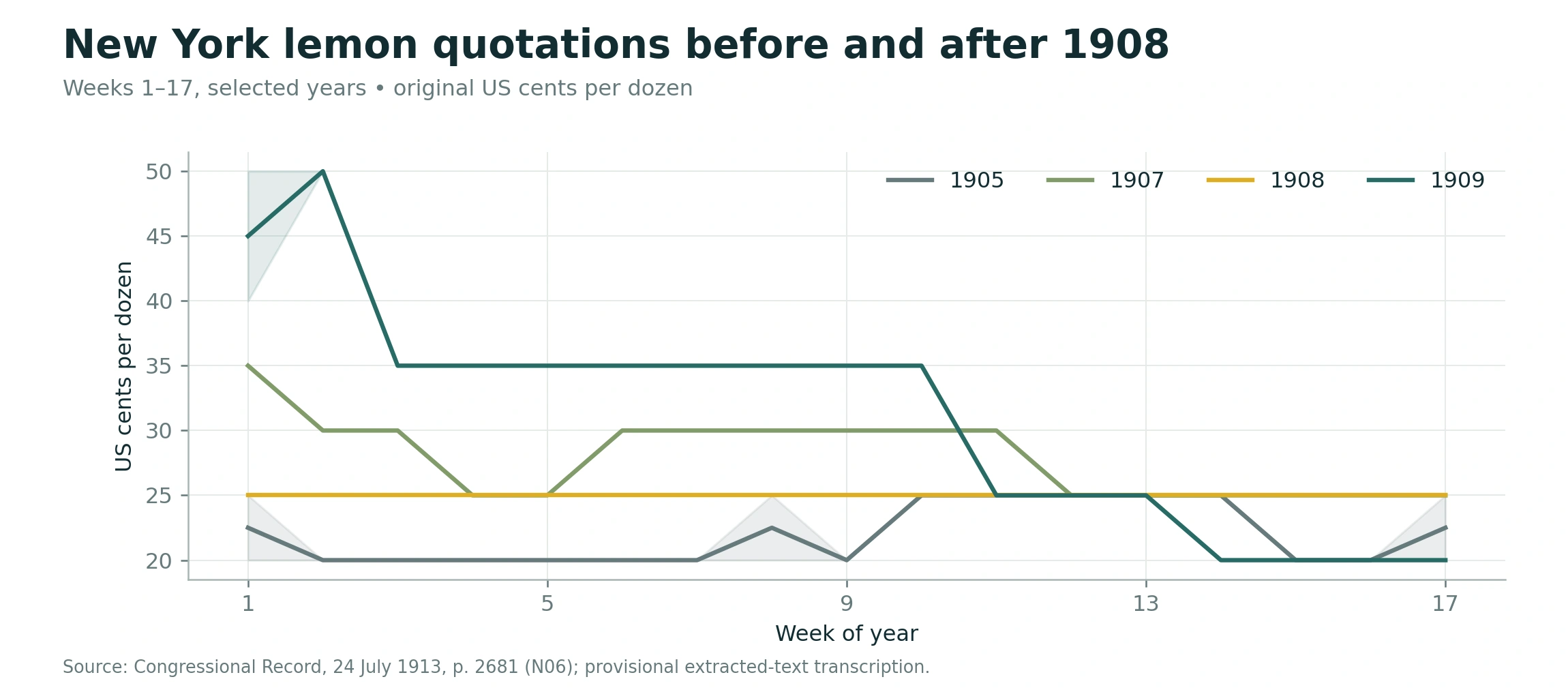
In New York, weekly retail quotations taken from a newspaper and placed before the Senate during a tariff debate put a dozen lemons at 40 to 50 cents in the first week of 1909, against 25 cents a year earlier; by the fourteenth week of 1909 the quote was 20 cents19. The table came from a party to the debate, so it is a record of quotations rather than a survey. California’s groves had by then been rescued from a scale insect, a story told in The ladybird that saved California citrus.
The United States: a farm index since 1947, a shop price since 1980
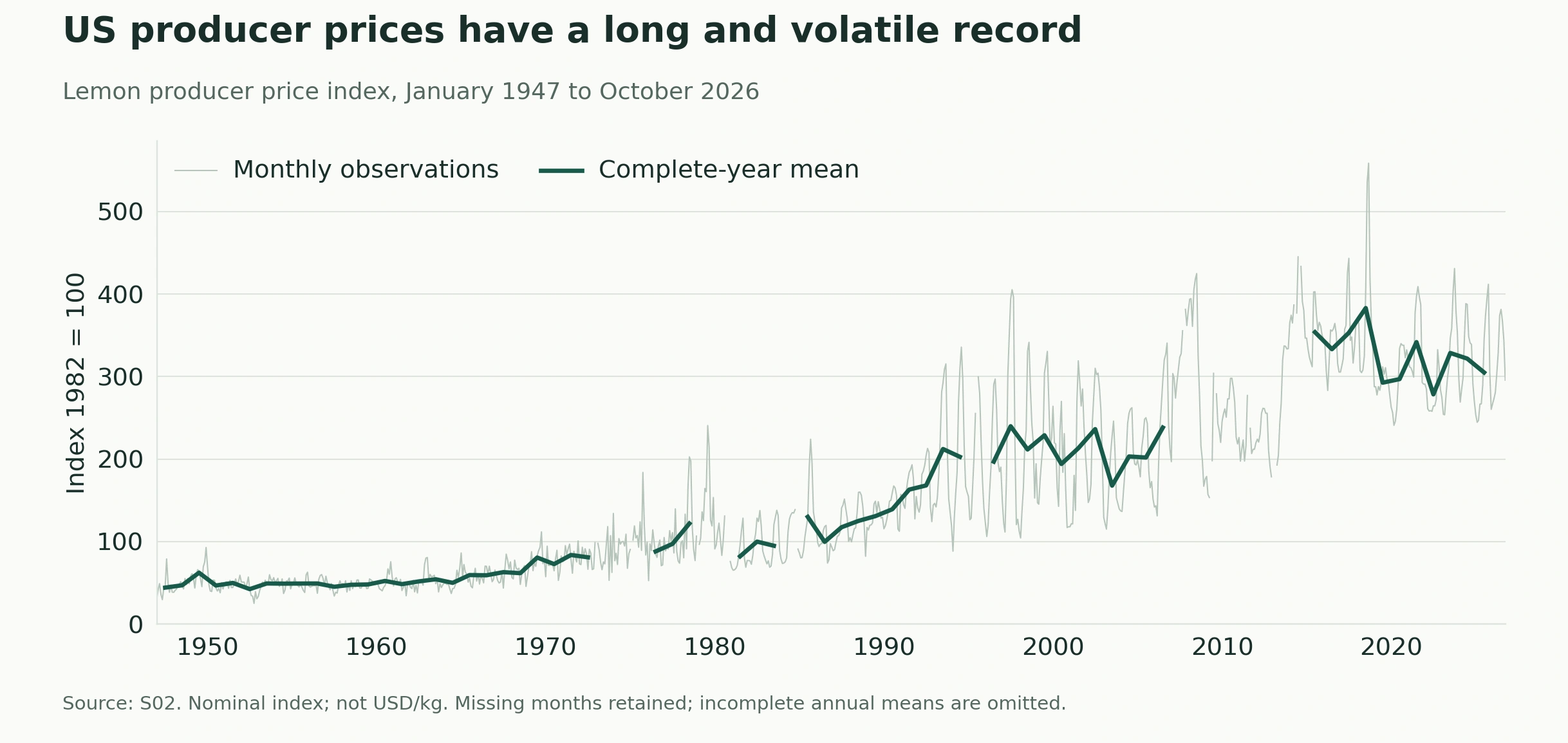
The producer price index for lemons averaged 44.25 in 1947 and 321.84 in 2024 (1982 = 100). Its highest complete-year average was 383.1, in 2018, and 2025 averaged 305.01, 5.2% below 20241. Within a year the index swings widely: in 2026 it rose from 267.3 in January to 381.6 in July, then fell to 295.7 in October, 28.2% below October 2025.
In the shops a pound of lemons cost $0.702 on average in 1980 and $2.023 in 2024, 188.2% more. General prices rose faster: in 2024 dollars the 1980 price was $2.67, so lemons became 24.3% cheaper in real terms2021. Decade medians in 2024 dollars stayed between $2.31 a pound in the 2000s and $2.59 in the 2010s. BLS publishes these averages from the prices it collects for the consumer price index22. There is no figure for October 2025, when collection stopped during the lapse in federal appropriations23; in October 2026 the average was $2.142 a pound, about $4.72 a kilogram20.
| Year | Nominal | In 2024 dollars |
|---|---|---|
| 1980 | 0.702 | 2.67 |
| 1990 | 1.074 | 2.58 |
| 2000 | 1.289 | 2.35 |
| 2010 | 1.634 | 2.35 |
| 2024 | 2.023 | 2.02 |
Annual means of twelve monthly averages. Deflated by the CPI for all urban consumers, all items; not a lemon-specific quality adjustment.
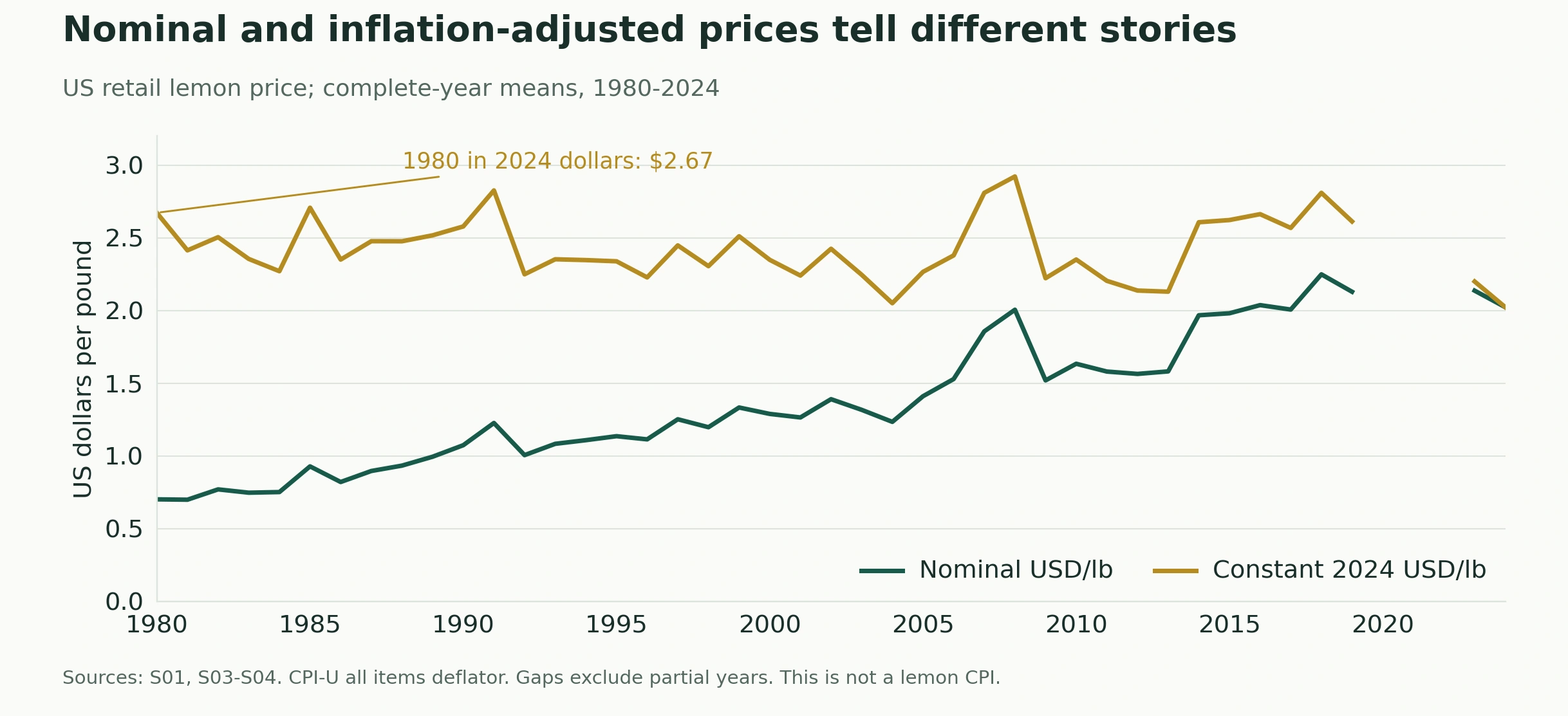
What American growers receive
USDA’s citrus summary of August 2026 puts California’s 2025/26 lemon crop at 26.0 million boxes and Arizona’s at 0.72 million; Florida’s 0.9 million boxes all went for processing. The average return was $27.52 a box in California, $24.78 in Arizona and $17.30 in Florida, where a box holds 90 lb against 80 lb in the West24. The country also bought 371 million lb of fresh lemons abroad that season and sold 196.8 million lb25.
The return depends on where the fruit goes. In 2025/26 a box sold fresh was worth $26.52 on the tree, after the defined costs of picking, packing and selling, while fruit sent for processing returned −$2.54 a box, after −$4.49 a year earlier: the costs deducted exceeded what processors paid. Fresh lemons quoted free on board at the packing house moved from $62.20 a box in September 2025 to $31.90 in March 2026 and $56.70 in July24.
| Use | 2024/25 | 2025/26 |
|---|---|---|
| Fresh | 26.50 | 26.52 |
| Processing | −4.49 | −2.54 |
| All uses | 19.52 | 19.88 |
USDA on-tree equivalents: the price at the packing house less harvesting, hauling and packing costs. Not farm profit.

Spain, Italy and Greece since 1991
Lemons leaving Spanish packing stations averaged €0.373 a kilogram in 1991 and €1.325 in 2025; Italian lemons €0.442 and €1.270. In 2025 the Spanish price rose 25.0% and the Italian 16.6%2. Prices before the euro are shown in euros as the Commission publishes them.
| Year | Spain | Italy |
|---|---|---|
| 1991 | 0.373 | 0.442 |
| 2000 | 0.538 | 0.328 |
| 2010 | 0.867 | 0.650 |
| 2020 | 1.106 | 1.239 |
| 2024 | 1.060 | 1.089 |
| 2025 | 1.325 | 1.270 |
Unweighted means of twelve monthly prices published by the European Commission.
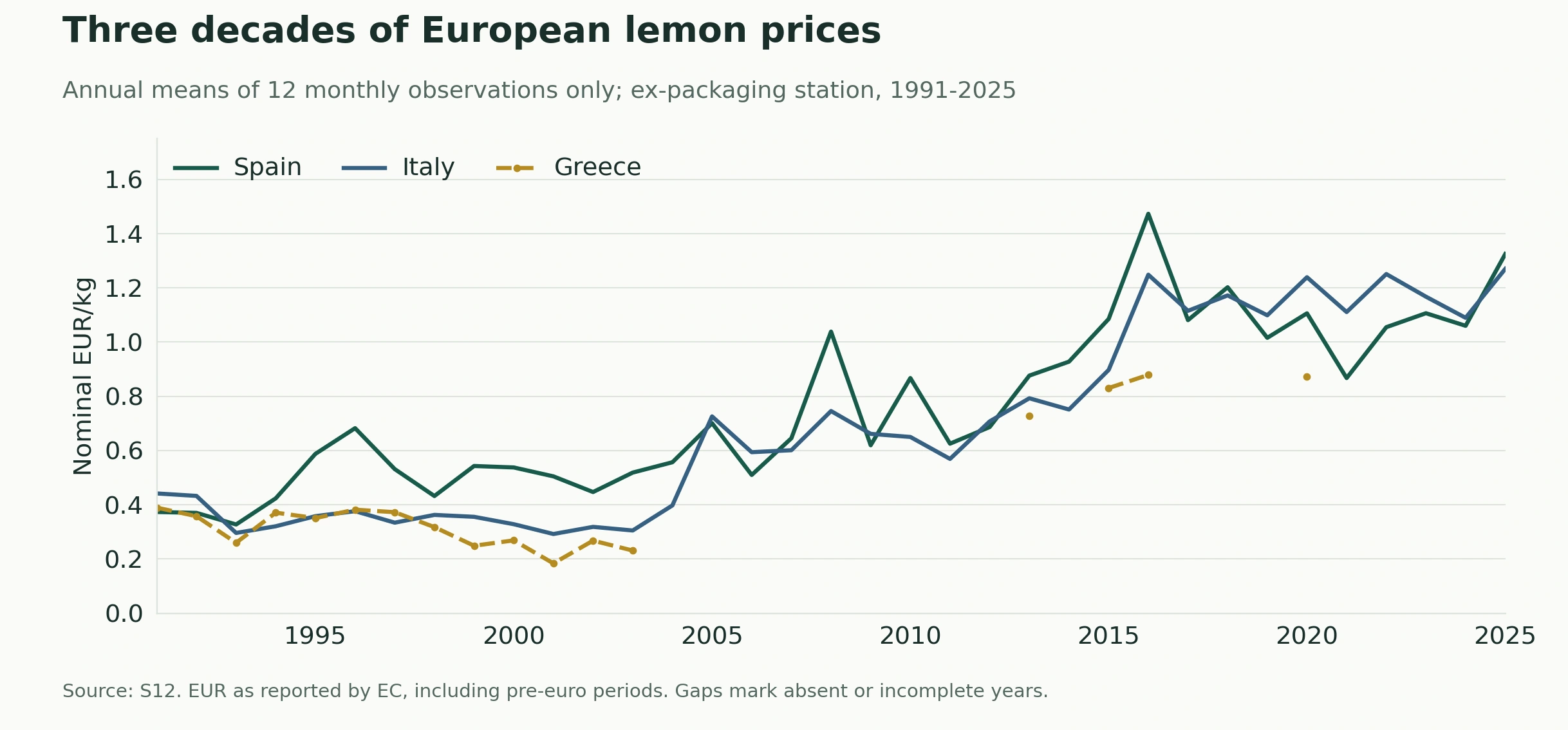
In 2026 prices went higher still. From January to October Spanish lemons averaged €1.671 a kilogram, 33.5% more than in the same months of 2025, and Italian lemons €1.468, 18.7% more. In September Spanish lemons reached €2.09, the highest monthly price since 1991, before falling to €1.331 in October, 24.5% below October 2025; Italian lemons stood at €1.627 and Greek at €0.9562. In January USDA had projected the EU crop 12.0% smaller, linking the fall to adverse conditions in Spain26.
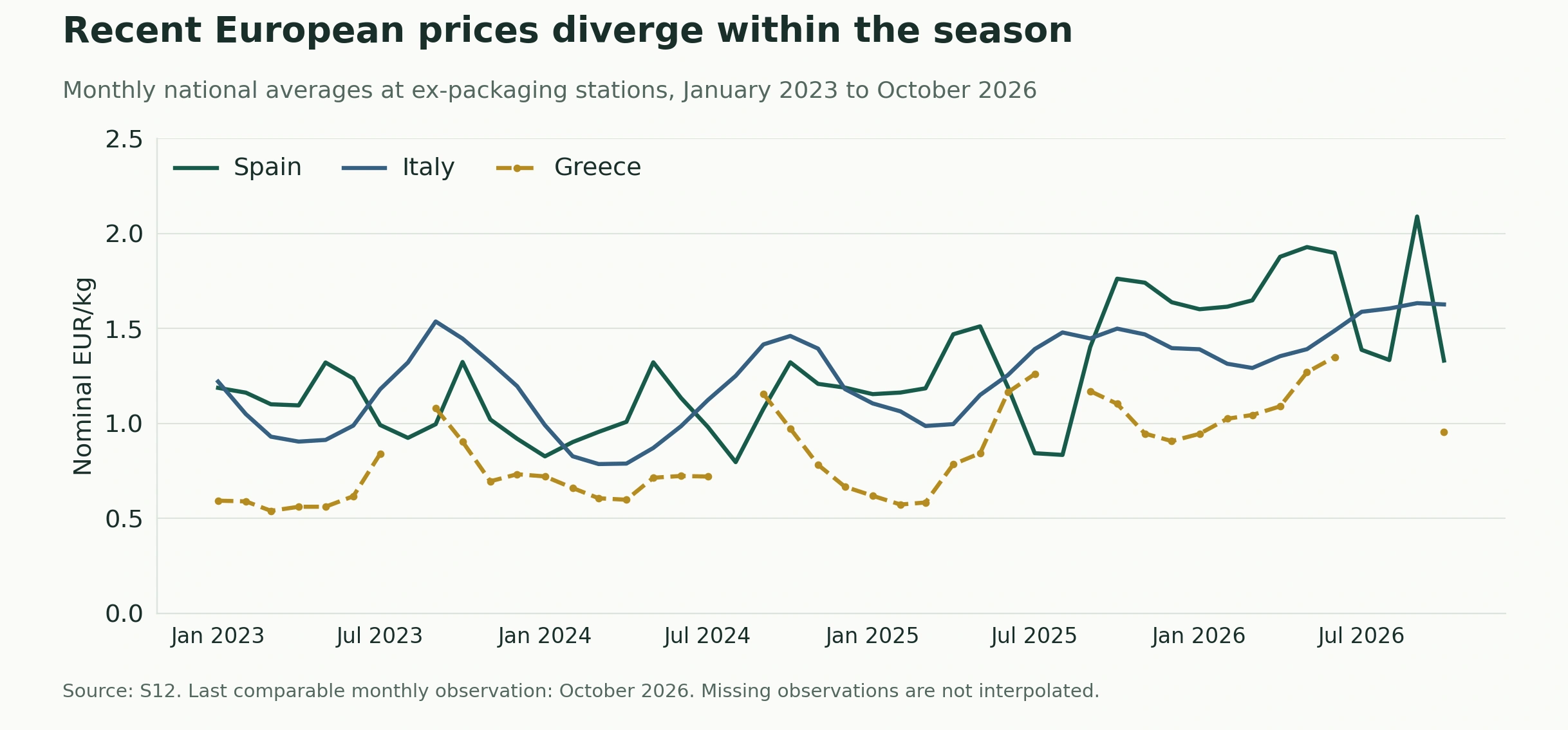
Seasons shape the European price. Over 2015–2025 the dearest month on average was May for Spanish lemons and September for Italian ones2. Imports fill the summer gap: the EU brought in 73,232 tonnes of lemons in August 2024 against 10,034 tonnes in April5.
The southern season: South Africa, Argentina, Chile and Australia
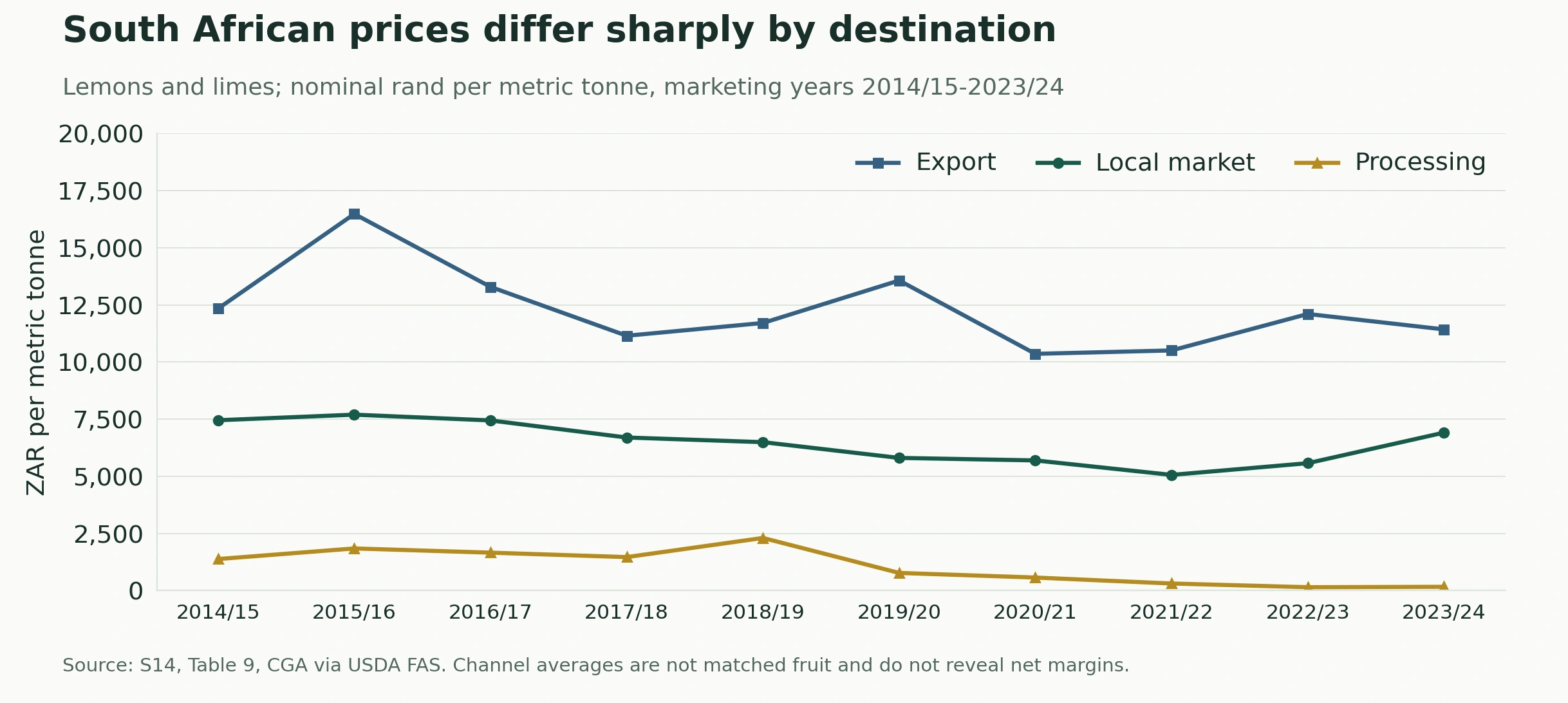
South Africa shows how one crop earns three prices. In 2023/24 lemons and limes fetched ZAR 11,429 a tonne for export, ZAR 6,911 on the home market and ZAR 163 for processing; the processing price was 92.9% below 2018/1927. In Argentina the average FOB export price for March–September was $554.43 a tonne in 2023, $569.29 in 2024 and $623.00 in 2025, 9.4% more than a year earlier28.
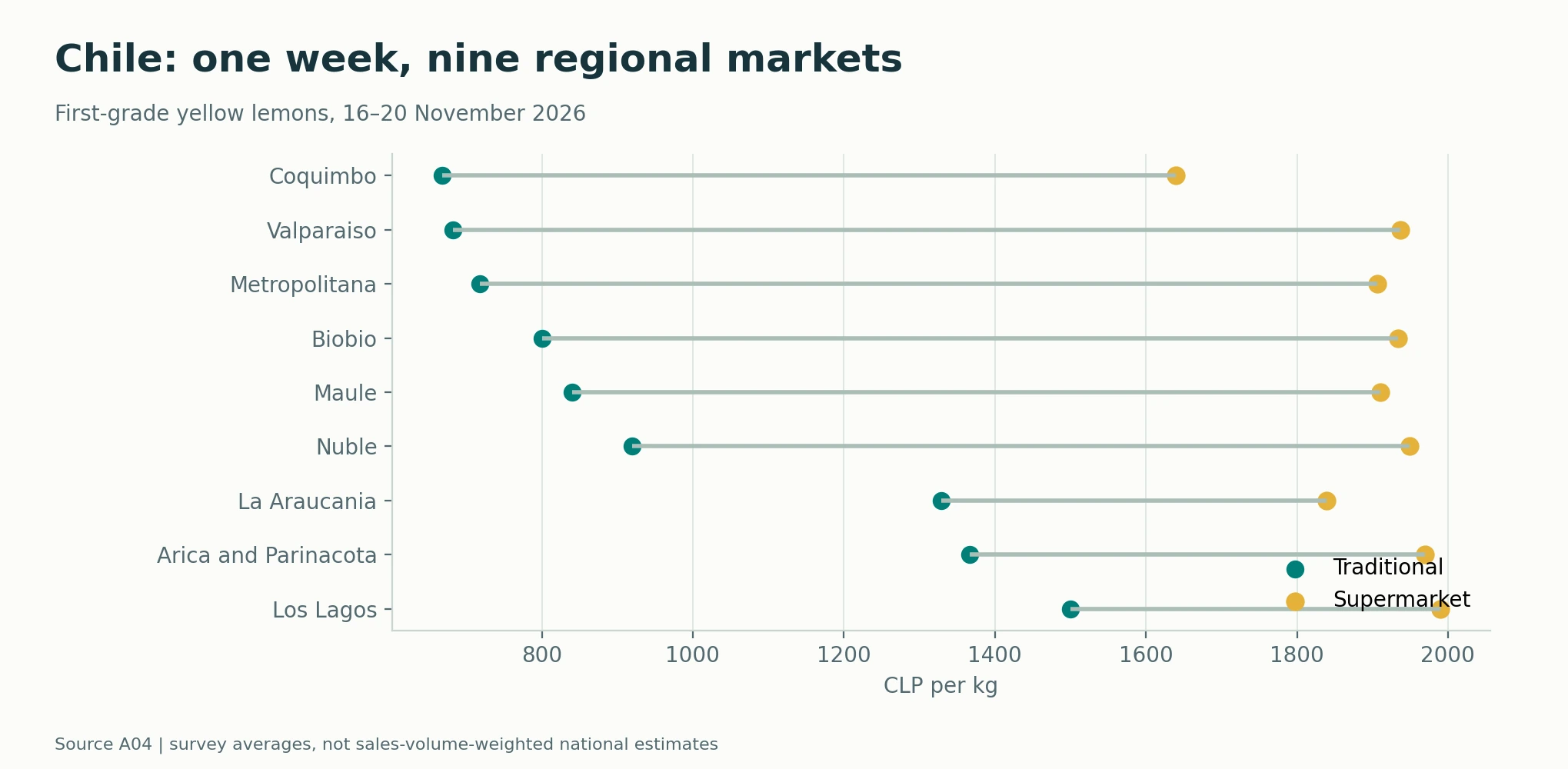
Australia’s lemon and lime crop barely grew between 2023/24 and 2024/25, by 0.4% to 83,666 tonnes, yet its farm value rose to AUD 221 million. Per kilogram that is AUD 2.64, against 2.16 a year earlier and 2.10 in 2022/23293031. In Chile, the agriculture ministry’s survey for 16–20 November 2026 found first-grade yellow lemons at CLP 668 to 1,500 a kilogram in traditional outlets and CLP 1,640 to 1,990 in supermarkets across nine regions. In the Santiago metropolitan region the supermarket price was 165.5% above the traditional one, a gap the survey does not explain32.
A ninefold crop
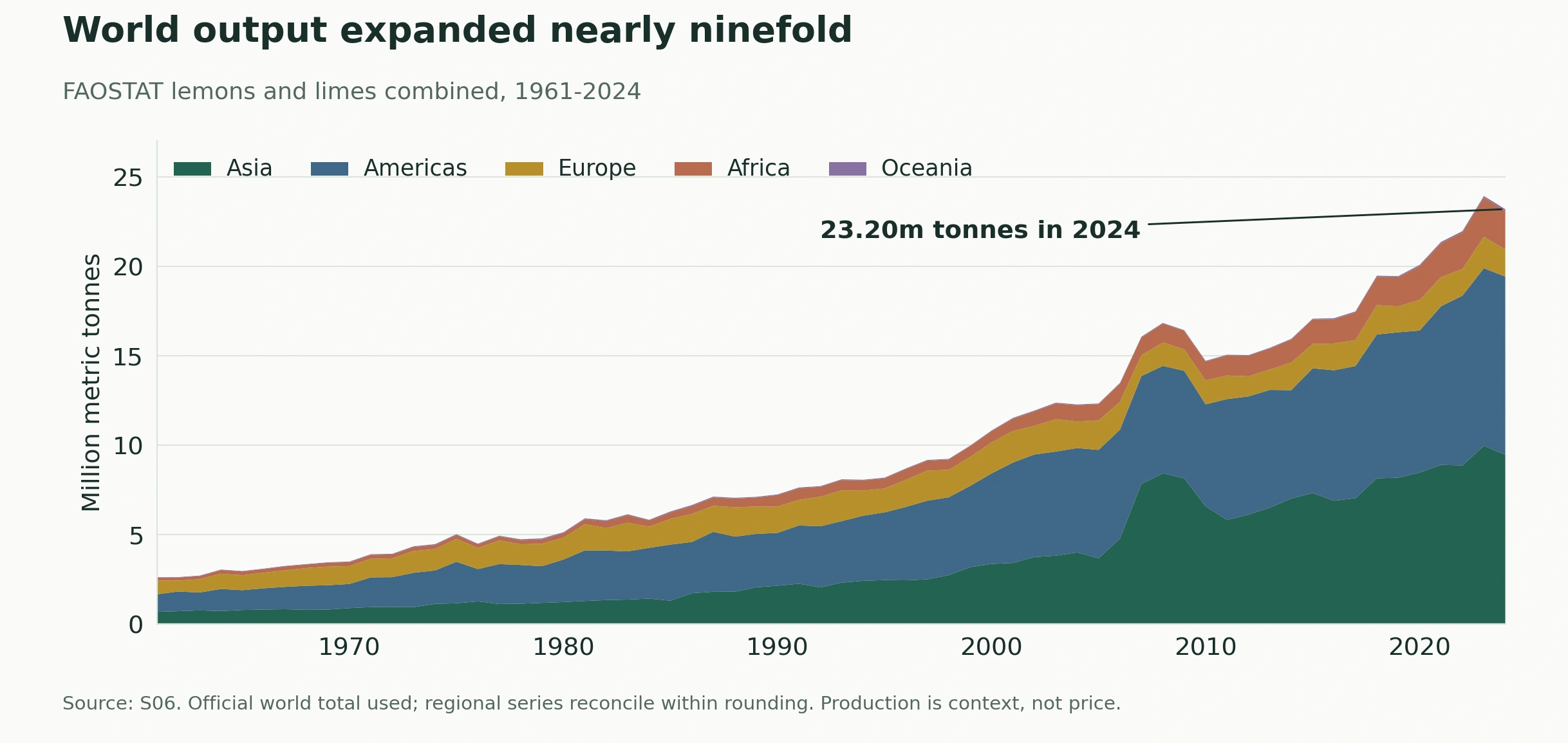
World production of lemons and limes rose from 2.62 million tonnes in 1961 to 23.20 million in 2024, 8.86 times as much, or 3.52% a year; 2024 was 3.06% below 2023. India, Mexico, mainland China and Argentina grew half of the total, and together with Türkiye 57.46%3. For six major producers USDA projected 10.057 million tonnes in 2025/26, 6.6% less than in 2024/25: Mexico and South Africa were expected to grow, Türkiye to lose 36.3% after spring frost and the EU 12.0%26.
| Market | 2024/25 | 2025/26 forecast |
|---|---|---|
| Mexico | 3.275 | 3.373 |
| Argentina | 1.910 | 1.900 |
| European Union | 1.525 | 1.342 |
| Türkiye | 1.730 | 1.102 |
| United States | 1.005 | 0.978 |
| South Africa | 0.810 | 0.840 |
| Selected total | 10.769 | 10.057 |
USDA FAS forecast of January 2026; later estimates may differ.
More on the growers is in Lemon and lime production by country.
Exporters, importers and the 2025 split
Customs data count fresh and dried lemons and limes together (HS 080530). In 2025 Spain exported 627.0 thousand tonnes, 6.9% less than in 2024, yet earned 24.5% more, $1.048 billion, or $1.672 a kilogram. Mexico shipped more, 756.7 thousand tonnes, at $0.967 a kilogram, and South Africa 650.0 thousand tonnes at $0.817, with its unit value up 30.7%33.
| Exporter | $ million | 1,000 tonnes | $ per kg |
|---|---|---|---|
| Spain | 1,048.4 | 627.0 | 1.672 |
| Mexico | 731.9 | 756.7 | 0.967 |
| South Africa | 531.3 | 650.0 | 0.817 |
| Netherlands | 438.5 | 237.0 | 1.850 |
| Brazil | 199.2 | 203.7 | 0.978 |
Türkiye reported $411.3 million for 2025 but no weight, so no unit value is shown. Dutch exports can include re-exports.
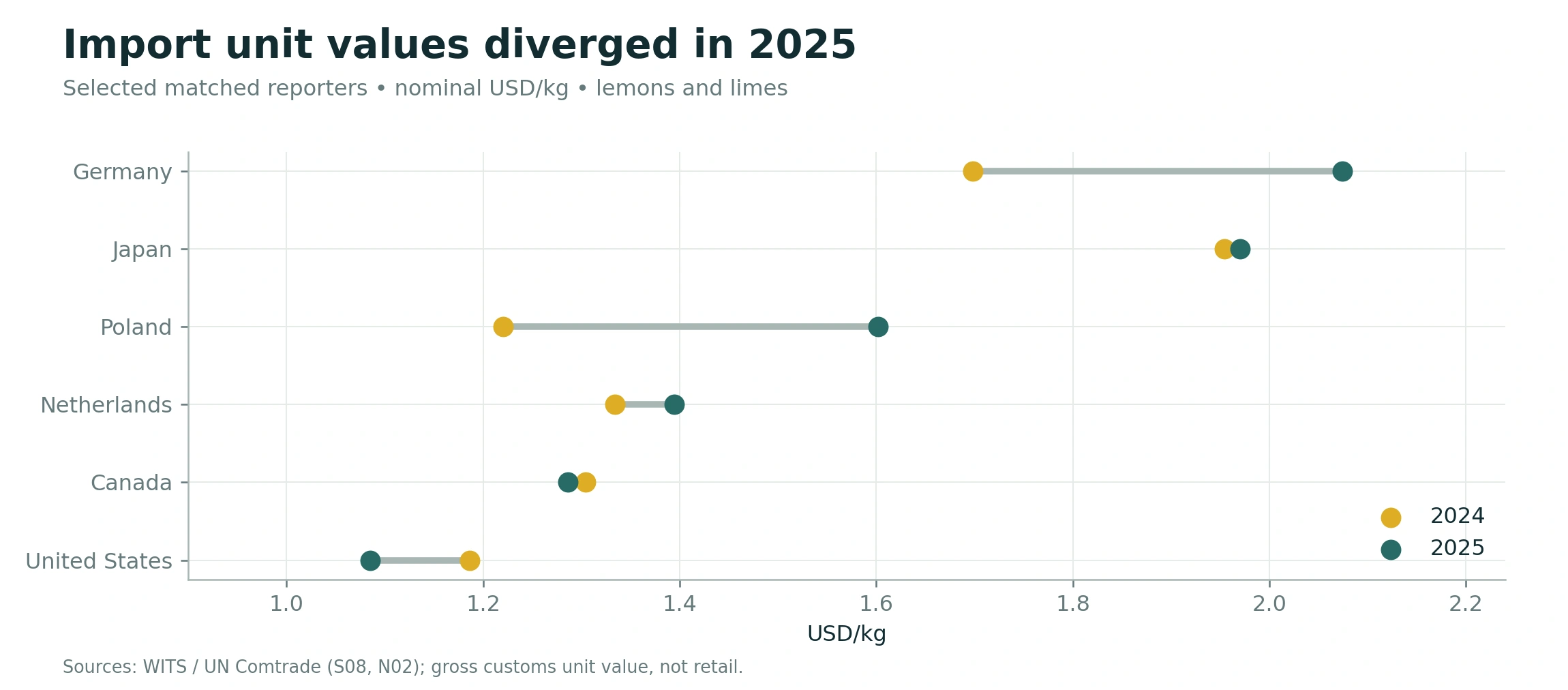
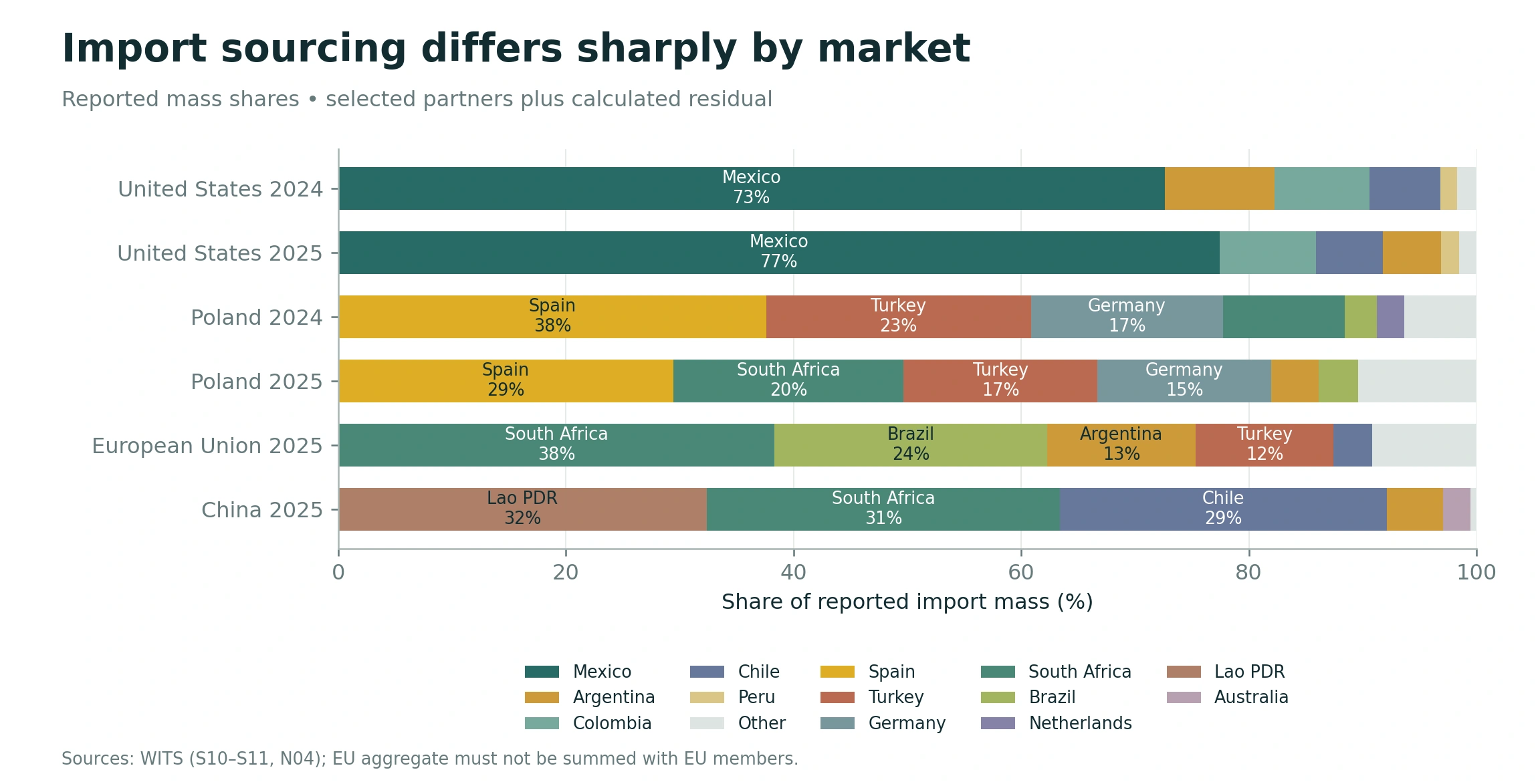
Buyers’ prices went different ways. The average value of German imports rose 22.1% in 2025 to $2.074 a kilogram and Poland’s 31.3%, while the US figure fell 8.5% to $1.085 and Japan’s barely moved, at $1.9704. A fixed panel of six importers, each weighted equally, put 2025 at 106.0 on a base of 2018 = 100. Mexico supplied 77.4% of US import weight in 2025, up from 72.6% in 2024, while South Africa supplied 38.3% and Brazil 24.0% of what the EU bought from outside the bloc34.
Local shocks: Chandigarh in 2022, Türkiye in 2025
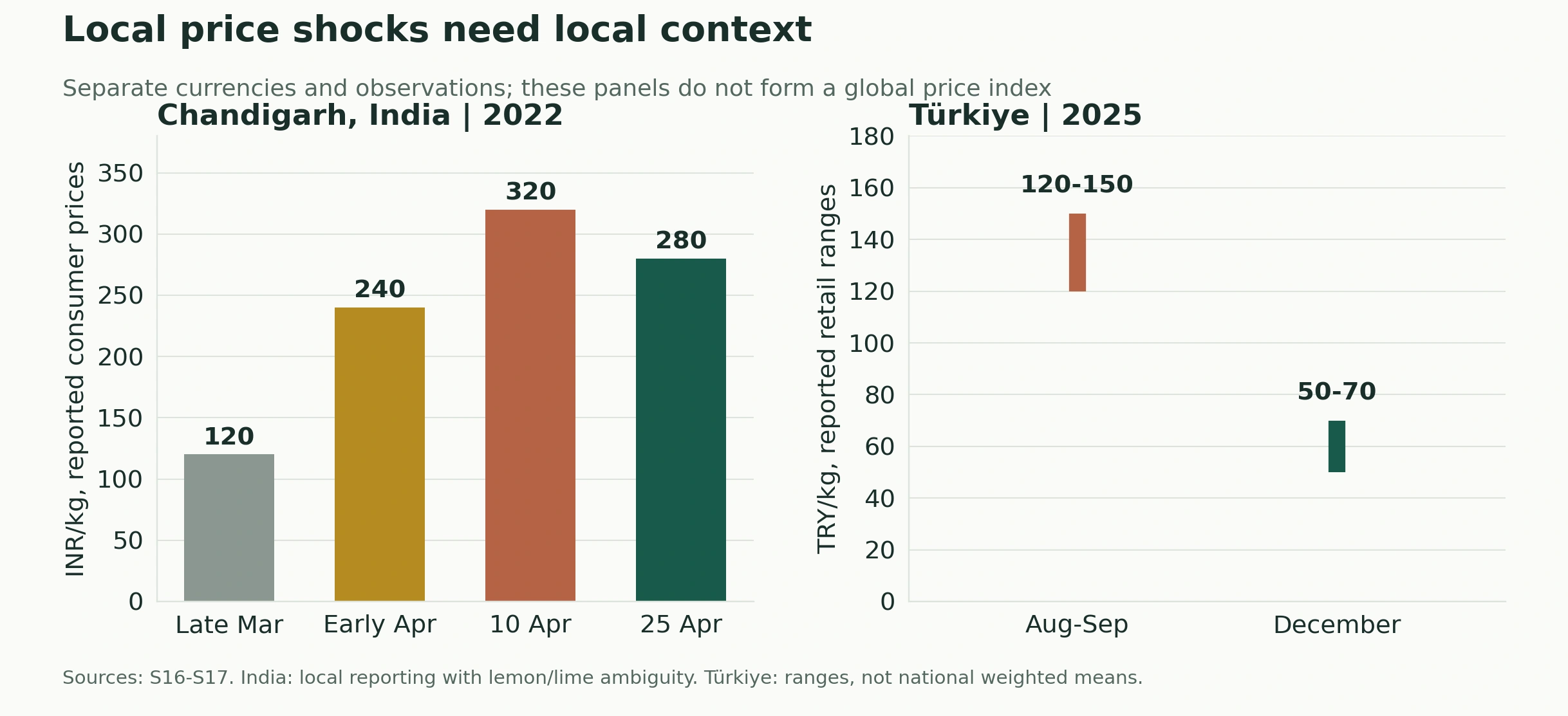
In Chandigarh a local newspaper reported lemons rising from INR 120 a kilogram in late March 2022 to INR 320 on 10 April, 166.7% more, before easing to INR 280 by 25 April; it linked the rise to short supply, weather and transport costs35. In Türkiye, after frost in March and April 2025, USDA reported shop prices of TRY 120–150 a kilogram in August and September and TRY 50–70 in December. A suspension of lemon exports announced from 8 April was later replaced by a duty to report each sale36.
Limes, often counted with lemons, have had their own shocks: Mexican rainfall losses and the US lime price spike and Rain, heat and Lima lime prices in 2023.
Per fruit, per pound, per kilogram
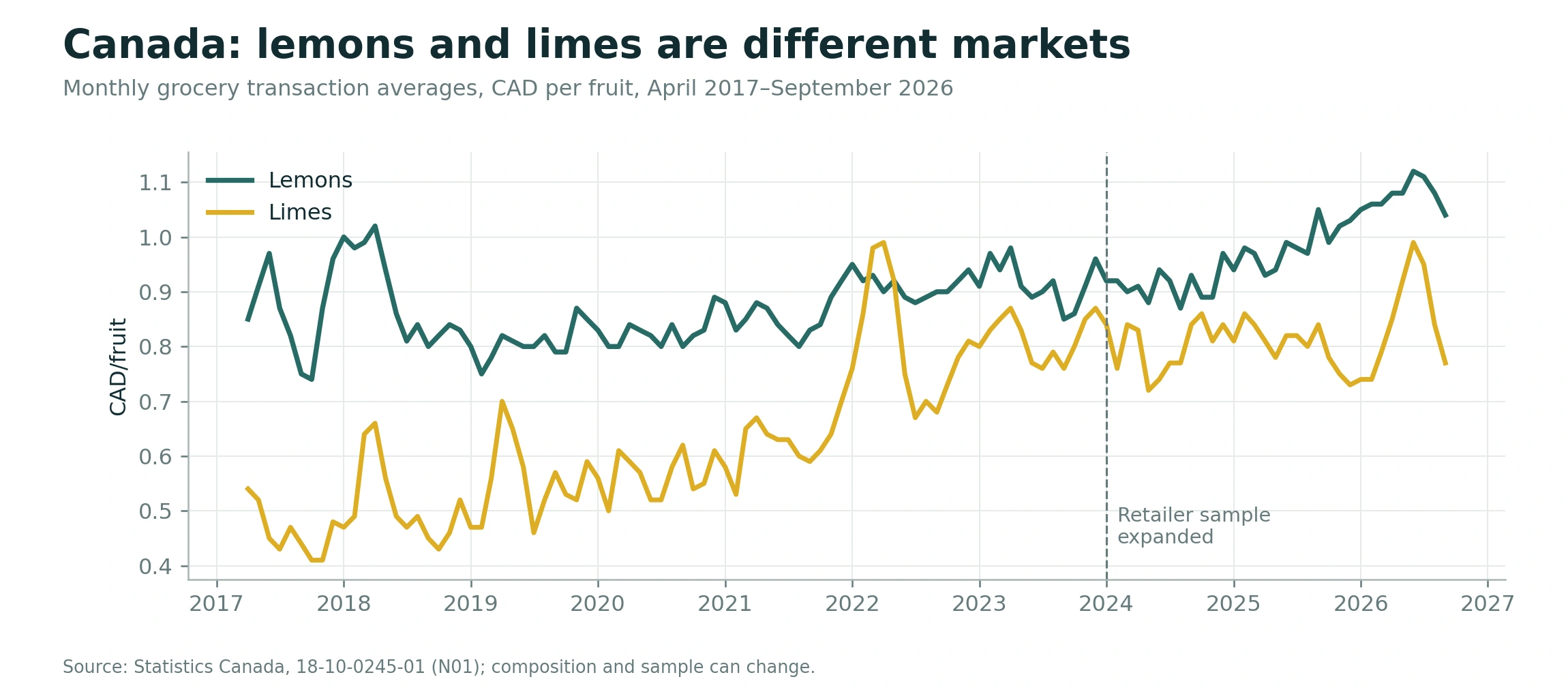
Canada prices a single fruit. A lemon cost C$0.807 on average in 2019, C$0.983 in 2025 and C$1.04 in September 2026; a lime C$0.552, C$0.803 and C$0.77. Statistics Canada widened its sample of grocers in January 202437. In the first nine months of 2026 Canadian lemons cost 10.6% more than a year earlier and American ones 3.1% more3720.
Wholesale markets show another layer. In September 2025 Nagoya’s municipal market handled 82 tonnes of lemons at an average JPY 426 a kilogram; Japanese lemons averaged JPY 641 and imported ones JPY 398, with Chile supplying about 79% of the volume38. South Korea imported 28,525 tonnes of lemons in 2024/25, mostly from the United States in the first half of the year and from Chile later39.
Autumn 2026 in context
Spain’s September record of €2.09 a kilogram was followed by €1.331 in October, below the €1.762 of October 2025, so the 33.5% rise for January–October does not describe every month2. The US producer index fell 28.2% between October 2025 and October 20261, while shop prices moved little: $2.142 a pound in October 202620. Supply forecasts made in January pointed to smaller crops in Türkiye and the EU and larger ones in Mexico and South Africa26.
Latest lemon prices on Husfarm
Updated automatically from wholesale markets in several countries, each in its own currency and unit. Each price links to its history and source.
| Price series | Market | Latest | Change | Date |
|---|---|---|---|---|
| Lemons, California, Shippers First Grade, 7/10 bushel carton | New York Terminal MarketUnited States | 38.0–48.0 USD/7/10 bushel carton | ± 0.0% | 23 Nov 2026 |
| Lemons Spain Class I 4(58-67mm) | MIN RungisFrance | 2.00–2.40 EUR/kg | ± 0.0% | 13 Nov 2026 |
| Lemons | MercamadridSpain | 0.80 EUR/kg | −15.8% | 6 Nov 2026 |
| Verdello lemons, Class I, Italy, 58–63 mm | Turin Wholesale MarketItaly | 1.40–1.60 EUR/kg | −25.0% | 30 Oct 2026 |
| Lemons, Eureka, Tucuman, grade EL, size 090/100 | Buenos Aires Central MarketArgentina | 19,000–21,000 ARS/18 kg box | +5.3% | 20 Nov 2026 |
| Lemons, First quality, Variety unspecified | Mercado Mayorista Lo Valledor de SantiagoChile | 6,749 CLP/18 kg mesh bag | ± 0.0% | 23 Oct 2026 |
| Lemons, grade 1L | Cape Town MarketSouth Africa | 35.0–40.0 ZAR/7 kg bag | +7.1% | 23 Nov 2026 |
| Lemons (Lamas) | İzmir Wholesale MarketTurkey | 30.0–50.0 TRY/kg | ± 0.0% | 24 Nov 2026 |
Lemon prices today Lemon and lime production by country The price of oranges
How to read lemon prices
- Name the stage: grower, packing station, export port, customs value, wholesale market or shop shelf.
- Name the unit: a thousand, a box, a dozen, a single fruit, a pound and a kilogram are not interchangeable without a weight.
- Check whether limes are included: FAOSTAT, customs data and some national tables count lemons and limes together.
- Compare the same months: harvests in the two hemispheres make prices seasonal, so match September with September or use year-to-date means.
- Keep an index an index: a producer price index of 321.84 is not a price in dollars.
Price changes are 100 × (last ÷ first − 1). Customs unit values are reported value divided by reported weight. Real US prices use annual averages of the CPI for all urban consumers. Historical prices stay in their own currencies and units; no value is invented for years without records.
Questions and answers
When were lemons most expensive?
It depends on the series. Spanish lemons at the packing station reached €2.09 a kilogram in September 2026, the highest monthly price since 1991. The US producer price index had its highest complete-year average in 2018. In US shops, after inflation, the 2010s had the highest median price of any decade since 1980.
Why did lemon prices rise in 2025 and 2026?
Spanish ex-packing prices rose 25.0% in 2025 and another 33.5% in January–October 2026. USDA projected in January 2026 that the EU crop would be 12.0% smaller because of adverse conditions in Spain and Türkiye’s 36.3% smaller after spring frost. The sources do not measure how much each factor moved prices.
Are lemons more expensive than in the past?
In US shops a pound cost $0.702 in 1980 and $2.023 in 2024, 188.2% more. Over the same years general prices rose faster, so in 2024 dollars lemons became 24.3% cheaper.
Which country grows the most lemons?
FAOSTAT counts lemons and limes together. In 2024 India led with 3.84 million tonnes, followed by Mexico, mainland China and Argentina; these four grew half of the world total of 23.20 million tonnes. Spain is the largest exporter by value, with $1.048 billion in 2025.
Why do lemons cost different amounts in different countries?
Prices are taken at different stages and in different units, and the hemispheres harvest at different times. In 2025 the average value of German lemon and lime imports was $2.074 a kilogram and of US imports $1.085; origin, grade and the share of limes also differ, and Mexico supplied 77.4% of US import weight.
How much did a lemon cost in history?
A household in Taunton paid 4 old pence for one lemon in 1702. In New South Wales in 1809 a dozen cost 6 pence, and in New York in early 1909 a dozen was quoted at 40 to 50 cents. In October 2026 a pound of lemons averaged $2.142 in US shops.
Sources
Links to other websites open in a new tab.
- US Bureau of Labor Statistics, via FRED (2026). Producer price index by commodity: farm products, lemons (WPU01110104). Index 1982 = 100, January 1947–October 2026
- European Commission, DG AGRI (2026). Fruit and vegetables: supply chain prices, lemons. Ex-packing station prices in Spain, Italy and Greece, January 1991–October 2026
- FAOSTAT (2025). Crops and livestock products: lemons and limes. Production in tonnes, 1961–2024
- UN Comtrade, via World Bank WITS (2026). Lemon and lime imports, fresh or dried (HS 080530). Reporter from world, 2017–2025
- European Commission (2025). Citrus: monthly imports into the EU. Edition of 5 June 2025
- Dafna Langgut (2017). The Citrus Route Revealed: From Southeast Asia into the Mediterranean. HortScience 52, pp. 814–822
- Katherine Strange Burke (2021). The Sheikh’s House at Quseir al-Qadim. Oriental Institute Publications 144, University of Chicago, notes 627–635
- UK Data Service (2009). Bristol particular accounts and port books of the sixteenth century. Study 6275, documentation: the 1582 book of rates
- MarineLives. High Court of Admiralty, HCA 13/63: deponents by folio. Transcription of depositions of 1650
- Anne Stobart (2008). The Making of Domestic Medicine: Household Healthcare in South West England in the Late Seventeenth Century. PhD thesis, Middlesex University
- A. B. Graham (2022). Morals on the Margins: Commerce, Trust and Public Service in Louisbourg, 1758–1760. In Global Commerce and Economic Conscience in Europe, 1700–1900 (Oxford University Press), p. 11, notes 25–28
- John Ashton (1885). Old Times: A Picture of Social Life at the End of the Eighteenth Century. p. 154: The Times, 2 January 1797 and 16 July 1799
- David Dickinson Mann (1811). The Present Picture of New South Wales. Prices of provisions in 1809
- Iain Milne (2012). Who was James Lind, and what exactly did he achieve?. Journal of the Royal Society of Medicine
- Ulrich Tröhler (2003). James Lind and scurvy: 1747 to 1795. James Lind Library
- Arcangelo Dimico, Alessia Isopi and Ola Olsson (2017). Origins of the Sicilian Mafia: The Market for Lemons. The Journal of Economic History 77, pp. 1083–1115
- The Economist (1847). The Economist, vol. 5, no. 204, 24 July 1847. p. 855: foreign fruit market
- G. Harold Powell and E. M. Chace (1909). Italian Lemons and Their By-Products. USDA Bureau of Plant Industry Bulletin 160, tables I–II, pp. 11–12
- US Government Publishing Office (1913). Congressional Record, Senate, 24 July 1913. Printed p. 2681: New York lemon quotations, 1905–1909
- US Bureau of Labor Statistics, via FRED (2026). Average price: lemons, per pound, US city average (APU0000711412). January 1980–October 2026, nominal US dollars per pound
- US Bureau of Labor Statistics (2026). Consumer price index for all urban consumers, all items (CUUR0000SA0). Annual averages; 2024 = 313.689
- US Bureau of Labor Statistics (2026). CPI average price data. Fact sheet on how average prices are collected and published
- US Bureau of Labor Statistics (2025). 2025 lapse in appropriations: impact on the CPI. Why October 2025 prices were not collected
- USDA National Agricultural Statistics Service (2026). Citrus Fruits 2025 Summary. 27 August 2026, pp. 12–21: lemon utilization, prices and returns
- USDA Economic Research Service (2026). Fruit and Tree Nuts Outlook: September 2026. FTS-386, p. 27: US lemon imports and exports, 2025/26
- USDA Foreign Agricultural Service (2026). Citrus: World Markets and Trade. January 2026; lemons and limes in selected markets, 2024/25 and 2025/26
- USDA Foreign Agricultural Service, Pretoria (2025). South Africa: Citrus Annual. GAIN report SF2025-0042, table 9: lemon and lime prices by channel
- USDA Foreign Agricultural Service, Buenos Aires (2025). Argentina: Citrus Annual. GAIN report AR2025-0026: monthly FOB lemon export prices
- Hort Innovation and Freshlogic (2023). Australian Horticulture Statistics Handbook 2022/23. Lemons and limes, year to June 2023
- Hort Innovation and Freshlogic (2024). Australian Horticulture Statistics Handbook 2023/24. Lemons and limes, year to June 2024
- Hort Innovation, Freshlogic and Kynetec (2025). Australian Horticulture Statistics Handbook 2024/25. Lemons and limes, year to June 2025
- ODEPA, Ministry of Agriculture of Chile (2026). Precios de alimentos por región. Survey of 16–20 November 2026, first-grade yellow lemons
- UN Comtrade, via World Bank WITS (2026). Lemon and lime exports, fresh or dried (HS 080530). Reporter to world, 2024–2025
- UN Comtrade, via World Bank WITS (2026). Lemon and lime imports by partner (HS 080530). United States and European Union, 2024–2025
- The Indian Express (2022). Summer lemonade a distant dream as supply shortage causes lemon price hike. Chandigarh, 26 April 2022
- USDA Foreign Agricultural Service, Ankara (2026). Türkiye: Citrus Annual. GAIN report TU2025-0067: frost, retail prices and export rules in 2025
- Statistics Canada (2026). Monthly average retail prices for selected products (18-10-0245-01). Lemons and limes, dollars per unit, April 2017–September 2026
- City of Nagoya (2025). Central wholesale market: fruit handled by product, origin and market. September 2025, product 4120, pp. 12–13
- USDA Foreign Agricultural Service, Seoul (2025). Korea: Citrus Annual. GAIN report KS2025-0052, 19 December 2025, p. 16
About this price history
The Husfarm editorial team prepared this price history from the sources listed above, from a sixteenth-century book of rates and merchants’ letters to the latest BLS, USDA, European Commission, FAOSTAT and UN Comtrade data. Calculations (price changes, unit values, prices in 2024 dollars and the matched-month comparisons for 2026) are our own and use the published observations at their own precision.
Charts: Husfarm, from the sources listed. Cover: plate from Köhler’s Medizinal-Pflanzen (1887), public domain; gold line: US producer price index for lemons, 1947–2026.
Prices are nominal, in the currency and unit of each source, unless a base year or a wage measure is stated. Figures checked on 24 November 2026. To report an error, write to us through the contact page.
Cite as: Husfarm editorial team (2026). The price of lemons: from a 1582 book of rates to Spain’s 2026 peak. Husfarm, 24 November 2026. https://husfarm.com/price-histories/lemons/