

Before bananas had a price
The oldest evidence about bananas is not a price but a field. At Kuk Swamp in the New Guinea highlands, plant remains and worked ground show intensive banana cultivation by about 5000–4490 BCE1. Fragments of banana skin from a medieval deposit at Quseir al-Qadim, the Red Sea port in Egypt, dated to 1040–1160 CE, prove that the fruit travelled, but say nothing about what it cost2.
The first dated price comes from the court of the Mughal emperor Akbar. In the Ain-i-Akbari, compiled in the 1590s, Abu’l Fazl lists plantains among the sweet fruits of Hindustan at two for one dam, a copper coin, in the rainy season34. In the same list a pineapple costs four dams, as much as eight plantains. The translation does not say which variety was meant. Europe still knew the plant from books: Michał Boym’s Flora Sinensis, printed in Vienna in 1656, includes a banana illustration, and a copy survives in the National Library of Poland5. In Batavia in 1770 Joseph Banks distinguished bananas eaten fresh from kinds fried in butter or boiled, but recorded no price6.
A fruit, a dozen or a bunch: nineteenth-century prices
For most of the nineteenth century the unit depended on the buyer. A household bought single fruit or a dozen; an exporter bought whole bunches by the shipload. A Jamaican market list published in 1825 by H. T. De la Beche records what enslaved people from the Halse Hall estate usually received at nearby markets in 1823–18247. A large bunch of bananas sold for a quarter of a dollar, a large bunch of plantains for half a dollar; in the medium size, 2 and 4 bits. In both sizes plantains cost twice as much as bananas. No weight is given, so the prices cannot be turned into a price per kilogram.
| Date | Place | Price | What was sold |
|---|---|---|---|
| 1590s | Mughal India | ½ dam per fruit | plantains, court price list |
| 1823–1824 | Halse Hall, Jamaica | ¼ dollar per large bunch; 2 bits per medium bunch | bananas at local markets |
| 1846 | New York | 4¢ per fruit | consumer price |
| by 1871 | Portland, Jamaica | 1 shilling per bunch | paid to growers by early exporters |
| May 1874 | Lucea, Jamaica | 2 shillings per bunch | a schooner cargo of 1,200 bunches |
| by 1875 | Portland, Jamaica | 2 shillings per bunch | paid to growers |
| 1886 | British Honduras | 37½–50¢ per bunch | trade to New Orleans |
| 1890 | United States | 12–25¢ per dozen | in-season range, household guide |
Currencies and units as in each source. Bunch weights are not recorded.
The early Jamaican export trade shows the first price effect of a new market. In the parish of Portland, the price that exporters paid growers doubled from one shilling a bunch around 1871 to two shillings by 18758; in May 1874 a schooner captain bought 1,200 bunches at Lucea for the same two shillings9. A handbook for the 1886 London exhibition quoted bananas from British Honduras at 37½–50 cents a bunch for the New Orleans trade, and plantains at 75 cents to a dollar per hundred fruit10. In 1846 a single banana had cost 4 cents in New York11; by 1890 a US household guide gave 12–25 cents a dozen in season12.
The US import bill, 1884–1929
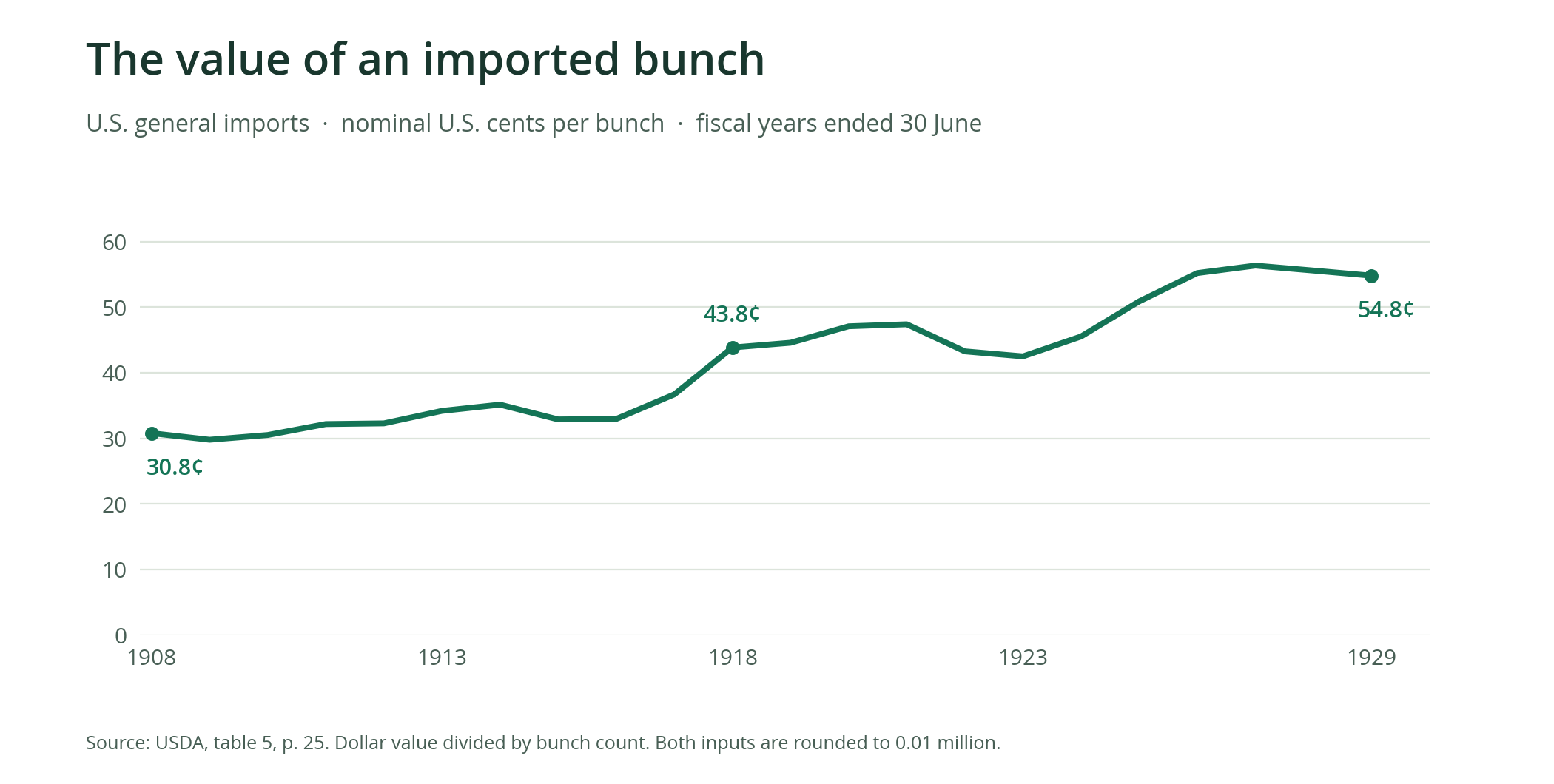
US customs ledgers, summarised by the Bureau of Agricultural Economics in 1930, record banana imports worth $1.82 million in the fiscal year ending June 1884 and $11.88 million by 190713. From 1908 the ledger also counts bunches, which allows an average value per bunch: 30.8 cents in 1908, 47.1 cents in 1920 and 54.8 cents in 1929. Between 1908 and 1929 the number of bunches grew by about 72% and their average value by about 78%; together they tripled the import bill to $34.81 million.
| Fiscal year | Million bunches | Import value, $ million | Cents per bunch |
|---|---|---|---|
| 1884 | — | 1.82 | — |
| 1907 | — | 11.88 | — |
| 1908 | 37.00 | 11.39 | 30.8 |
| 1914 | 46.68 | 16.40 | 35.1 |
| 1918 | 34.55 | 15.15 | 43.8 |
| 1920 | 36.85 | 17.35 | 47.1 |
| 1929 | 63.52 | 34.81 | 54.8 |
Gross general imports. Value per bunch = 100 × dollars ÷ bunches. Bunch sizes varied, so the ledger cannot give a price per pound.
The fruit in these bunches was mostly the Gros Michel variety, later wiped out on plantations by Panama disease; how the trade switched to Cavendish is told in our history From Gros Michel to Cavendish.
Shelf prices from New York to London, 1920–2024
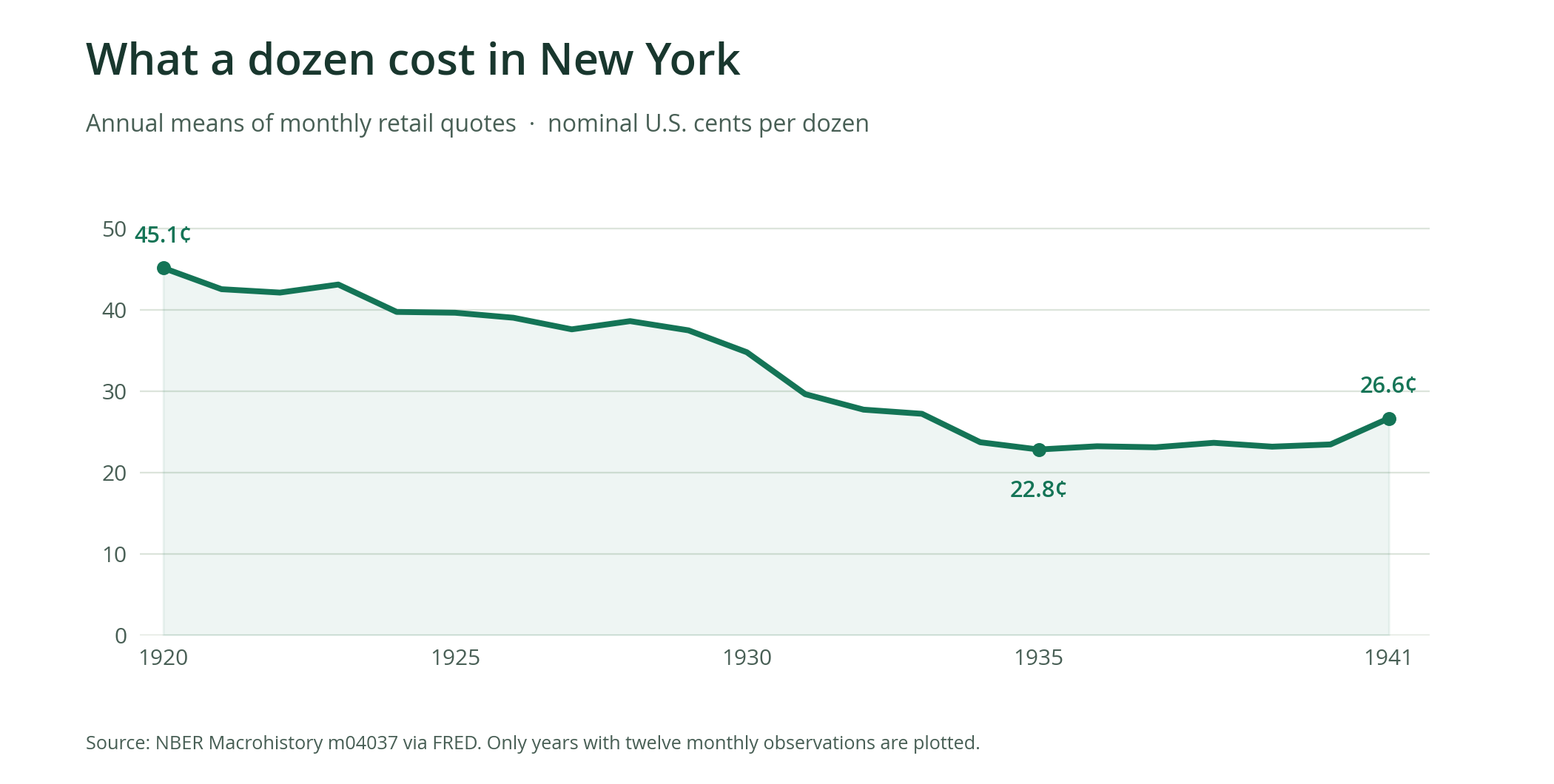
The first long retail series is for New York. Collectors were told to price the best bananas in the bunch; a dozen cost 45.1 cents in 1920, fell to 22.8 cents in 1935, the lowest full year, and rose to 26.6 cents by 19411415. The 1935 average was 49.5% below 1920.
After the war the World Bank compared shelf prices in three markets in US cents per kilogram16. In 1955 the United States, West Germany and France were within seven cents of each other (37.4, 36.2 and 42.9 cents). By 1979 a kilogram cost 71.5 cents in the US, 84.0 in Germany and 117.8 in France. Exchange rates moved as well as shelf prices, so the dollar comparison mixes both.
| Year | United States | Germany | France |
|---|---|---|---|
| 1955 | 37.4 | 36.2 | 42.9 |
| 1965 | 35.3 | 37.5 | 40.1 |
| 1970 | 35.1 | 38.0 | 42.5 |
| 1975 | 51.2 | 64.2 | 86.8 |
| 1979 | 71.5 | 84.0 | 117.8 |
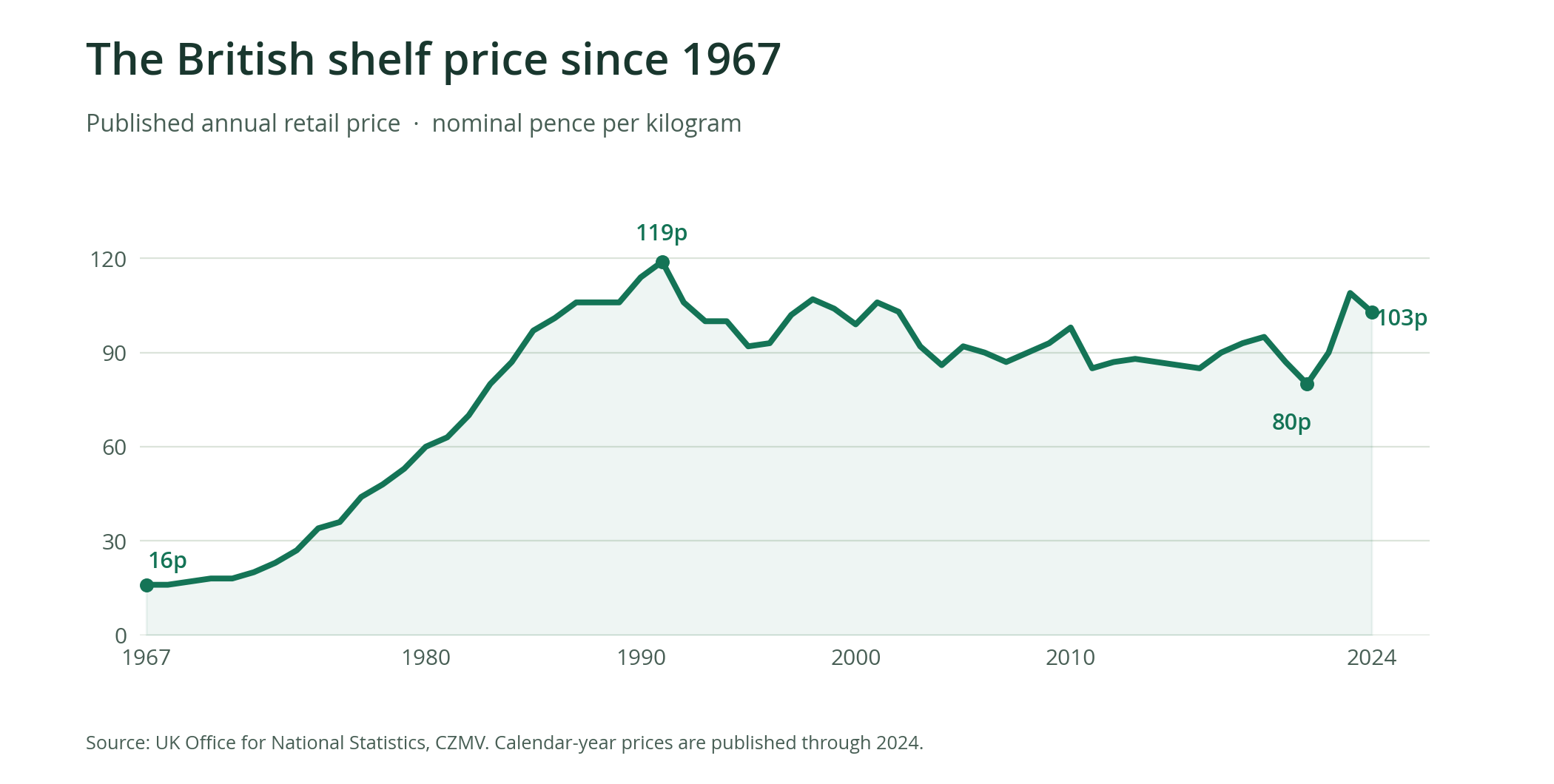
The British record from the Office for National Statistics runs from 16 pence per kilogram in 1967 to a nominal peak of 119 pence in 199117. In 2024 the average was 103 pence, 13.4% below that peak in money of the day, after 80 pence in 2021 and 109 pence in 2023.
United States, 1980–2026: a higher tag, a lower real price
The Bureau of Labor Statistics has priced a pound of bananas in US cities every month since 198018. The average rose from $0.342 in 1980 to $0.620 in 2024, by 81.4%. Over the same years general consumer prices rose faster: in 2024 dollars the 1980 pound cost $1.301, so the real price fell by 52.3%19.
| Year | Nominal | In 2024 dollars | CPI-U |
|---|---|---|---|
| 1980 | 0.342 | 1.301 | 82.4 |
| 1990 | 0.463 | 1.112 | 130.7 |
| 2000 | 0.501 | 0.913 | 172.2 |
| 2010 | 0.580 | 0.834 | 218.056 |
| 2020 | 0.578 | 0.700 | 258.811 |
| 2024 | 0.620 | 0.620 | 313.689 |
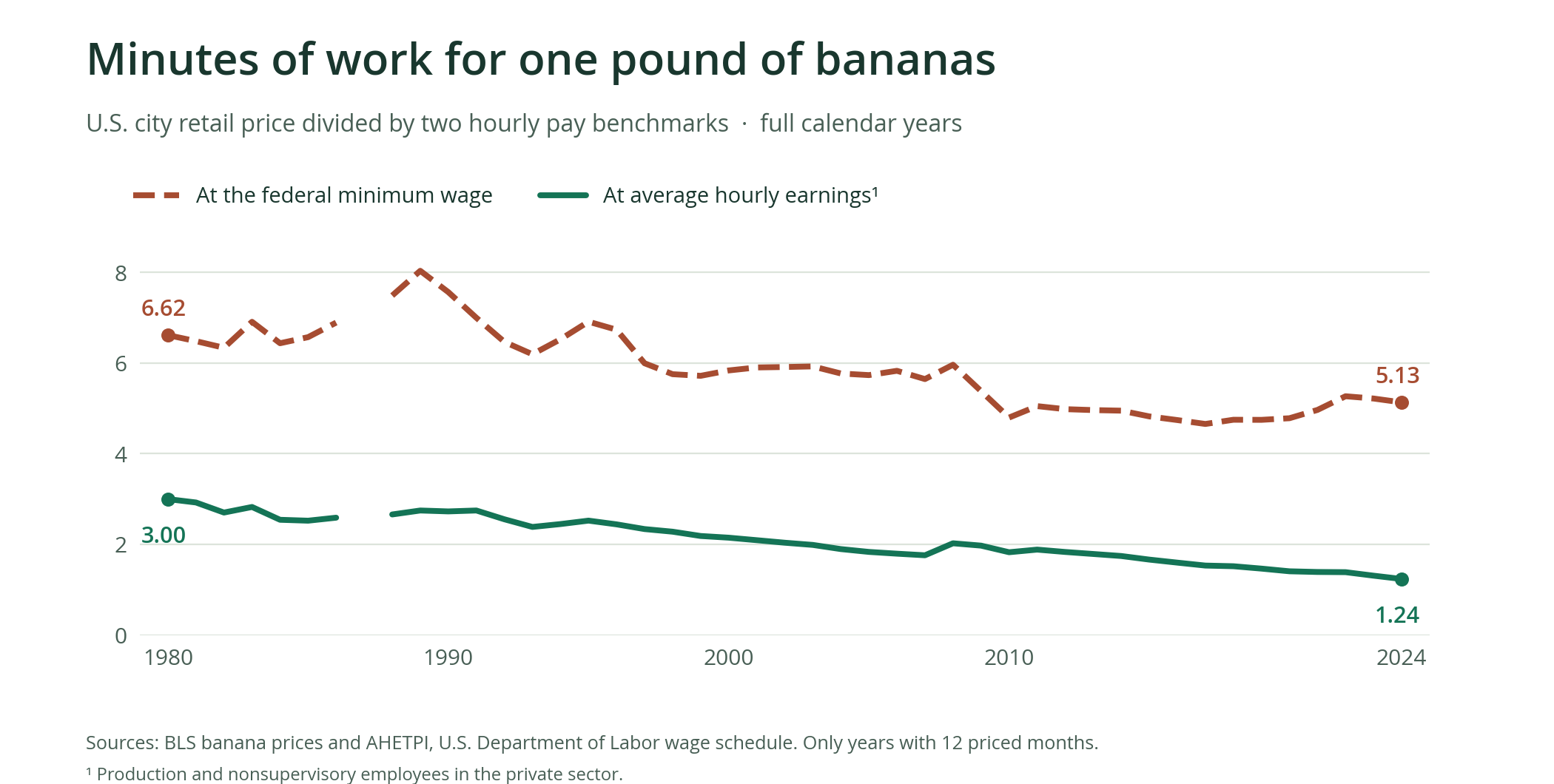
Wages give a more intuitive measure. At the average hourly earnings of private-sector production and non-supervisory workers, a pound cost 3.00 minutes of gross pay in 1980 and 1.24 minutes in 2024, 58.8% less20. At the federal minimum wage the improvement was much smaller, from 6.62 to 5.13 minutes (−22.4%), because the minimum has stayed at $7.25 since 200921. In October 2026 a pound cost 65.5 cents: 1.20 minutes at average earnings of $32.75 an hour and 5.42 minutes at the federal minimum. State minimum wages and individual pay vary.
| Measure | 1980 | 2024 | Change |
|---|---|---|---|
| Current dollars per lb | 0.342 | 0.620 | +81.4% |
| 2024 dollars per lb | 1.301 | 0.620 | −52.3% |
| Minutes of work at the federal minimum | 6.62 | 5.13 | −22.4% |
| Minutes of work at average earnings | 3.00 | 1.24 | −58.8% |
In 2026 the shelf price has barely moved. Across January–September it averaged 65.2 cents a pound, against 64.5 cents in the same months of 2025, a rise of 1.1%. An October-to-October comparison is impossible: the federal government shutdown of autumn 2025 interrupted collection and there is no published price for October 202522.
Poland, the UK and the US since 2015
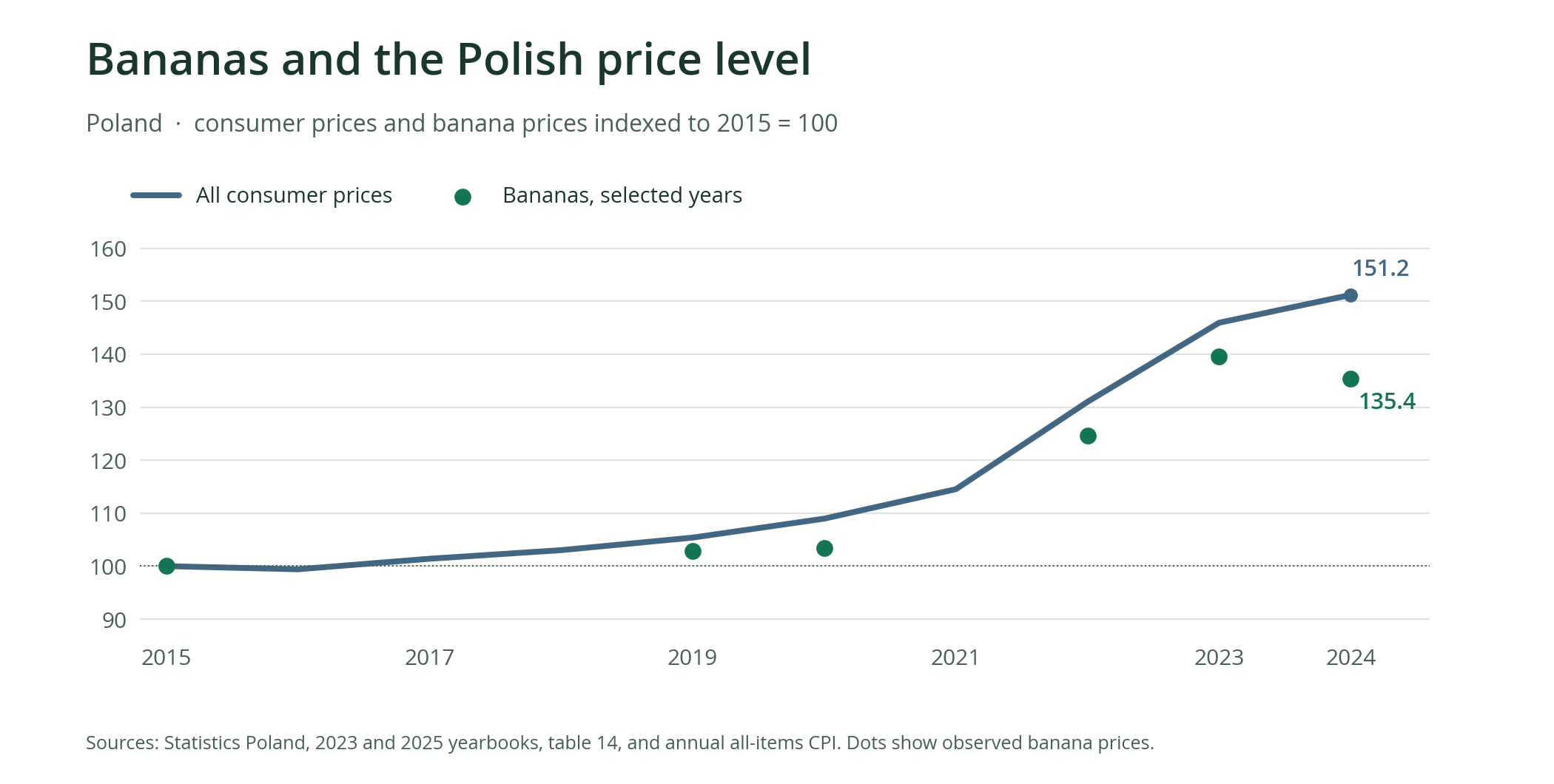
Bananas have risen fastest in Poland. Setting each country’s 2015 price to 100, Poland reached 135.4 in 2024, the UK 119.8 and the United States 106.4. In local money a kilogram cost PLN 4.91 in Poland in 2015 and PLN 6.65 in 20242324. The index compares changes only: it cannot rank countries by price or by affordability.
| Market and unit | 2015 | 2024 | Change |
|---|---|---|---|
| Poland, PLN/kg | 4.91 | 6.65 | +35.4% |
| UK, pence/kg | 86 | 103 | +19.8% |
| US, USD/lb | 0.583 | 0.620 | +6.4% |
Yet even in Poland the banana got cheaper in real terms. Had it kept pace with general Polish consumer prices, a kilogram bought for PLN 4.91 in 2015 would have cost PLN 7.42 in 2024; the reported price was PLN 6.6525. Between 2023 and 2024 the price fell from PLN 6.85 to 6.65 (−2.9%) while consumer prices rose 3.6%.
World trade prices: the US–EU gap and Ecuador’s box
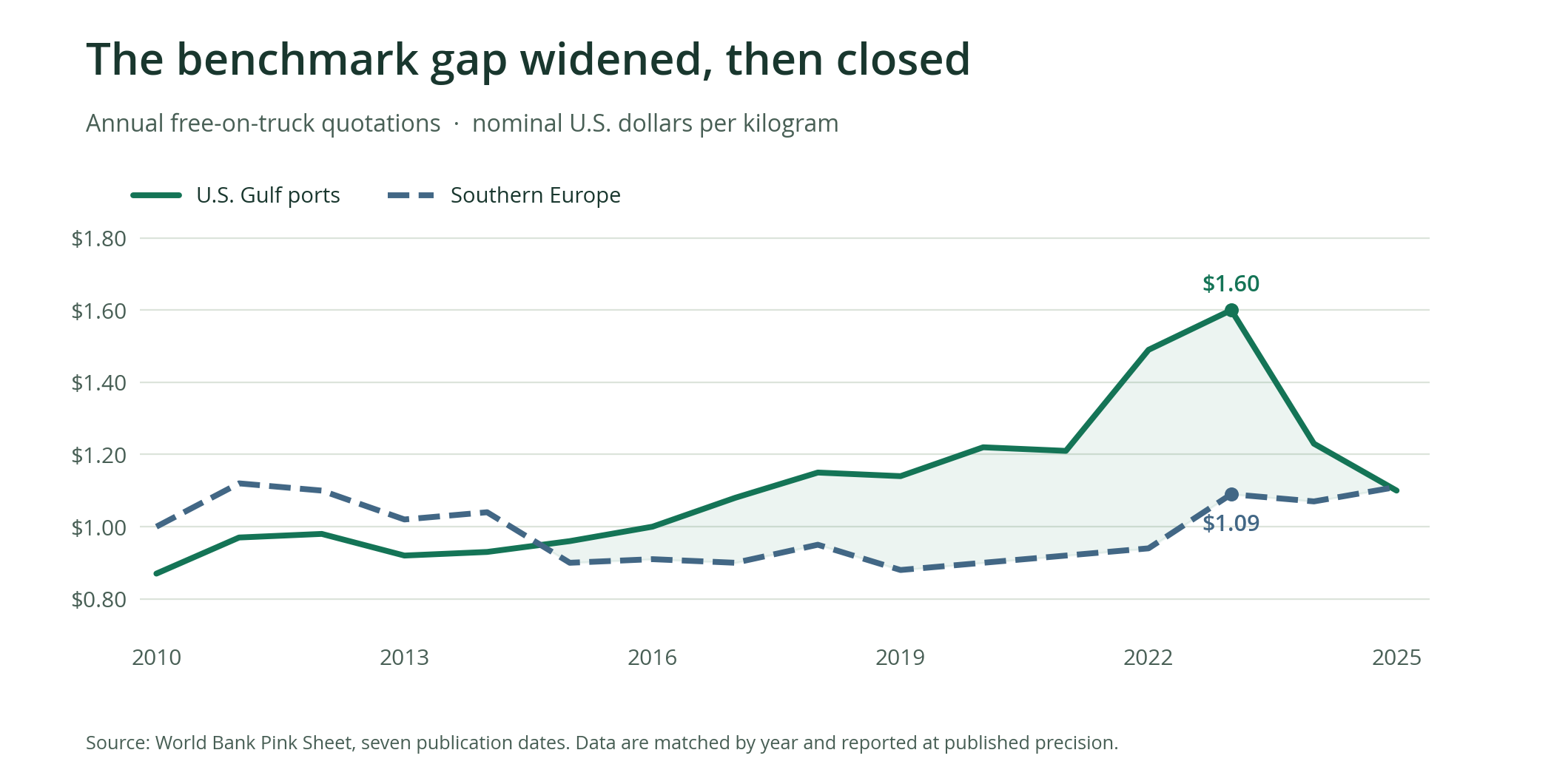
The World Bank publishes two import benchmarks for Central and South American bananas of major brands: a US price, free on truck at Gulf ports, and a European one, free on truck in Southern Europe and including duties26. In 2010 the US quote was 13 cents per kilogram below the European one. It overtook it in 2015, and the gap peaked at $0.55 per kilogram in 2022. The US quote reached $1.60 in 2023, then fell 31% to $1.10 by 2025, when the two prices met again. In October 2026 the US benchmark stood at $1.18 and the European at $1.10 per kilogram.
| Year | US (Gulf ports) | EU (Southern Europe) | US minus EU |
|---|---|---|---|
| 2010 | 0.87 | 1.00 | −0.13 |
| 2015 | 0.96 | 0.90 | +0.06 |
| 2018 | 1.15 | 0.95 | +0.20 |
| 2022 | 1.49 | 0.94 | +0.55 |
| 2023 | 1.60 | 1.09 | +0.51 |
| 2025 | 1.10 | 1.11 | −0.01 |
| Oct 2026 | 1.18 | 1.10 | +0.08 |
Annual figures from successive editions of the World Bank Pink Sheet (2013–2026); October 2026 from the November 2026 edition.
The import price is not the shelf price. In 2024 the US benchmark fell 23.1% while the US retail average fell 1.6%. For 2024 the OECD and FAO reported storm-related supply losses in Ecuador and Guatemala and better growing conditions in Colombia27; annual data cannot isolate the effect on shelf prices, but weather hits some origins far harder than others, as our cases on Cyclone Larry and Cyclone Yasi in Australia show.
At the start of the chain, Ecuador sets official prices for the standard 43-pound (19.5 kg) export box of 22XU bananas2829. For 2026 the minimum support price paid to growers is $7.50 per box, up 25 cents from 2025, and the reference free-on-board export price is $9.75, after an unchanged $2.25 allowance for exporters’ expenses. Per kilogram that is about $0.385 for the grower and $0.500 on board ship. Actual contract prices can differ from the schedule.
| Component | 2025, $/box | 2026, $/box | 2026, $/kg |
|---|---|---|---|
| Minimum support price | 7.25 | 7.50 | 0.385 |
| Exporter expenses | 2.25 | 2.25 | 0.115 |
| Reference FOB price | 9.50 | 9.75 | 0.500 |
Poland: half a million tonnes a year
Poland imported 491,960 tonnes of fresh bananas in 2025 for €353.53 million, according to Eurostat trade data30. The bill was almost exactly the same as in 2024 (€21,061 more on €353.5 million), but the tonnage fell 3.8% and the average value per kilogram rose 4.0%, to €0.719. Imports have grown by half in ten years, from 321,301 tonnes in 2015; the record year was 2020, with 562,773 tonnes at the lowest unit value of the decade, €0.527 per kilogram.
| Year | Value, € million | Net mass, 1,000 t | €/kg | PLN/kg at the border | Retail PLN/kg |
|---|---|---|---|---|---|
| 2015 | 206.47 | 321.3 | 0.643 | 2.69 | 4.91 |
| 2020 | 296.62 | 562.8 | 0.527 | 2.34 | 5.08 |
| 2022 | 311.92 | 448.8 | 0.695 | 3.26 | 6.12 |
| 2023 | 349.40 | 494.2 | 0.707 | 3.21 | 6.85 |
| 2024 | 353.51 | 511.6 | 0.691 | 2.98 | 6.65 |
| 2025 | 353.53 | 492.0 | 0.719 | 3.05 | not yet published |
Fresh bananas excluding plantains and dried bananas (CN 08039010 to 2023; 08039011 and 08039019 from 2024). Border value converted at the ECB annual average PLN/EUR rate.
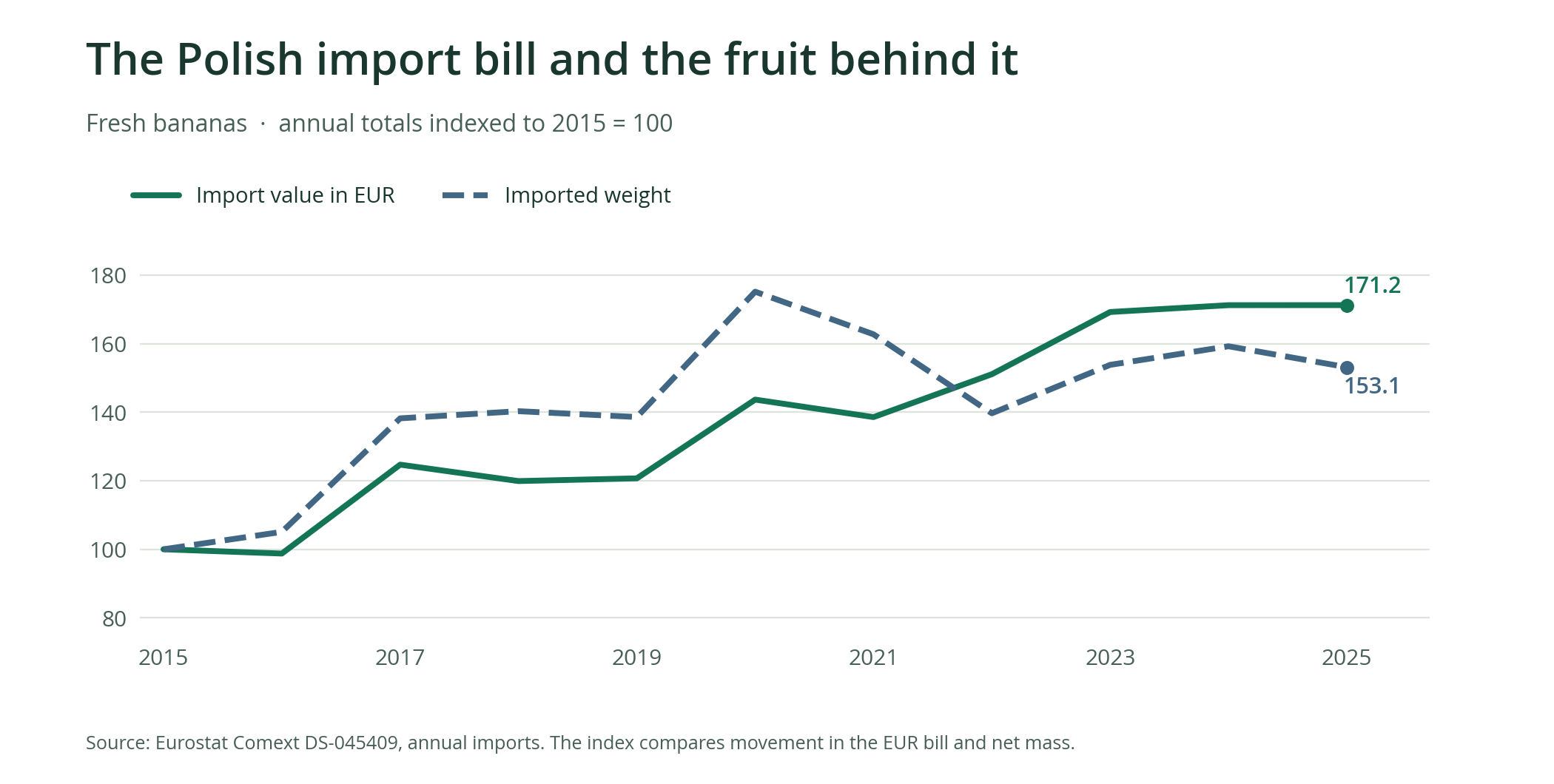
In 2024 a kilogram crossed the border at an average PLN 2.98 and sold in shops at PLN 6.65. The difference, PLN 3.67, covers ripening, inland transport, losses, taxes and trading margins, but the customs and shop surveys measure different lots on different dates, so the data cannot split it between them.
Where the bananas come from. Ecuador was the largest reported partner in 2025, with 28.5% of the weight (140,352 tonnes at €0.667 per kilogram), followed by the Netherlands (17.4%), Germany (13.9%), Belgium (12.3%) and Guatemala (12.2%). For the three EU countries the statistic records the country of dispatch, not of origin: most of that fruit was grown in Latin America and re-shipped through Rotterdam, Hamburg or Antwerp31.
| Reported partner | Tonnes | Share of volume | €/kg |
|---|---|---|---|
| Ecuador | 140,352 | 28.5% | 0.667 |
| Netherlands | 85,820 | 17.4% | 0.775 |
| Germany | 68,333 | 13.9% | 0.765 |
| Belgium | 60,590 | 12.3% | 0.839 |
| Guatemala | 59,896 | 12.2% | 0.611 |
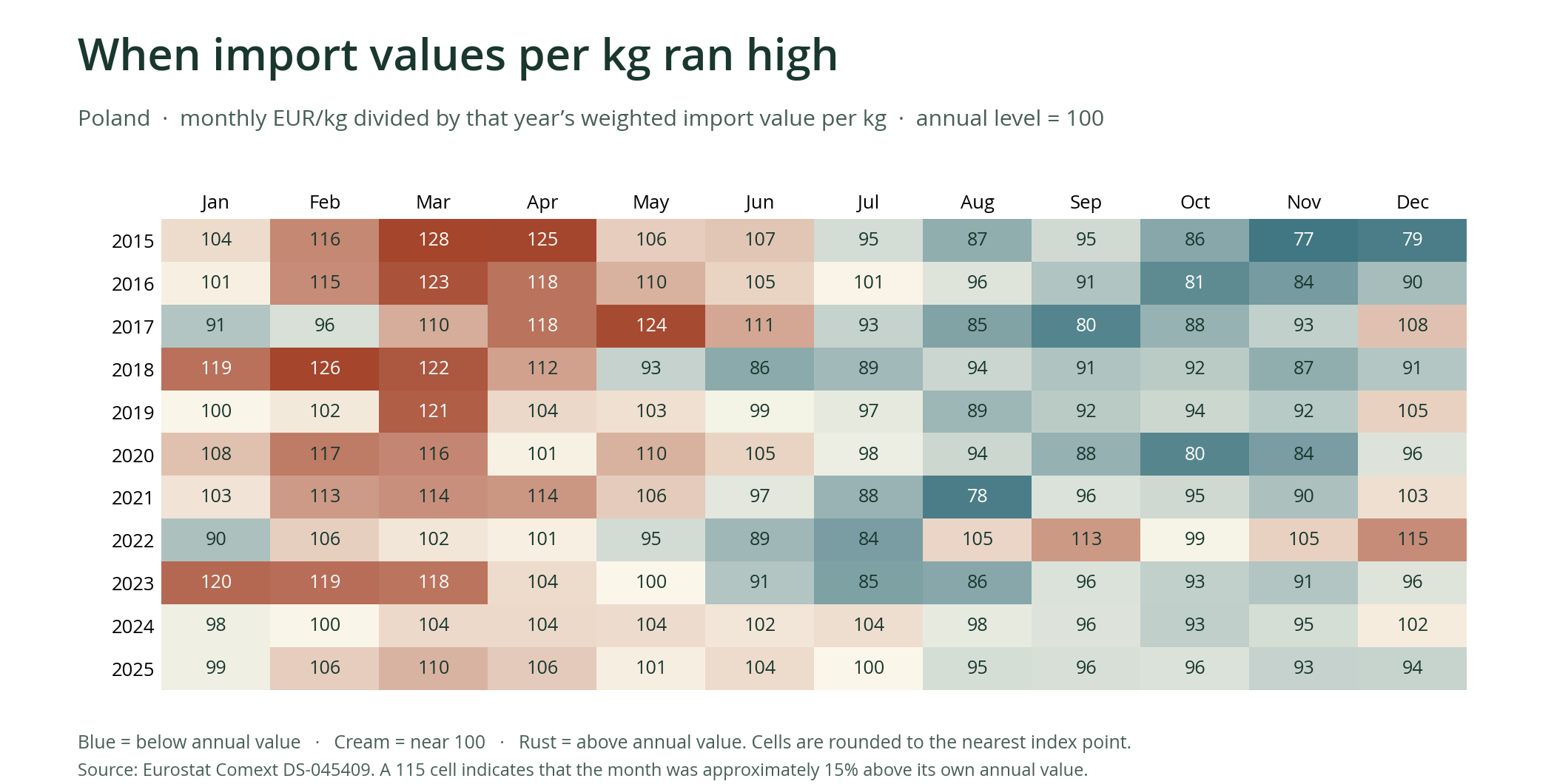
The seasonal pattern. In every one of the eleven years from 2015 to 2025, the import value per kilogram in March ran above that year’s average, by a median 15.6%; every October ran below it, and November had the lowest median, 91.1 (annual average = 100). Whether this reflects the season, the mix of suppliers or contract timing, the trade data cannot say.
| Month | Median index | Middle half of years | Years above 100 |
|---|---|---|---|
| January | 101.1 | 98.5–105.8 | 7 of 11 |
| March | 115.6 | 110.0–121.9 | 11 of 11 |
| June | 102.5 | 94.2–105.0 | 6 of 11 |
| October | 92.9 | 86.8–94.4 | 0 of 11 |
| November | 91.1 | 85.6–93.3 | 1 of 11 |
Wholesale markets. The agriculture ministry’s 2024 bulletins contain 295 priced market-day quotations for bananas from ten locations32. In the 44 weeks when four of them reported together, the median midpoint of the quoted range was PLN 4.99 per kilogram at Bronisze near Warsaw, 5.14 in Łódź, 5.28 in Kalisz and 5.61 in Poznań. Husfarm publishes the current quotations from several of these markets; see the Łódź market Zjazdowa, WGRO in Poznań and all banana prices today.
| Market | Quote of 17–18 December | 44-week median midpoint |
|---|---|---|
| Bronisze (Warsaw) | 4.25–5.50 | 4.99 |
| Kalisz | 5.00–5.56 | 5.28 |
| Łódź | 4.72–5.28 | 5.14 |
| Poznań | 4.56–6.67 | 5.61 |
Latest banana prices on Husfarm
Updated automatically from the markets Husfarm monitors, in each market’s own unit. Each price links to its history and source.
| Price series | Market | Latest | Change | Date |
|---|---|---|---|---|
| Bananas, Central and South America, US import price | World Bank benchmark prices, United States | 1.18 USD/kg | +5.4% | 31 Oct 2026 |
| Bananas, Central and South America, importers’ price to Europe | World Bank benchmark prices, France | 1.10 USD/kg | −1.8% | 31 Oct 2026 |
| Bananas | Łódź Wholesale Market ZjazdowaPoland | 60.0–110 PLN/18 kg package | ± 0.0% | 3 Nov 2026 |
| Bananas, Imported, origin country unspecified | Wielkopolska Agricultural Exchange (WGRO), PoznańPoland | 98.0–130 PLN/18 kg | +3.6% | 20 Nov 2026 |
| Bananas | Elizówka Lublin Wholesale MarketPoland | 6.20–6.50 PLN/kg | +1.6% | 17 Nov 2026 |
| Bananas | Targpiast, WrocławPoland | 4.00–6.50 PLN/kg | ± 0.0% | 18 Nov 2026 |
| Bananas, Imported, imported | Renk Pomeranian Wholesale Centre, GdańskPoland | 5.50 PLN/kg | −4.3% | 19 Nov 2026 |
| Bananas, imported | Agrohurt Rzeszów Wholesale MarketPoland | 100–110 PLN/carton (18 kg) | ± 0.0% | 3 Nov 2026 |
Banana prices today Banana production by country Prices in Poland
How to read banana prices
- Units change through history: a fruit, a dozen, a bunch, a pound, a kilogram, an 18 kg carton, a 43-pound export box. Bunch weights are rarely recorded, so early prices cannot be converted to a price per kilogram.
- Each stage of the chain has its own price: the grower’s minimum price, the free-on-board export price, the import price (in Europe including duties), the wholesale quote and the shelf price.
- A nominal price is in money of the time. A real price removes general inflation (US CPI-U, Polish CPI). Minutes of work divide the shelf price by a named hourly wage.
- An index with each country’s 2015 price = 100 compares changes, not price levels.
- Partner countries in EU trade statistics are countries of dispatch for intra-EU shipments, not countries where the fruit was grown.
More on how prices respond to shocks in our price shocks collection; the biggest banana bunch on record is among the agricultural records.
Questions and answers
Are bananas more expensive than they used to be?
In money of the day, yes: the US average rose from $0.342 a pound in 1980 to $0.620 in 2024, and in Poland from PLN 4.91 a kilogram in 2015 to PLN 6.65 in 2024. In real terms they became cheaper: after US inflation the 1980 price equals $1.301 in 2024 dollars, so the real price fell 52.3%, and the Polish price in 2024 was below the PLN 7.42 it would have reached had it followed general inflation.
How many minutes of work does a pound of bananas cost in the US?
In October 2026 a pound cost 65.5 cents: 1.20 minutes of gross pay at average hourly earnings of private-sector production and non-supervisory workers ($32.75), or 5.42 minutes at the federal minimum wage of $7.25. In 1980 it took 3.00 and 6.62 minutes.
How many bananas does Poland import and from where?
In 2025 Poland imported 491,960 tonnes of fresh bananas worth €353.53 million, an average of €0.719 per kilogram. Ecuador was the largest reported partner with 28.5% of the volume, followed by the Netherlands, Germany, Belgium and Guatemala; the EU partners are dispatch countries for fruit grown mostly in Latin America.
When are bananas cheapest to import into Poland?
In the autumn. From 2015 to 2025 the import value per kilogram in October was below its annual average every year, and November had the lowest median, 91.1% of the annual average. March was above the average in all eleven years, by a median 15.6%.
What is the difference between the US and EU banana benchmarks?
Both are World Bank import prices for major-brand Central and South American bananas. The US price is free on truck at Gulf ports; the EU price is free on truck in Southern Europe and includes import duties. In 2022 the US price was $0.55 per kilogram higher; by 2025 they were almost equal, and in October 2026 the US quote was $1.18 and the EU quote $1.10 per kilogram.
How much does an Ecuadorian banana grower receive?
Ecuador’s official minimum support price for 2026 is $7.50 for a 43-pound (19.5 kg) export box, about $0.385 per kilogram. The reference free-on-board export price is $9.75 per box, about $0.500 per kilogram. Actual contract prices can differ.
What did a banana cost in the nineteenth century?
A New York banana cost 4 cents in 1846; in 1890 a US household guide gave 12–25 cents a dozen in season. Jamaican growers received one shilling a bunch around 1871 and two shillings by 1875. Bunch weights were not recorded, so these prices cannot be converted to a price per kilogram.
Sources
Links to other websites open in a new tab.
- T. P. Denham et al. (2003). Origins of Agriculture at Kuk Swamp in the Highlands of New Guinea. Science 301, 189–193
- I. Grimaldi, T. van Andel and T. Denham (2022). Looking beyond history: tracing banana dispersal to Africa. American Journal of Botany 109
- Abu’l Fazl (1590s). The Ain-i-Akbari, vol. I (table of sweet fruits of Hindustan).
- NCERT. Peasants, Zamindars and the State (dating of the Ain-i-Akbari).
- Michał Boym (1656). Flora Sinensis (banana illustration, National Library of Poland copy).
- Joseph Banks (1770). The Endeavour journal: Batavia.
- H. T. De la Beche (1825). Notes on the Present Condition of the Negroes in Jamaica. Appendix A, p. 53
- JN Foundation, Parish History Project. A History of Portland.
- The Falmouth Post (1874). Report of 22 May 1874 (Lucea). Transcription
- Colonial and Indian Exhibition (1886). Handbook and Catalogue: the West Indies and British Honduras.
- Anne Yentsch (2013). Applying Concepts from Historical Archaeology to New England’s Nineteenth-Century Cookbooks. Northeast Historical Archaeology 42
- Hester M. Poole (1890). Fruits and How to Use Them. p. 51
- USDA Bureau of Agricultural Economics (1930). Foreign Trade of the United States, Annual, 1790–1929: Fruit (F.S. 48). Table 5
- NBER Macrohistory Database, via FRED. Retail price of bananas, New York (m04037).
- US Bureau of Labor Statistics (1922). Retail Prices, 1890 to 1921 (Bulletin 300). Table B
- World Bank (1982). Bananas Handbook. Table V-4
- Office for National Statistics (2025). Bananas, per kg (series CZMV).
- US Bureau of Labor Statistics, via FRED (2026). Average price: bananas, per lb, US city average (APU0000711211).
- US Bureau of Labor Statistics (2025). Historical CPI-U, December 2024.
- US Bureau of Labor Statistics, via FRED (2026). Average hourly earnings of production and non-supervisory employees, total private (AHETPI).
- US Department of Labor (2026). History of federal minimum wage rates.
- US Bureau of Labor Statistics (2025). 2025 federal government shutdown: impact on the CPI (FAQ).
- Statistics Poland (2023). Statistical Yearbook of the Republic of Poland 2023. Table 14 (370)
- Statistics Poland (2025). Statistical Yearbook of the Republic of Poland 2025. Table 14 (334)
- Statistics Poland (2026). Annual consumer price indices.
- World Bank (2026). Commodity Price Data (The Pink Sheet), 3 November 2026. Earlier annual values from editions of 2013–2025
- OECD and FAO (2025). OECD-FAO Agricultural Outlook 2025–2034. Other products: bananas
- Ecuador, Registro Oficial (2024). Supplement 682: banana minimum support and reference prices for 2025. In Spanish
- Ecuador, Ministry of Agriculture (2025). Ministerial Agreement 107: banana prices for 2026. In Spanish
- Eurostat (2026). Comext DS-045409: Polish imports of fresh bananas, 2015–2025. Annual data, 2015–2025
- Eurostat (2026). User manual on international trade in goods statistics. Partner country definitions
- Polish Ministry of Agriculture and Rural Development (2024). Fresh fruit and vegetable market: wholesale quotations, 2024 bulletins. In Polish
About this price history
The Husfarm editorial team prepared this price history from the 32 sources listed above, from Mughal and Jamaican records to the latest official statistics. Calculations (real prices, minutes of work, unit values, seasonal indices, wholesale medians) are our own and use the published observations. The October 2026 benchmark prices come from the World Bank’s November 2026 release.
Charts: Husfarm, from the sources listed. Cover: AI-generated illustration.
Prices are nominal, in the currency and unit of each source, unless a base year or a wage measure is stated. Figures checked on 23 November 2026. To report an error, write to us through the contact page.
Cite as: Husfarm editorial team (2026). The price of bananas: from Mughal plantains to October 2026. Husfarm, 23 November 2026. https://husfarm.com/price-histories/bananas/