

Key dates
- 1868Icerya purchasi is recorded in California.106
- 1888–1889Koebele travels to Australia; beetle shipments reach California.31
- 1889Rapid suppression of cottony cushion scale where introductions succeed.21
- 1973Quezada and DeBach publish research comparing the beetle and fly under different environmental conditions.6
- 2003Grafton-Cardwell and Gu document the effects of selected insecticides on vedalia.7
Why cottony cushion scale threatened citrus orchards
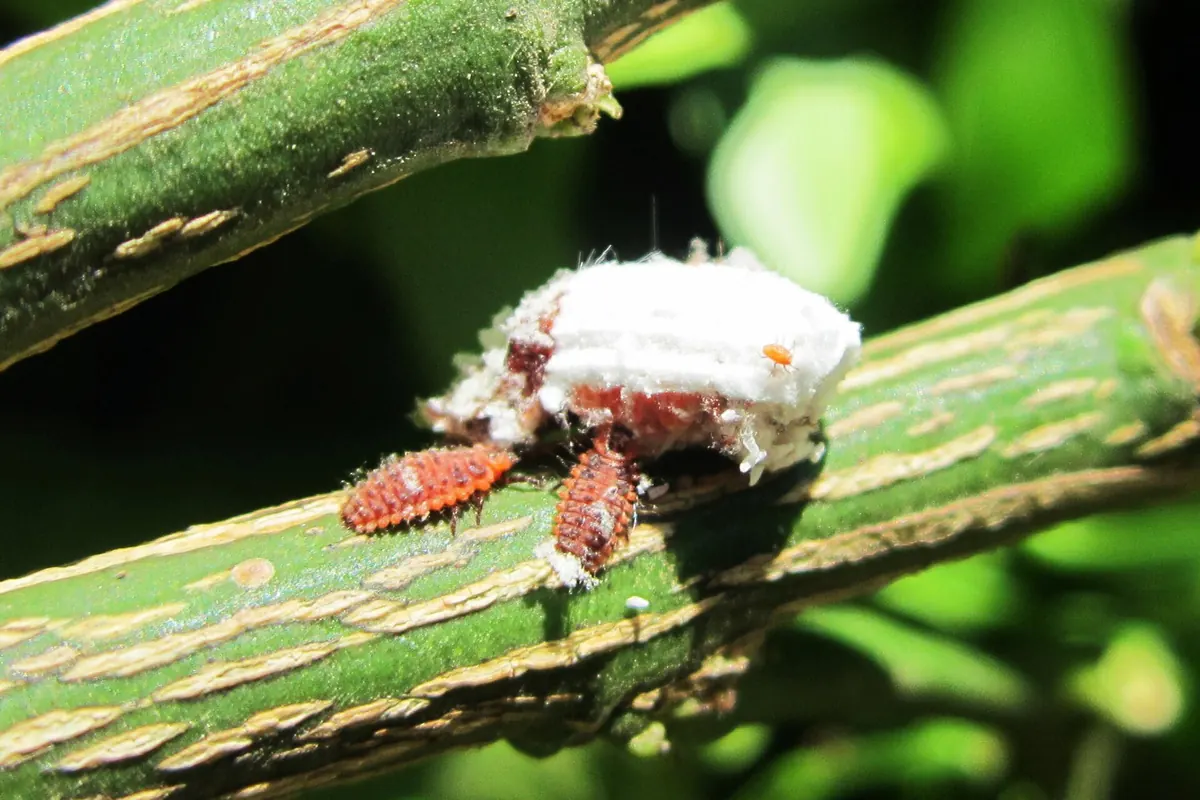
Icerya purchasi was recorded in California in 1868. This Australian insect feeds by taking sap from plants. Its conspicuous white, elongated egg sacs make heavily infested branches easy to recognise. By the 1880s, damage to citrus orchards was causing serious concern. Weakened trees threatened more than the current harvest: they put at risk the value of perennial plantings in which growers had already invested land, labour and time.
The insects also produced honeydew on which sooty moulds could grow, coating surfaces with a dark layer. Historical analysis benefits from distinguishing the presence of a pest, damage to a plant and economic loss. Finding an individual insect did not always imply the same level of harm, but heavy infestations could undermine an orchard's viability. Tree crops also differ from annual crops: abandoning established plantings sacrifices some of the resources invested in earlier years.104
The Australian expedition and the organisation behind it
Charles Valentine Riley, who led federal entomological work, supported the search for the scale insect's natural enemies in Australia. Albert Koebele was sent there in 1888. Collecting insects, moving them across an ocean and keeping them alive required cooperation among many people. Beetle shipments reached California from late 1888 into early 1889. This explains why historical accounts describe an operation extending across two years rather than a discovery confined to one memorable day.
In Los Angeles the insects came under the care of Daniel William Coquillett. They were reared on scale-infested trees and subsequently distributed to orchards. Linking investigation with local organisation was essential: finding a promising predator overseas could not by itself protect scattered farms. The operation needed people capable of translating an observation of natural history into practical work among growers. Commemorating Riley and Koebele should therefore also recognise field collaborators and orchardists.314
How vedalia worked: predator and prey
Older literature names the ladybird Rodolia cardinalis, while contemporary University of California materials use Novius cardinalis. Here, the two names refer to the same species. Both larvae and adult beetles eat scale insects. Females lay eggs near the scales' egg sacs, placing food close to the newly hatched larvae. Under favourable conditions, successive predator generations can respond to an abundant supply of prey. The relationship operates through feeding and reproduction, not simply through the presence of an unfamiliar insect in an orchard.
This is not an interchangeable ladybird that eats any available crop pest. Vedalia has a relatively narrow prey range associated with particular groups of scale insects; it should not be described as feeding exclusively on one species. Biological matching was central to the result. Rather than viewing an orchard as trees plus pests, it becomes possible to see several interacting populations. Success depends not only on a predator being present but also on its ability to feed, reproduce and persist under local conditions.514
The rapid success of 1889 and how to measure it
By 1889, substantial reductions in cottony cushion scale were being observed where introductions had succeeded. The speed of improvement contributed to the operation's fame: growers could see a connection between the expanding predator population and declining numbers of its prey. Accounts describe renewed confidence in retaining orchards previously threatened with destruction. The case provided a compelling demonstration that knowledge of relationships between insects could have direct economic value. Its visibility helped the result travel beyond the original sites.
Success did not mean removing Icerya purchasi from California. In biological control, a desirable outcome may be to keep a pest population below levels that cause serious losses. Small remaining populations of prey can also allow their natural enemies to persist. Bringing an outbreak under control and eradicating a species are therefore different achievements. This case shows why agricultural effectiveness should be judged through crop condition and the persistence of reduced damage, rather than solely by asking whether a single pest can still be found.216
More than one ally: a fly and the influence of climate
The fly Cryptochaetum iceryae, another Australian natural enemy of Icerya purchasi, is often overshadowed by the beetle's fame. It is a parasitoid: its development takes place at the expense of a host and ultimately kills it. A predator and a parasitoid do not operate in identical ways, although both can suppress the same species. Research published by Quezada and DeBach in 1973 compared their importance under different conditions in southern California, including coastal and drier environments.
Their findings and later accounts show that the contributions of the two natural enemies varied geographically. Vedalia was especially important in warmer inland areas, whereas the fly played an important role along the coast. A regional success should not become a story about one species working in exactly the same way everywhere. Comparing places allows more precise questions: what is limiting the pest, in which season, and under which environmental conditions? This approach connects the historical account with investigation of the actual mechanisms maintaining control, including interactions that the original celebratory story could obscure.65
Why control could be disrupted
Establishing a beneficial insect did not remove the influence of later decisions in the orchard. Research by Grafton-Cardwell and Gu published in 2003 showed that some insecticides used in citrus could reduce vedalia survival, reproduction or the development of immature stages. Exposure through food also mattered. The findings illustrate why evaluating a treatment solely through its effect on one harmful species can overlook consequences for the wider system of relationships that protects the crop.
Weather also affects the beetle's activity and development. When a natural enemy is weakened, an earlier degree of scale suppression may no longer persist. Historical success consequently did not turn orchards into systems that required no further observation. The relationships between measures directed at different pests, weather and beneficial organisms remained important. This is one reason the method's development involved successive investigations rather than ending with the enthusiastic reports of 1889.759
From historical introduction to assessment of risk
Moving an organism between continents changes an environment beyond the boundaries of an individual orchard. Modern research therefore asks about prey range, establishment and effects on organisms that are not the intended targets. ISPM 3, developed under the International Plant Protection Convention, sets out institutional responsibilities and the importance of risk assessment, documentation and monitoring. In the history of biological control, this represents an important stage in organising activities that had earlier taken place under different conditions of knowledge and oversight.
California's successful example does not establish that every predator moved into a new country will be beneficial. Even a familiar organism must be considered in relation to the particular receiving environment and its native species. Asking whether it suppresses a pest cannot replace asking what it will do to the rest of the ecosystem. Vedalia's story is therefore an account of a research-based approach, not a recipe for independently importing insects. Its historical value increases when effectiveness and responsibility are examined together, including the distinction between evidence from one location and assumptions about another.8410
Three approaches and the significance of this case
Classical biological control introduces a suitably assessed natural enemy with the intention that it will establish and suppress a pest over the long term. Increasing the numbers of beneficial organisms and conserving those already present in a landscape are other, related approaches. They differ in organisation, timescale and the evaluation of results. Distinguishing them helps avoid treating every use of a living organism as a repetition of the late nineteenth-century California operation. The shared principle does not erase the practical differences.
Vedalia's history marks a turning point because of its visible results and influence on subsequent research, not because people had previously been unaware of natural enemies. It demonstrated the economic potential of identifying relationships between species accurately. Its enduring legacy can be expressed through three questions: why did pest numbers increase, what can limit them, and how can control remain effective without creating new problems? Understood this way, biological control links agricultural history with ecology, the organisation of research and responsibility for landscapes shaped by production.9103
Questions and answers
Are Rodolia cardinalis and Novius cardinalis different species?
In this case the names refer to the same vedalia ladybird. Older publications commonly use Rodolia, while the contemporary UC IPM page lists Novius (=Rodolia) cardinalis.5
Was cottony cushion scale completely eradicated in 1889?
No. Rapid reductions in pest numbers and damage followed successful introductions. Later studies examined the maintenance of scale populations at low levels, not their complete absence from California.26
Does the success justify introducing beneficial insects anywhere?
No. Assessment must consider the receiving environment, non-target species and oversight by the relevant institutions. Effectiveness against one pest is not a complete evaluation of the consequences of introducing an organism.8
Sources
- Curtis P. Clausen; U.S. Department of Agriculture (1956). Biological Control of Insect Pests in the Continental United States. Technical Bulletin 1139
- Cornell University, Biological Control (b.d. / n.d.). Rodolia cardinalis: Vedalia Beetle
- USDA National Agricultural Library (b.d. / n.d.). Charles Valentine Riley Collection
- Mark Hoddle; University of California, Riverside (b.d. / n.d.). Cottony cushion scale: Biological Control of Icerya purchasi with Rodolia cardinalis in the Galapagos; includes California history
- University of California Statewide Integrated Pest Management Program (b.d. / n.d.). Vedalia: Novius (=Rodolia) cardinalis
- José R. Quezada, Paul DeBach (1973). Bioecological and Population Studies of the Cottony-Cushion Scale, Icerya purchasi Mask., and its Natural Enemies, Rodolia cardinalis Mul. and Cryptochaetum iceryae Will., in Southern California. Hilgardia 41(20):631–688
- Elizabeth E. Grafton-Cardwell, Ping Gu (2003). Conserving Vedalia Beetle, Rodolia cardinalis (Mulsant) (Coleoptera: Coccinellidae), in Citrus: A Continuing Challenge as New Insecticides Gain Registration
- Secretariat of the International Plant Protection Convention, FAO (2005; wydanie / edition 2017). ISPM 3: Guidelines for the export, shipment, import and release of biological control agents and other beneficial organisms
- University of California Statewide Integrated Pest Management Program (b.d. / n.d.). Biological Control and Natural Enemies of Invertebrates
- Matthew J. W. Cock, Joop C. van Lenteren, Jacques Brodeur, Barbara I. P. Barratt, Franz Bigler, Karel Bolckmans, Fernando L. Cônsoli, Fabian Haas, Peter G. Mason, José Roberto P. Parra (2009). The Use and Exchange of Biological Control Agents for Food and Agriculture. Background Study Paper No. 47
Approximate dates (c.) describe the nature of the evidence: archaeology dates settlements, layers and remains, not single moments of invention.