

An avocado price is a bean, a dozen or a pound
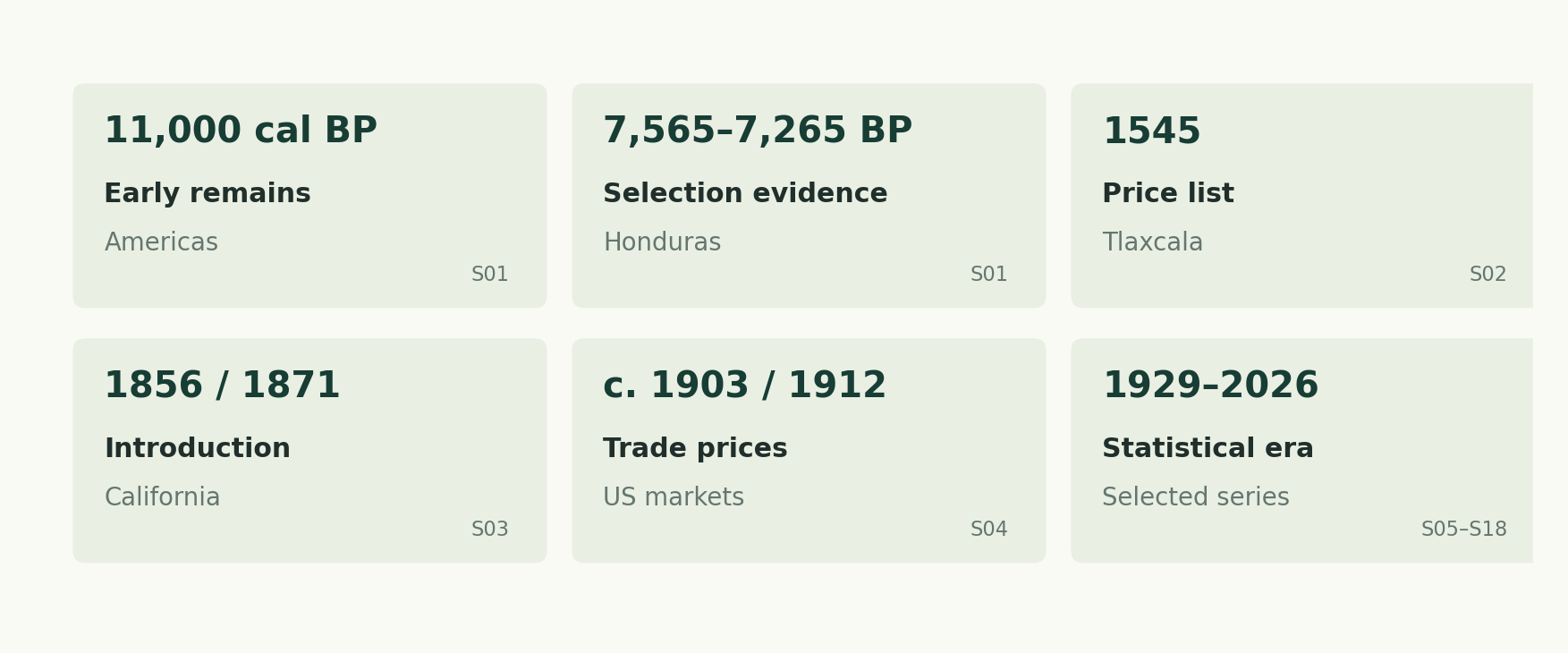
People have been selecting avocados for about 11,000 years, as finds from a rockshelter in Honduras show1, but prices appear only after the Spanish conquest, and the next figures come from California more than three centuries later. After that the record is rich: prices per dozen and per crate, farm prices per ton since 1929, California industry data, a producer price index, customs values and, today, the average selling price of a single fruit in American shops. These are different measures and this history keeps them apart.
Tlaxcala, 1545: priced in cacao beans
A price list from Tlaxcala dated 1545, from the early colonial period, values a ripe avocado at one cacao bean. On the same list a large tomato also cost one bean, a turkey egg three beans and a good turkey hen 100 beans2. Cacao beans served as small change, so the list gives relative prices, not a sum that can be converted into modern money.
California’s first avocado market
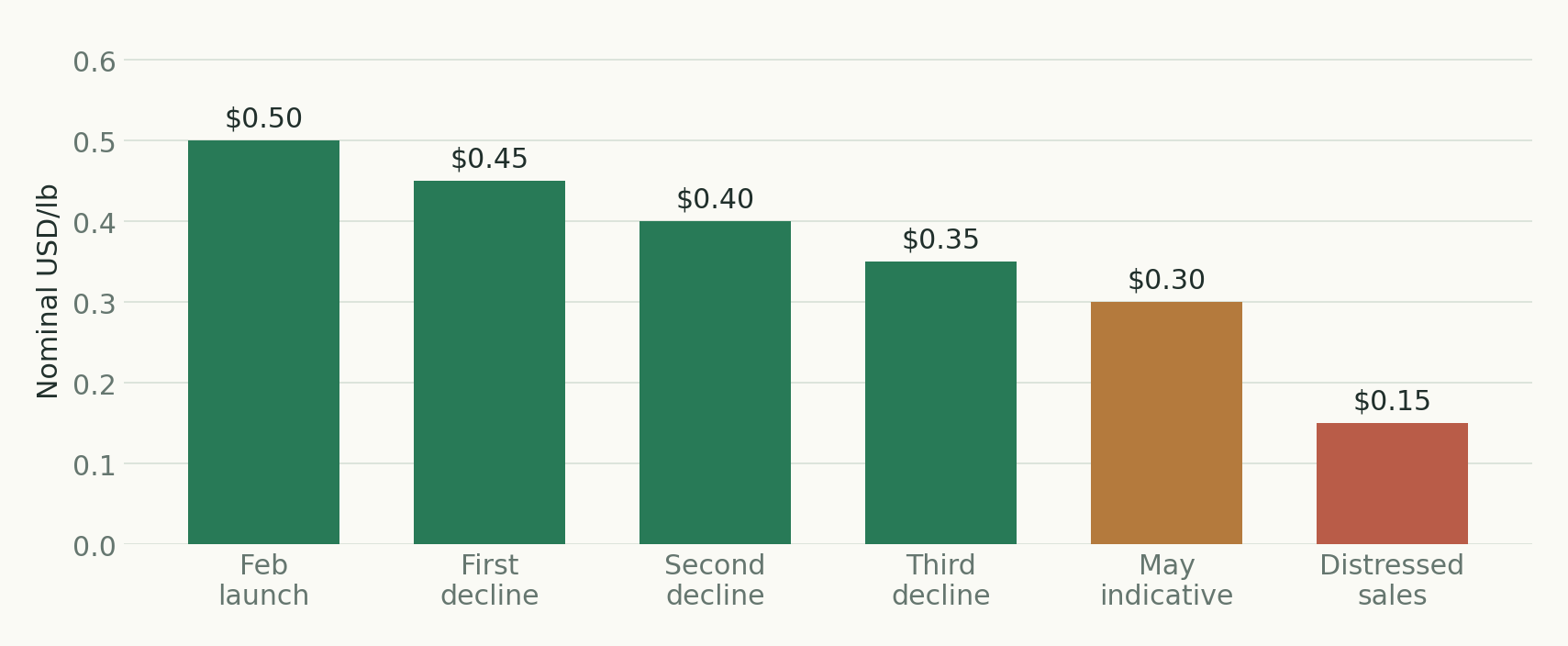
Avocados were brought to California in 1856 and 18713 and remained a rarity for decades. A dealer recalled selling them in Los Angeles for $6 to $7 a dozen around 1903, and a holiday shipment around 1912 fetched $6 a dozen, 50 cents a fruit4. When the growers’ exchange began selling in February 1924, its wholesale price was 50 cents a pound; by May it was about 30 cents, and some softened fruit was sold off at 15 cents5.
In Florida in 1925 the season set the price. Shippers to New York received $8 to $10 a crate for early Pollock avocados in July, $5 to $6 in September and $30 to $35 for late Trapps in January and February; growers selling on the tree received about 8 to 10 cents a pound6. In 1931–32 the Calavo cooperative sold 3.54 million pounds of packed avocados for $561,151, about 15.8 cents a pound, and returned a little over 8 cents a pound to its members7. In 1935 the Hass avocado received a plant patent8.
Farm prices since 1929
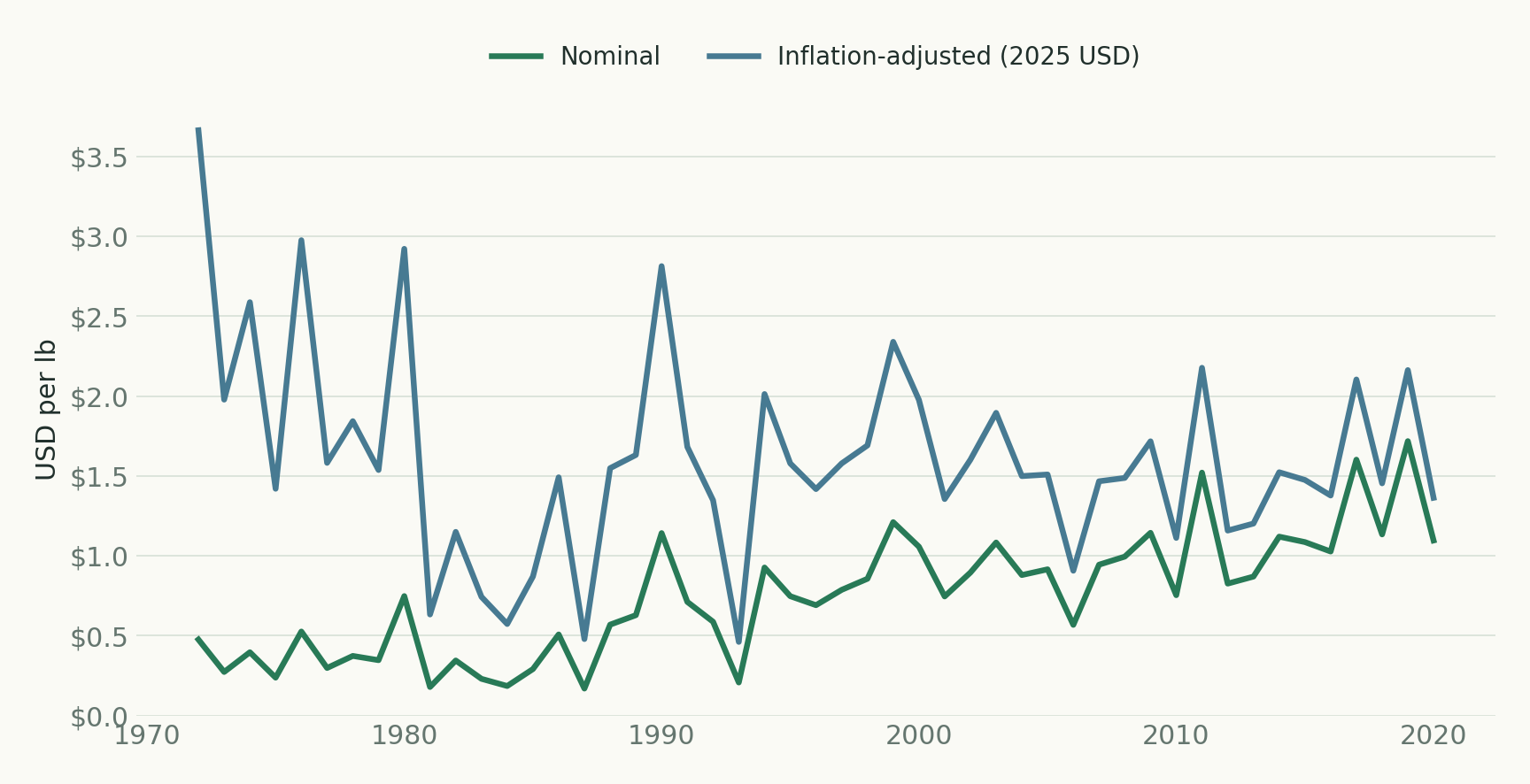
USDA farm prices begin in 1929, when California and Florida growers together received $394 a short ton, or 19.7 cents a pound. In 1934 they received $85, 78% less9. The price kept swinging: $377 in 1944, $109 in 1959 and $546 in 196991011. In 2025 dollars, the 1929 price equals $3.69 a pound, more than the $1.38 American growers received in 2025 (our calculation)91213.
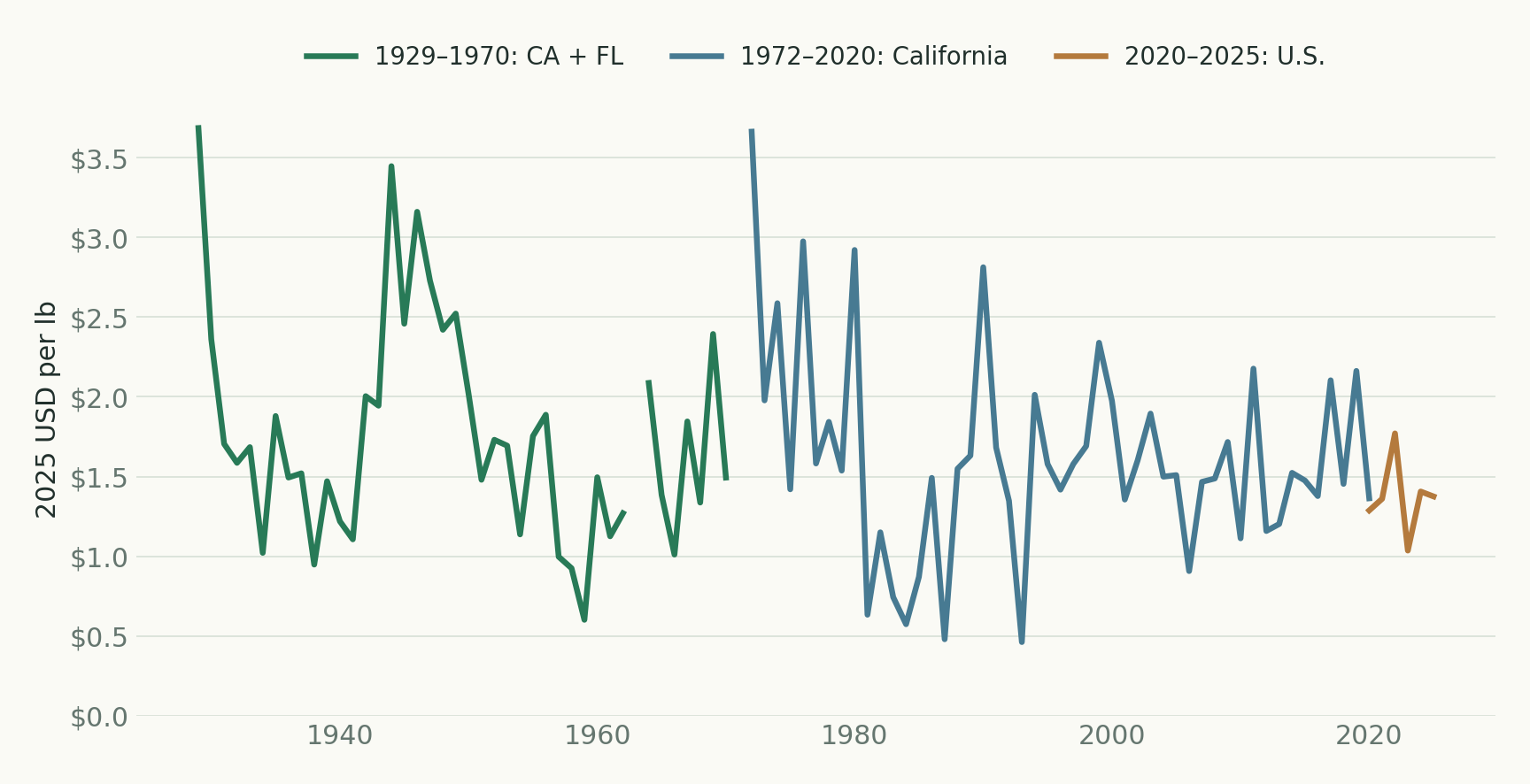
The California Avocado Commission’s data for 49 seasons show a low of 16.9 cents a pound in 1986/87 and a high of $1.718 in 2018/19. California’s bearing orchards grew from 19,039 acres in 1971/72 to a peak of 76,307 acres in 1987/88, then shrank to 46,078 acres by 2019/2014.
The 2020s: high prices and a slump
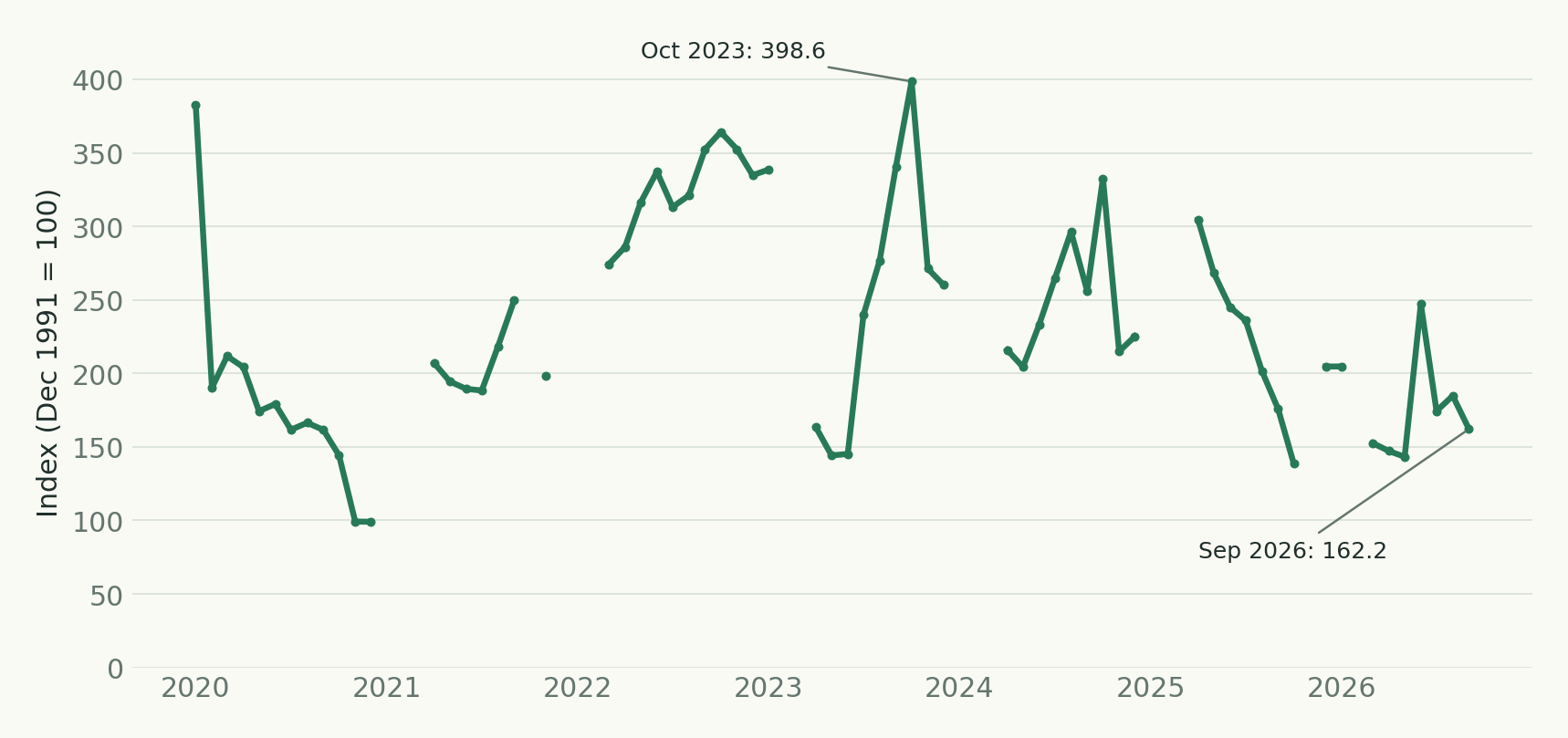
American growers received $3,220 a short ton in 2022, then $1,960 in 2023, 39% less, and $2,750 in 2025; California growers received $2,890 and Florida growers $1,1201513. The producer price index for avocados (December 1991 = 100) averaged 238.6 in April–September 2025 and 176.5 in the same months of 2026, 26% less16. In October 2026 it rebounded to 183.197, 32.2% above October 202517.
The fall at the border was steeper. Larger Hass avocados from Mexico cost about $3 a pound at the shipping point in mid-March 2025 and about $1 in mid-March 2026; USDA linked the drop to more large fruit in the 2025/26 Mexican crop18. In American shops the average selling price of an avocado was $1.19 in 2024, with small fruit at $1.03 and extra-large fruit at $2.4919.

Mexico and the import market
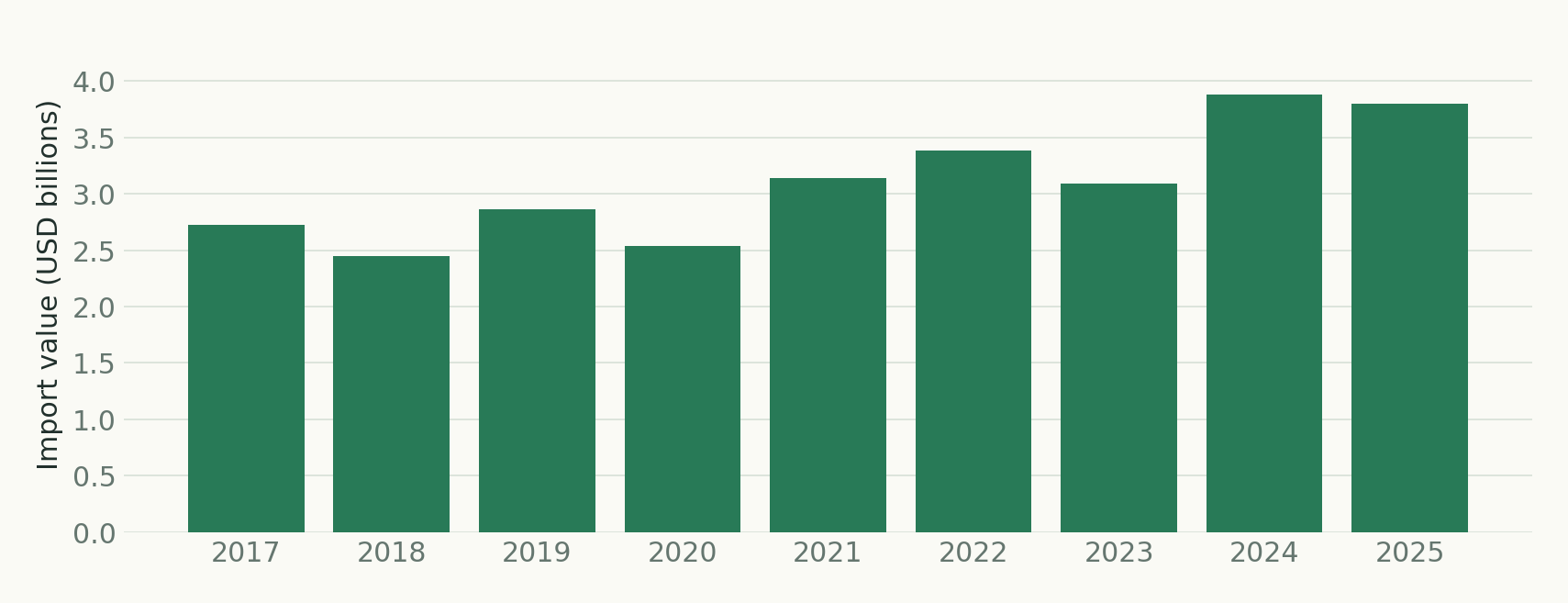
The United States now imports most of its avocados: USDA estimated import dependence at about 90% by 2021, against about 40% in the early 2000s20. American imports were worth $2.73 billion in 2017 and $3.80 billion in 2025; in 2025 Mexico supplied 83.4% of the volume, Peru 7.8% and Colombia 4.3%2122. Mexico reported avocado exports of $3.97 billion for 1.22 million tonnes in 202523.
The world harvested 11.2 million tonnes of avocados in 2024, a quarter of them in Mexico24. Prices in producing countries are far lower than at the border: in Kenya Hass avocados sold for $0.50 a kilogram in 2022 and $0.98 in 202525. The OECD and FAO project world exports to rise from about 3.3 million tonnes in 2025 to 4.3 million in 203526. Europe is a growing market too: Poland imported 13.9 million kilograms of avocados in 2017 and 51.6 million in 20252728.
Avocado prices today
Latest avocado prices on Husfarm
Updated automatically from wholesale markets in several countries, each in its own currency and unit. Each price links to its history and source.
| Price series | Market | Latest | Change | Date |
|---|---|---|---|---|
| Hass avocados, Michoacan, Mexico, first grade | Guadalajara Wholesale MarketMexico | 27.8–33.3 MXN/kg | — | 29 Oct 2026 |
| Hass avocados, First quality, Hass variety, packed in 17 kg boxes | Mercado Mayorista Lo Valledor de SantiagoChile | 2,800 CLP/kg | — | 23 Oct 2026 |
| Hass Avocado; origin: Kenya; Air; Carton | Al Aweer Central Fruit and Vegetable Market, DubaiUnited Arab Emirates | 12.5 AED/kg | — | 3 Nov 2026 |
| Hass avocados, Peru, class I, 306-365 g | Rome Wholesale MarketItaly | 4.20–4.50 EUR/kg | — | 26 Oct 2026 |
| Avocado Ryan, grade 2L | Cape Town MarketSouth Africa | 250 ZAR/15 kg bag | — | 30 Oct 2026 |
| Avocados | Taipei MarketTaiwan | 54.7 TWD/kg | — | 29 Oct 2026 |
| Fuerte avocados, Local | MercatenerifeSpain | 7.50–9.00 EUR/kg | −5.7% | 30 Oct 2026 |
| Avocado | Kalimati Fruits and Vegetable MarketNepal | 200–300 NPR/kg | +117.4% | 24 Nov 2026 |
How to read avocado prices
- Name the unit: a cacao bean, a dozen, a crate, a pound, a short ton of 907 kg, a kilogram or a single fruit.
- Name the stage: farm, packing house, shipping point, customs border or shop shelf.
- Name the variety and size: Hass and Fuerte, small and extra-large fruit sell at very different prices.
- Read the Mexican harvest first: it now sets the price for most of the American market.
- Compare like with like: a producer price index is not a price in money, and a customs unit value is not a shop price.
Price changes are 100 × (last ÷ first − 1). Real prices use the US consumer price index. Historical prices stay in their original currencies and units.
Questions and answers
How much does an avocado cost in the United States?
In 2024 the average retail selling price of an avocado was $1.19 a fruit: $1.03 for small and $2.49 for extra-large fruit. Prices fell in 2026, when larger Mexican Hass avocados cost about $1 a pound at the shipping point in mid-March, against about $3 a year earlier.
Were avocados expensive in the past?
Yes. Around 1903 a Los Angeles dealer sold them for $6 to $7 a dozen. In 2025 dollars the 1929 farm price was $3.69 a pound, against $1.38 received by American growers in 2025.
What is the oldest known avocado price?
A Tlaxcala price list of 1545 values a ripe avocado at one cacao bean, the same as a large tomato.
Why did avocado prices fall in 2026?
USDA linked the fall in Mexican Hass shipping-point prices, from about $3 a pound in mid-March 2025 to about $1 a year later, to more large fruit in the 2025/26 Mexican crop.
Where do American avocados come from?
Mostly from Mexico, which supplied 83.4% of US import volume in 2025. USDA estimated that about 90% of avocados available in the United States were imported by 2021.
Who grows the most avocados?
Mexico, with 2.76 million of the world’s 11.2 million tonnes in 2024.
Sources
Links to other websites open in a new tab.
- Proceedings of the National Academy of Sciences (2025). Early evidence of avocado domestication from El Gigante Rockshelter, Honduras. Archaeological evidence over about 11,000 years
- Cornell University Library (2026). When money grew on trees (Chocolate: Food of the Gods). Tlaxcala price list of 1545, as reproduced in the exhibition
- University of California, Riverside (2026). Early history of the avocado in California. Introductions of 1856 and 1871
- E. B. Rivers, California Avocado Association (1915). Marketing, Annual Report 1915. pp. 75–77: early sale prices recalled by a dealer
- California Avocado Association (1925). Field day at Hewes Park, 26 July 1924. 1924–25 Yearbook, pp. 9–13: prices of the Growers Exchange in 1924
- Robert W. Hodgson, California Avocado Association (1926). The Florida avocado industry: a survey. 1925–26 Yearbook, pp. 60–71: New York crate prices and grower returns
- J. G. France, California Avocado Association (1933). Status of the avocado industry in San Diego County. 1933 Yearbook, p. 64: Calavo sales of 1931–32
- U.S. Patent Office (1935). Plant patent USPP139P: Avocado. 27 August 1935, the Hass variety
- USDA Bureau of Agricultural Economics (1950). Agricultural Statistics 1950. Table 228, p. 184: avocado prices in California and Florida, 1929–1948
- U.S. Department of Agriculture (1964). Agricultural Statistics 1964. Table 238, p. 164: avocado prices, 1949–1963
- USDA Statistical Reporting Service (1973). Fruits, noncitrus: revised estimates 1964–70 (Statistical Bulletin 505). Table 6: avocado prices of utilized production
- Federal Reserve Bank of Minneapolis (2026). Consumer Price Index, 1913–. Annual CPI-U, used for real US prices
- USDA National Agricultural Statistics Service (2026). Noncitrus Fruits and Nuts 2025 Summary. May 2026, pp. 21–22: avocado prices and value, 2023–2025
- California Avocado Commission (2026). Industry statistical data, 1971/72–2019/20. Prices, volumes, bearing acreage and yields by crop season
- USDA National Agricultural Statistics Service (2023). Noncitrus Fruits and Nuts 2022 Summary. May 2023, p. 22: avocado prices, 2020–2022
- U.S. Bureau of Labor Statistics via FRED (2026). Producer price index by commodity: farm products, avocados (WPU01110205). Monthly, December 1991 = 100, not seasonally adjusted
- U.S. Bureau of Labor Statistics via FRED (2026). Producer price index release tables: farm products, October 2026. Avocados: October 2026 and October 2025
- USDA Economic Research Service (2026). Fruit and Tree Nuts Outlook, FTS-384. 26 March 2026, p. 18: Mexican Hass shipping-point prices
- Hass Avocado Board and Circana (2025). Total U.S. 2024 Q4: retail market report. Average selling prices per unit by category, 2022–2024
- USDA Economic Research Service (2022). Imports play dominant role as U.S. demand for avocados climbs. Chart of Note, 2 May 2022
- World Bank WITS / UN Comtrade (2026). United States: avocado imports by partner, 2017 (HS 080440). World total and leading partners
- World Bank WITS / UN Comtrade (2026). United States: avocado imports by partner, 2025 (HS 080440). World total and leading partners
- World Bank WITS / UN Comtrade (2026). Avocados (HS 080440): exports by reporter, 2025. Selected reporters, values and quantities
- FAO, FAOSTAT (2026). Crops and livestock products: avocados. Production by country, 2024
- USDA Foreign Agricultural Service, Nairobi (2026). Avocado annual, KE2026-0007. 6 April 2026, pp. 5–6, figure 4: Kenyan domestic prices by variety
- OECD and FAO (2026). OECD–FAO Agricultural Outlook 2026–2035: other products. World avocado trade, 2025 estimate and 2035 projection
- World Bank WITS / UN Comtrade (2026). Poland: avocado imports by partner, 2017 (HS 080440). World total
- World Bank WITS / UN Comtrade (2026). Poland: avocado imports by partner, 2025 (HS 080440). World total
About this price history
The Husfarm editorial team prepared this price history from the sources listed above, from a colonial price list and early California yearbooks to USDA statistics, the California Avocado Commission, the Hass Avocado Board and customs data.
Charts: Husfarm, from the sources listed. Cover illustration: Husfarm.
Prices are nominal, in the currency and unit of each source, unless a base year or a wage measure is stated. Figures checked on 24 November 2026. To report an error, write to us through the contact page.
Cite as: Husfarm editorial team (2026). The price of avocados: from cacao beans to the 2026 Hass slump. Husfarm, 24 November 2026. https://husfarm.com/price-histories/avocados/