

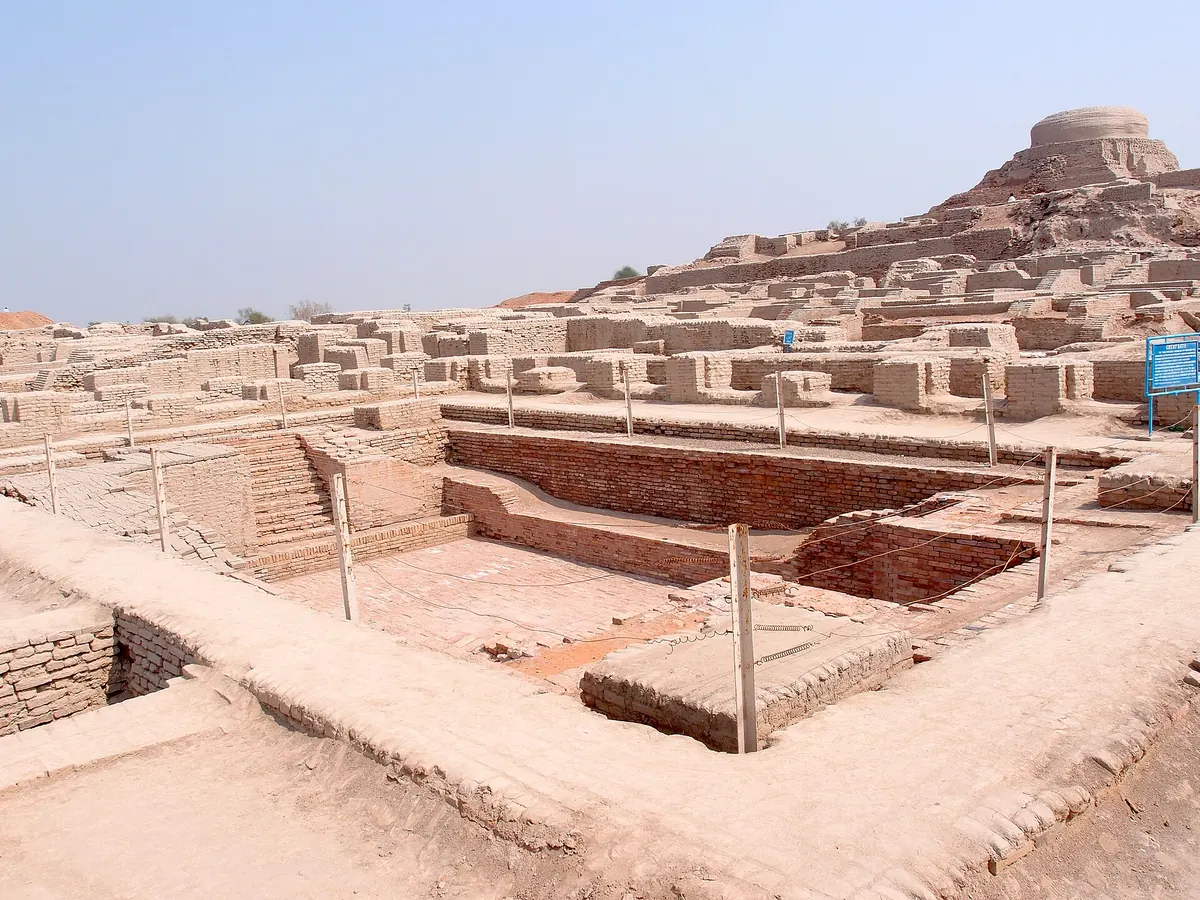
An extensive farming world: Harappa, Sindh, Gujarat and Haryana
The phrase “Indus Valley civilisation” can suggest a narrow strip of land beside one river. Its settlements actually occupied substantial parts of present-day Pakistan and northwestern India. Harappa in Punjab, centres in Sindh, Gujarat settlements and the hinterland of Rakhigarhi in Haryana operated within different patterns of rainfall, soils and watercourses. Cultural connections and exchange did not remove those differences. Farming therefore needs to be reconstructed regionally and often at the level of individual settlements.
This article focuses on the Mature Harappan phase, approximately 2600–1900 BCE, when substantial urban centres existed. That period did not mark the beginning of cultivation throughout the region, nor did subsequent urban changes end farming. Seeds from earlier and later deposits help trace continuity and transformation. Applying a single date to every location could obscure the fact that neighbouring settlements used different solutions and that the importance of those solutions changed over successive generations. A civilisation-wide label is a framework for comparison, not proof of uniform agricultural practice.31
The cooler growing season: wheat, barley and pulses
Wheat and barley were among the most important plants identified in many Harappan assemblages. Peas and lentils were among their companions. In broad seasonal terms, these crops are associated with the cooler part of the year. Moisture could come from rainfall, local ground conditions and water retained after inundation. This does not mean that every harvest depended on the same mechanism or that every field lay immediately beside the main Indus channel.
At Harappa, archaeobotanical material indicates the substantial importance of wheat and barley despite the presence of summer crops. Identifying several species does not establish that they grew together in one field. They could have occupied separate plots and become mixed during processing or disposal. Different plant requirements presented households with choices about location, timing and labour. Successful cultivation therefore involved more than familiarity with a species: it required the ability to fit crops to local conditions. Those decisions are essential to understanding how a varied landscape supported long-lived settlements.16
The summer season: millets, rice and local pulses
Summer crops included different small-grained cereals collectively called millets, rice and pulses suited to the warmer growing season. These millets should not be treated as one species or assumed to share a common origin. Research in the Rakhigarhi hinterland, including Masudpur I and Masudpur VII, identified complex plant assemblages. Direct dating of selected seeds confirmed the role of some summer crops during the development of the urban system.
Rice requires particularly careful interpretation. Its presence does not automatically establish a fully domesticated population or flooded fields resembling modern rice landscapes. Spikelet-base anatomy and associated weeds help investigate domestication status and growing conditions. Findings from northern India support a picture of varied practices. This regional component does not justify describing the entire civilisation as predominantly rice-based or transferring its importance to every city. A crop can be historically significant in one area while making a smaller contribution elsewhere; reconstructing that difference is part of the explanation.24
Two seasons do not mean two harvests from every field
Cultivating in more than one season could spread labour and food availability across a larger part of the year. A household using plants with different requirements might also reduce dependence on rainfall at a single time. These are potential benefits, rather than guarantees of success. A second season requires suitable moisture, seed, labour and land ready for another cycle. Crop diversity did not remove environmental constraints or make poor weather irrelevant.
Several situations need to be distinguished: growing different crops in separate fields, sowing them together, and harvesting successive crops from the same plot. Summer and winter seeds at a settlement could reflect two seasons of cultivation, but also exchange or the mixing of stored produce. Researchers therefore combine crop composition with weed ecology, archaeological context and dating. Differences between nearby settlements show why an identical pattern of intensification should not be assumed even within one region. The question is how particular farmers organised their land and time, rather than whether all Indus agriculture fits one broad label.123
Water: from residual flood moisture to urban reservoirs
Rivers created opportunities as well as hazards. Inundation could leave moisture and sediment, while channel migration or an unusually strong flood could disrupt land use. Research on fluvial landscapes shows that these dynamics changed over time. A floodplain was not a fixed stage for an unchanging farming calendar. Cultivators worked in relation to local hydrology, and the nature of that relationship varied between different parts of the river system.
Dholavira in Gujarat provides exceptional evidence for collecting and directing water in an urban centre within an arid setting. Reservoirs and the use of seasonal streams demonstrate substantial engineering knowledge. They do not independently prove an extensive irrigation network serving every surrounding field. Supplying residents, draining water and irrigating crops are connected but distinct functions. Each requires appropriate evidence and its own scale of analysis. Preserving those distinctions allows the engineering achievement to be recognised without turning urban water infrastructure into evidence for a farming system that has not been demonstrated.68
Feeding cities: why smaller settlements matter
Large centres containing workshops and substantial built environments needed regular access to food. Their economies therefore cannot be understood through monumental buildings alone. Smaller settlements preserve traces of crops, processing and local decisions. Research around Rakhigarhi showed that plant diversity mattered while cities were flourishing. Villages were active places of knowledge, work and adjustment of production to local conditions, rather than merely an undifferentiated background to urban achievement.
Harvests had to be cleaned, some grain retained for sowing, and the remainder allocated to consumption or exchange. This sequence creates different residues: grain, chaff and weed seeds do not reach every location in the same proportions. Finding a cereal in a city does not identify its supplying village or prove a single central collection system. Possible ways of organising provisioning need to remain models until evidence establishes their extent. Agricultural products connected settlements, but the precise relationships between producers, traders and urban households cannot simply be read from the presence of a crop.231
Beyond grain: animals, cooking and vessel use
Indus agricultural systems involved more than cereal fields. Animal remains and food residues add to the picture of subsistence. Analyses of fats in pottery from northwestern India identified the use of animal products and complex histories of vessel use. The study included both urban and rural sites. Similarities between them suggest shared elements of regional culinary practice without requiring identical diets in every community.
Interpretation is complicated by mixtures of ingredients and incomplete local reference collections. A chemical signal cannot always be assigned to one animal species, and limited identification of dairy fat does not prove the absence of dairying. Counting charred grains likewise does not directly produce the proportions of foods in meals. Combining evidence is necessary to distinguish production, preparation and consumption. Each stage leaves a selective, incomplete record. This broader approach connects the agricultural landscape with household practices while avoiding an apparently precise menu built from evidence that cannot support one.51
After 1900 BCE: climatic pressure and continuing agriculture
Sediments from the former lake of Kotla Dahar in Haryana indicate a weakening summer monsoon around 2150 BCE, approximately 4,100 years BP measured against the conventional reference year of 1950. This regional record helps investigate pressure on water availability, although climate and settlement chronologies carry their own uncertainties. Temporal overlap is insufficient to reduce the entire transformation of the civilisation to one drought. Different cropping systems could respond differently to weaker monsoon rainfall and altered river flows.
After approximately 1900 BCE, settlement networks and the importance of large centres changed, while cultivation and animal husbandry continued. Local persistence, settlement relocation and changing crop combinations belong within the same history of adaptation. Indus agriculture matters because it demonstrates shared connections alongside varied solutions. Food production operated across an extensive social world, but its success depended on particular places, seasons and the knowledge of people working there. The transition away from major urban centres should therefore be studied alongside the continued decisions and livelihoods of farming communities.7635
Questions and answers
Did all Indus farmers harvest twice each year?
The evidence does not support that generalisation. Summer and winter crops and several local strategies are documented, but their presence at one settlement does not prove two harvests from every field.1
Sources
- Cameron A. Petrie and Jennifer Bates (2017). ‘Multi-cropping’, Intercropping and Adaptation to Variable Environments in Indus South Asia CC BY 4.0 · https://creativecommons.org/licenses/by/4.0/
- Cameron A. Petrie, Jennifer Bates, Thomas Higham and Ravindra N. Singh (2016). Feeding ancient cities in South Asia: dating the adoption of rice, millet and tropical pulses in the Indus civilisation
- Cameron A. Petrie et al. (2017). Adaptation to Variable Environments, Resilience to Climate Change: Investigating Land, Water and Settlement in Indus Northwest India
- Jennifer Bates, Cameron A. Petrie and Ravindra N. Singh (2017). Approaching rice domestication in South Asia: New evidence from Indus settlements in northern India
- Akshyeta Suryanarayan et al. (2021; online 2020). Lipid residues in pottery from the Indus Civilisation in northwest India
- Liviu Giosan et al. (2012). Fluvial landscapes of the Harappan civilization
- Yama Dixit, David A. Hodell and Cameron A. Petrie (2014). Abrupt weakening of the summer monsoon in northwest India ~4100 yr ago
- UNESCO World Heritage Centre (2021). Dholavira: a Harappan City
Approximate dates (c.) describe the nature of the evidence: archaeology dates settlements, layers and remains, not single moments of invention.