

Key dates
- approximately 5,300 years agoSanta Ana–La Florida provides early evidence of cacao use; the findings were published in 2018.1
- c. 1900–1500 BCEResidues from Paso de la Amada document cacao on the Chiapas coast.10
- c. 1800–1000 BCECacao occurs in the investigated assemblage from Olmec San Lorenzo.11
- c. 600 BCE–250 CEVessels from Colha in Belize preserve chemical evidence of cacao consumption.13
- c. 1000–1125 CEPottery fragments from Pueblo Bonito indicate cacao far beyond its growing zone.15
- 2024 · research publicationResearch across ceramic collections expands knowledge of ancient cacao movement and genetic mixing.89
A forest tree becomes an agricultural resource
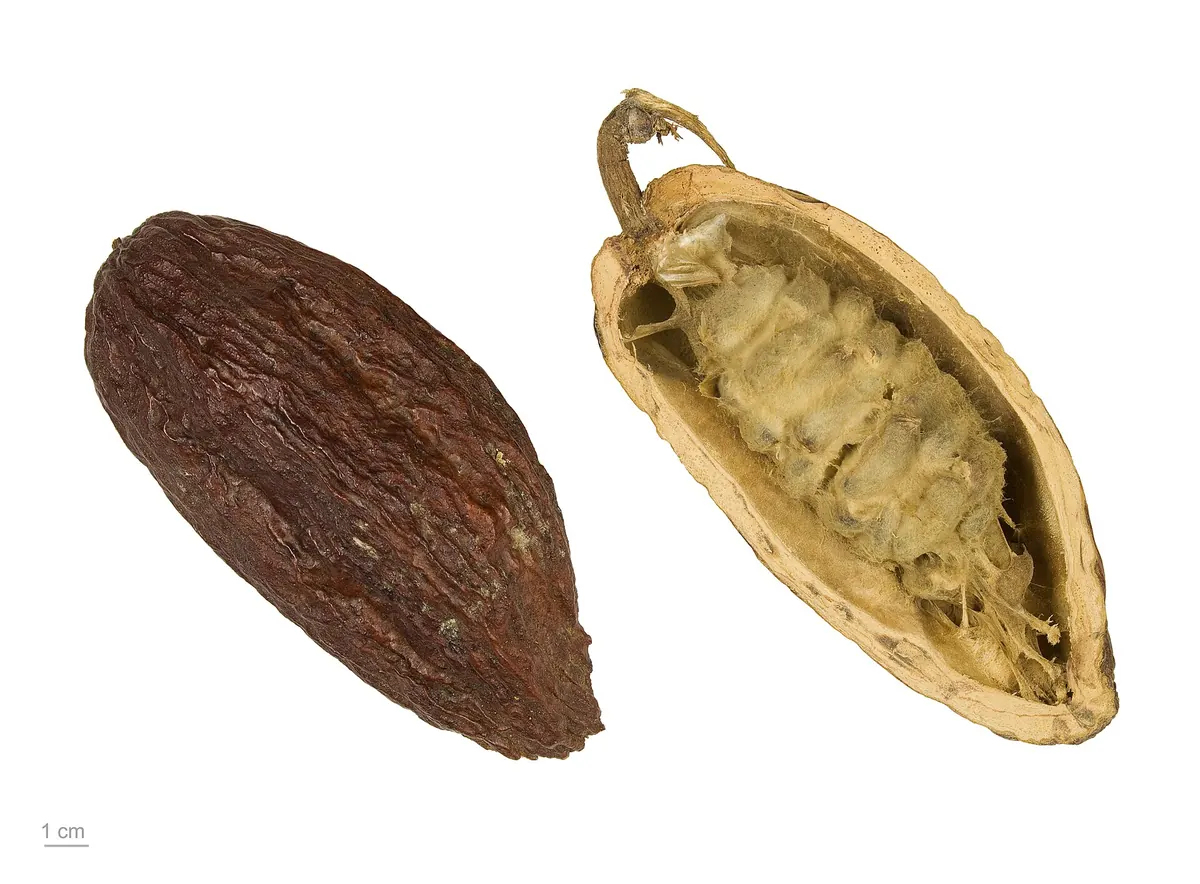
Theobroma cacao is a perennial tree of the humid tropics. Its flowers can develop directly on the trunk, and its large fruits contain seeds surrounded by pale pulp. The commercial term cacao bean therefore refers to a seed rather than a botanical bean. Tiny flies participate in pollination in natural conditions. The plant depends on a living environment and a suitable microclimate, features that disappear from view when the final product is presented as a bar of chocolate.
Incorporating such a tree into food production differed from sowing an annual cereal. People could protect useful individuals, move seeds and gradually enrich the surroundings of settlements. This is an interpretive model, rather than an excavated plan of the earliest cacao plantation. Genetic research finds a continuum between wild, naturalized and cultivated populations. A tree growing in a forest today is not automatically evidence of a population untouched by people. In tree agriculture, an earlier investment of labour can remain visible in vegetation after a particular field or settlement has been abandoned.418
Santa Ana–La Florida and converging evidence
Santa Ana–La Florida belongs to the Mayo-Chinchipe cultural setting in southeastern Ecuador. The study published in 2018 brought together starch analysis, absorbed theobromine residues and ancient DNA recovered from residues on artefacts. Agreement between different methods strengthened the identification of cacao. The figure of approximately 5,300 years describes early evidence of use; it is neither the publication date nor an exact moment when someone first planted a cacao tree.
The research depended on comparisons with modern plant material, careful sampling and collaboration between archaeologists, chemists and geneticists. Sonia Zarrillo explained how similarities between ancient vessels and forms associated with cacao in Mesoamerica helped frame the investigation. The shape of a vessel alone, however, cannot establish its former contents. The university account of the project also draws attention to connections between the site and the Pacific coast. Such links make it possible to investigate exchanges of products and knowledge, rather than imagining the Amazonian settlement as an isolated agricultural experiment.123
What genetics can tell us about domestication
Research led by Juan Motamayor in 2008 identified ten genetic clusters, challenging the adequacy of reducing cacao diversity to two broad categories. This was a result from a particular sample and analytical framework, not an eternal count of every possible variety. Genetic populations, cultivated varieties and commercial names describe different kinds of classification. Treating them as interchangeable can make the crop appear to have a simpler history than the evidence permits.
Omar Cornejo and colleagues subsequently examined cacao genomes, with particular attention to Criollo, identifying strong effects of selection and reduced diversity. Their demographic dates depend on assumptions and have broad uncertainty intervals. They should not be converted into a precise year for the first orchard. Work by Evert Thomas and colleagues also relates geographical diversity to older environmental changes and later human dispersal. Modern genetic maps therefore preserve overlapping histories: the natural differentiation of a species and the cumulative consequences of agricultural choices. Neither history can be read directly from a single archaeological pot.567
Connections between Amazonia and the Pacific coast
Archaeogenomic research published in 2024 extended the discussion beyond a single settlement. Residues from ceramics associated with many South and Central American cultures were investigated. The results indicate cacao use outside its Amazonian region of origin around five millennia ago. They also reveal genetic mixtures linking populations from distant regions. The authors connect these patterns with long-standing interactions between communities, presenting domestication as a process shaped by movement as well as selection.
CIRAD described a research collection of 352 ceramic objects associated with 19 cultures. Those figures measure the scope of analysis, not the number of excavated plantations. The agricultural implication is that transporting plants could bring genetic resources together and support cultivation in different environments. The results do not reconstruct every journey or establish one exclusive route northwards. A network of contacts is a more defensible interpretation. Seeds, processed products, preparation techniques and the social meaning of cacao could all circulate, without necessarily travelling at the same speed or through the same intermediaries.89
Mesoamerica develops its own cacao traditions
The Amazonian evidence does not diminish the contribution of Mesoamerican communities. Residues from pottery at Paso de la Amada on the Chiapas coast document cacao in contexts dating approximately to 1900–1500 BCE; material from El Manatí provides evidence in another region. These finds establish the use of a product, rather than measuring the area of surrounding orchards. Vessel form and manufacture nonetheless allow researchers to ask how liquids were served and what kinds of occasions brought people together.
At San Lorenzo, an important Olmec centre, analyses documented cacao use during approximately 1800–1000 BCE. Positive residues occurred in forms associated with preparation, storage and serving. One context was connected with an elite mortuary ritual. Such findings show how the value of an agricultural product could be shaped by ceremony and the standing of its providers. They do not establish equal access for every inhabitant, or prove that every fruit grew beside the settlement. Production, consumption and the exercise of social authority must be investigated as related but distinct parts of the economy.1011
Pulp, seeds and changing beverages
Early cacao products should not all be understood as versions of modern chocolate. Researchers investigating vessels from Puerto Escondido in Honduras proposed that some early drinks were made by fermenting the sweet pulp around the seeds. This remains an archaeological interpretation: detecting a characteristic compound does not reveal a complete recipe. Distinguishing pulp from seeds also helps explain why the original reasons for collecting or tending a tree could differ from the demands of a later market for its processed seeds.
Vessels from Colha in Belize, dating between about 600 BCE and 250 CE, provided further chemical evidence of cacao consumption. Spouted forms were linked to the preparation and serving of a frothy drink. The 2002 investigation sought to identify cacao rather than establish every ingredient mixed with it. Processing history therefore requires separate questions about the raw material, its treatment and the finished food. Changes in any of these stages could encourage interest in particular fruit characteristics, although ancient consumers and growers did not leave a modern breeding manual describing how their preferences developed.1213
From cultivation to feasting and distant exchange
A Maya vessel depicting a seated lord, held by the Metropolitan Museum of Art, combines a practical drinking function with the name of its owner and images associated with fertility. The museum interpretation places cacao serving within courtly feasting. Orchard labour could thus become part of political display. A harvested product acquired significance through the people able to distribute it, offer it and consume it in a particular setting, rather than through its food value alone.
The product travelled far beyond its growing zone. At Pueblo Bonito in Chaco Canyon, theobromine was identified in pottery fragments dated stylistically to approximately 1000–1125 CE. Cacao was not a local crop in this dry environment. The discovery indicates exchange, without identifying every intermediary or the orchard that supplied it. A consumption site and a production site can belong to entirely different landscapes, making their distinction essential to reconstructing agricultural networks.1415
The enduring legacy of managed landscapes
Soils in karst depressions of the northern Maya lowlands provide another perspective on cultivation. Richard Terry and colleagues detected cacao-related biomarkers in nine of eleven investigated sinkholes. Their study connects these findings with historical documentation of cacao groves tended in shaded, humid microclimates. Small patches of favourable conditions could therefore matter greatly within a wider landscape. A crop did not have to cover an entire plain to become significant in its regional economy and ritual life.
At a broader scale, Levis and colleagues compared the distribution of useful Amazonian trees with archaeological sites. Their results support lasting effects of earlier communities on the composition of some forests. This does not mean that every forest was a cacao plantation. The agricultural achievement is consequently better understood through generations of selection, care and connections between regions than through the search for one inventor. Cacao demonstrates how food production can transform a landscape without always leaving the geometry of an open field.1617
Questions and answers
Was cacao first cultivated in Ecuador?
Ecuador provides exceptionally early evidence of use. It does not establish one exclusive location or exact date for the entire domestication process.18
Was ancient cacao the same as modern chocolate?
No. Fruits, sweet pulp, seeds and different beverages must be distinguished. Chemical residues usually identify a raw material more securely than a complete ancient recipe.12
Does cacao at Chaco demonstrate local cultivation?
No. It is evidence of consumption far from suitable growing conditions, indicating exchange. The complete supply chain remains unknown.15
Sources
- Sonia Zarrillo i in. (2018). The use and domestication of Theobroma cacao during the mid-Holocene in the upper Amazon
- Sonia Zarrillo (2018). Clues to Cacao: Behind the Paper
- Lui Xia Lee / University of British Columbia (2018). Sweet discovery: New UBC study pushes back the origins of chocolate
- Royal Botanic Gardens, Kew (b.d. / n.d.). Theobroma cacao L.: botanical description and general information
- Juan C. Motamayor i in. (2008). Geographic and Genetic Population Differentiation of the Amazonian Chocolate Tree
- Omar E. Cornejo i in. (2018). Population genomic analyses of the chocolate tree, Theobroma cacao L., provide insights into its domestication process
- Evert Thomas i in. (2012). Present Spatial Diversity Patterns of Theobroma cacao L. in the Neotropics Reflect Genetic Differentiation in Pleistocene Refugia Followed by Human-Influenced Dispersal
- Claire Lanaud i in. (2024). A revisited history of cacao domestication in pre-Columbian times revealed by archaeogenomic approaches
- CIRAD (2024). Domestication of cocoa in pre-Columbian times: history revisited by archaeogenomics
- Terry G. Powis i in. (2007). Oldest chocolate in the New World
- Terry G. Powis i in. (2011). Cacao use and the San Lorenzo Olmec
- John S. Henderson i in. (2007). Chemical and archaeological evidence for the earliest cacao beverages
- W. Jeffrey Hurst i in. (2002). Cacao usage by the earliest Maya civilization
- James Doyle / The Metropolitan Museum of Art (b.d. / n.d.). Vessel with Seated Lord, Maya, 7th–8th century
- US National Park Service (2024). Pre-Columbian Chocolate Discovered at Chaco
- Richard E. Terry i in. (2022). Soil biomarkers of cacao tree cultivation in the sacred cacao groves of the northern Maya lowlands
- Carolina Levis i in. (2017). Persistent effects of pre-Columbian plant domestication on Amazonian forest composition
- Matheus Colli-Silva i in. (2025). Wild or Introduced? Investigating the Genetic Landscape of Cacao Populations in South America
Approximate dates (c.) describe the nature of the evidence: archaeology dates settlements, layers and remains, not single moments of invention.