

Key dates
The Nile Valley and the working year: why reserves mattered
The Middle Kingdom encompasses Egypt’s reunification and the development of political structures associated with Dynasties 11–13. The approximate range of 2055–1650 BCE used here is a chronological framework, not the beginning of Egyptian farming. Cereal production had long supported Nile Valley communities. Its rhythm depended on conditions following the inundation, soil preparation, sowing, growth and harvesting. Particular activities concentrated substantial labour within specific parts of the year.
Food was needed when no ripe grain stood in the fields. Storage connected a seasonal harvest with daily consumption and the retention of seed for future sowing. It did not solve every problem: a poor harvest limited supplies, while keeping them required protection and supervision. A reserve was therefore both a biological and a social matter. What counted was not only the quantity harvested, but who controlled it, what obligations they faced and who was entitled to receive it. Understanding storage means investigating all of those relationships together.186
From ear to store: several stages of processing
Emmer wheat and hulled barley were the principal cereals. Harvesting was followed by threshing, winnowing and sieving, but not every crop entered storage as completely cleaned grain ready for grinding. Emmer could be kept in spikelets, with further processing undertaken after removal from the granary. Separating these stages helps explain why plant remains from bread preparation differ from material left around a threshing area.
Straw, chaff and other materials separated from the harvest also had uses. Archaeobotanical research and analysis of representations indicate their employment as fuel, fodder and additions to building materials. Calling them simply “waste” can therefore be misleading: households and institutions managed several streams of useful material needed beyond harvest time. This is wider background to the Middle Kingdom, investigated through evidence from different periods of Egyptian history. It does not mean that every detail in one tomb scene applied to every settlement or century. The value lies in reconstructing a working sequence rather than assuming a universal recipe.89
Meketre’s granary: storage beside an accounting area
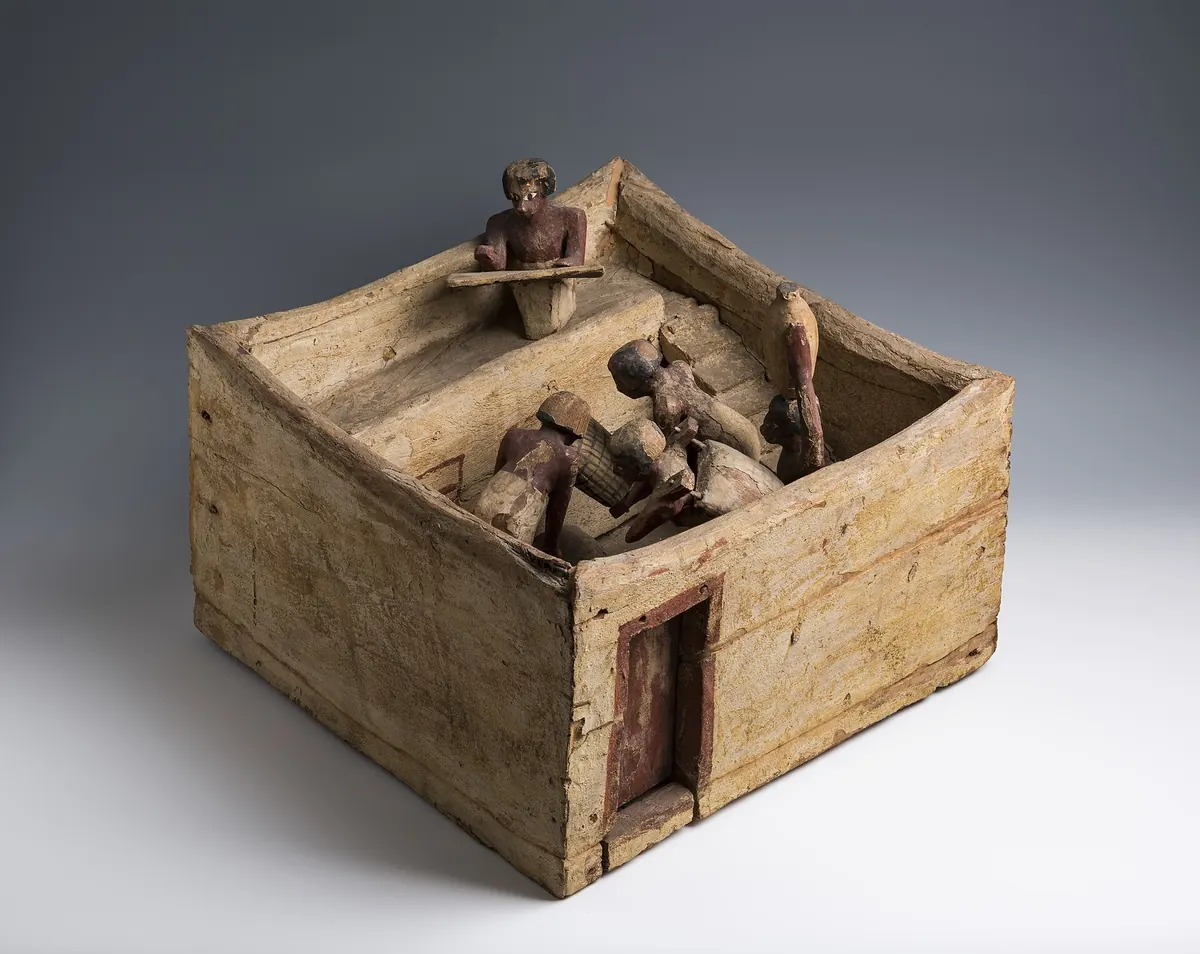
An exceptionally clear example comes from the Theban tomb of the senior official Meketre. The wooden granary model, dated by the Metropolitan Museum to approximately 1981–1975 BCE, depicts a storage section alongside an area for measuring and accounting. Figures carry sacks, measure contents and record information. The model emphasises that receiving grain was an organised activity involving several kinds of work, rather than merely tipping a harvest into an empty room.
The object was nevertheless funerary equipment intended to secure continuing provision for the deceased. It is not a construction plan for a particular building or a staff register. The numbers of figures should not be converted into the proportion of scribes within the entire economy. What can be investigated is the selection of activities and their spatial relationship. Placing accounting alongside physical storage shows the importance attached to controlling product flows within an ideal functioning estate. The object’s religious purpose and its information about economic practice must be understood together.210
Measuring, recording and issuing: grain as an obligation
Institutions could obtain goods through levies and estate income, then allocate them to support people and cult activities. Studies of Middle Kingdom documents show the role of accounts in monitoring both incoming and outgoing supplies. Measuring a consignment made it comparable with a written entry. Administration connected a physical product with information about quantity, recipient and purpose, allowing transactions to be followed beyond the moment of delivery.
Grain was food, but it could also discharge obligations and provide remuneration. Its importance does not require calling it modern money. Nor should the entire Egyptian economy be reduced to a single royal storehouse. Management operated at different scales, including the court, cult institutions, estates and households. Similar accounting techniques could serve different social relationships. The identity of a commodity did not determine its ownership or the way decisions about it were made. This distinction helps explain why central institutions and household concerns appear within the same broad grain economy.64
Heqanakht: land leases and supplies from a household perspective
Heqanakht’s papyri allow the economy to be seen through one person’s affairs. They belong to the early Twelfth Dynasty; the museum dates the documents discussed here to approximately 1961–1917 BCE. Heqanakht was responsible for a deceased official’s cult and associated resources. In his letters he also directed his household’s business, giving instructions about leasing land, grain debts and allocations to dependants and staff.
Account VII lists supplies in several locations, including a storehouse and a named individual’s house, and refers to payments. The documents therefore reveal a distributed resource that needed to be counted and mobilised. They do not describe an anonymous, perfectly uniform bureaucracy: negotiation, dependency and tension are visible. Heqanakht should not be treated as a statistically representative peasant, either. His position and surviving archive provide an exceptional view of economic practice rather than a complete cross-section of society. Their importance lies in connecting quantities with named people, places and decisions.34
Large granaries and fortresses: capacity is not a harvest total
Surviving storage buildings, including those in Middle Kingdom Nubian fortresses, allow documentary evidence to be compared with architecture. Barry Kemp’s study considers sites such as Mirgissa and Askut and the implications of their storage capacities for provisioning. A granary attached to a garrison helped support people beyond the immediate cycle of a local household farm. Its scale may reveal organisational intentions even when actual inventories are unknown.
Estimating capacity requires reconstruction of the height and shape of lost parts of a building. Converting volume into weight also depends on the stored product, its preparation and how fully a chamber was filled. Annual throughput can differ from the amount held at one time. A drawing of a large granary therefore cannot independently provide a population fed or a tax total. Reconstructions remain useful when they clearly separate measurements of surviving walls from assumptions. The distinction turns an impressive structure into evidence that can be assessed rather than an unsupported claim of administrative efficiency.56
From stock to ration: bread, beer and institutional duties
Stored grain became a meal only through further work. Pounding, sieving, grinding, preparing dough and baking required people and equipment. Bread and beer were important in Middle Kingdom food provision. For some workers and institutional personnel, allocations of products formed part of their remuneration. The connection between storehouse and consumer therefore included processing: an account of grain and an issued portion of bread represented different stages in resource management.
Wooden ration tokens from Nubian forts illustrate practical tools for organising access to food. Offerings to gods and the dead connected production with cult obligations, after which products could be distributed to those serving the ritual. Ideal representations of abundance should not, however, become a literal menu for all inhabitants. Tomb scenes also express hopes for prosperity and continuity. Compared with accounts, they help reveal both material flows and the values assigned to food. Administrative and religious evidence describe intersecting aspects of provision rather than wholly separate economies.1068
Seals and responsibility: the evidence from Edfu
Research at Tell Edfu recovered seal impressions associated with administrative activity. Some late Middle Kingdom and early Second Intermediate Period material, dated approximately 1770–1650 BCE, carries officials’ names and titles. Other impressions have decorative motifs that do not identify an owner so readily. Marks on the reverse and the archaeological find context also matter: they can help determine what was secured and the circulation in which an object participated.
A granary was consequently a building, a resource and a place of responsibility. Protecting goods and recording their movement enabled planning while also controlling access. The surviving evidence does not demonstrate that every system operated without loss, dispute or inequality. It does show that feeding a complex society required knowledge extending beyond cultivation itself. Egyptian agriculture emerges here as connected work: preparing a field, handling the harvest, storing its products and deciding when and to whom supplies should be issued. Studying those connections gives ordinary agricultural materials a central place in political and social history.765
Questions and answers
Did Egyptians invent granaries during the Middle Kingdom?
No. This article concerns well-documented storage organisation during that period, not the beginning of food storage. The practice had a much older history.89
Is Meketre’s model an exact scale plan of a real granary?
It is a funerary model depicting storage and accounting, not a surviving building plan. It reveals activities and their significance without automatically supplying actual dimensions or staff numbers.2
Sources
- Egyptian Ministry of Tourism and Antiquities (n.d.). Middle Kingdom
- The Metropolitan Museum of Art (n.d.). Model of a Granary with Scribes, object 20.3.11
- The Metropolitan Museum of Art (n.d.). Heqanakht Letter I
- The Metropolitan Museum of Art (n.d.). Heqanakht Account VII, object 22.3.522
- Barry J. Kemp (1986). Large Middle Kingdom Granary Buildings (and the Archaeology of Administration)
- Mahmoud Ezzamel (2002). Accounting and redistribution: The palace and mortuary cult in the Middle Kingdom, ancient Egypt
- Nadine Moeller (2012). Unsealing Tell Edfu, Egypt: Who Was a Local Official and Who Was Not?
- UCL, Digital Egypt for Universities (2000–2003). Cereal production
- Claire Malleson (2025). The Management of Agricultural Resources in Ancient Egypt: Production and Storage of By-Products
- Adela Oppenheim, The Metropolitan Museum of Art (2015). Food and Feasts in Middle Kingdom Egypt
Approximate dates (c.) describe the nature of the evidence: archaeology dates settlements, layers and remains, not single moments of invention.