

Key dates
The operating principle: water flows rather than being lifted
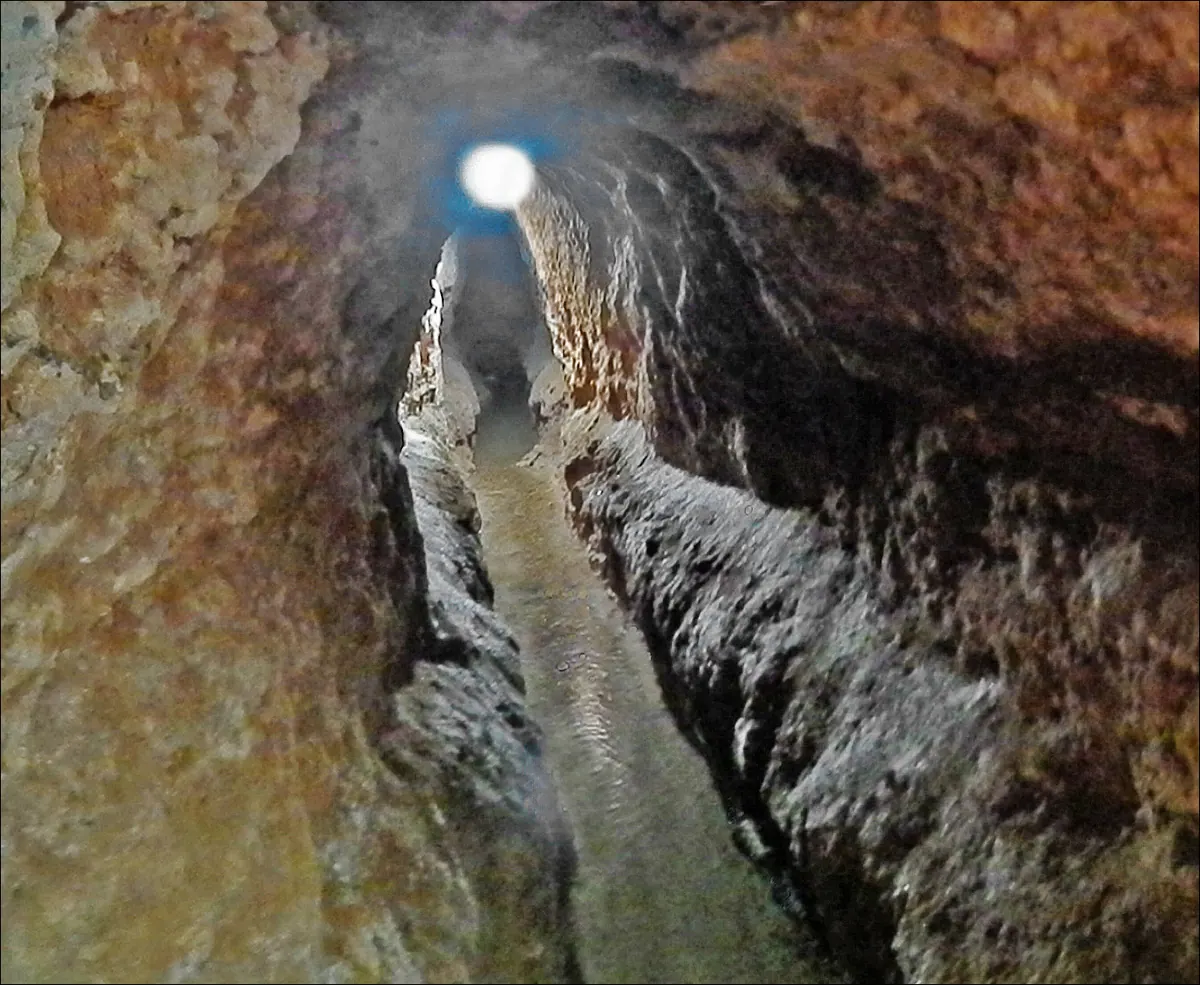
A basic qanat consists of a section collecting groundwater and a tunnel leading towards an outlet on lower terrain. In the Iranian tradition, a deep shaft near the upper end is often called the mother well. Further shafts along the route support construction, spoil removal and maintenance. At the surface, they may form a distinctive line of depressions surrounded by excavated earth.
Differences in elevation and a suitable gradient move the water. The shafts are not a chain of pumps lifting it from one stage to the next. The purpose also differs from draining a low-lying polder: a qanat intercepts groundwater and supplies users. It can lower groundwater locally, but its agricultural function is provision. Such a structure works only where ground conditions, the position of the resource and the relative elevations of intake and cultivated land permit it. Its operation depends on a relationship between landscape features rather than a machine capable of overcoming any difference in height.14
How does a qanat work?: Not to scale: gradients and distances are schematic. This is neither an engineering design nor a cross-section of a particular qanat.
Origins: why there is no single invention year
Qanat development has traditionally been associated with Iran during the first millennium BCE and the subsequent transfer of knowledge to other regions. More recent research emphasises the diversity of early systems, including examples in southeastern Arabia, and uncertainties in their dating. Scholars discuss both diffusion and the possibility of solutions developing in several places. “Persian qanats” identifies the Iranian tradition here without assigning every similar structure to a single inventive centre.
An underground passage is difficult to date because it can be repeatedly cleaned, deepened and repaired. Pottery in a neighbouring settlement need not establish when excavation began. Luminescence dating of deposits in shaft mounds can help identify episodes of work, but initial construction must be distinguished from later spoil removal. The oldest sample date is therefore not automatically the age of an entire system. A careful chronology describes phases and the quality of evidence rather than presenting only an impressive number of years. This distinction matters when comparing technological histories across regions.346
Piedmont landscapes and a concealed water resource
Many Iranian qanats draw on groundwater associated with alluvial deposits at the foot of mountains. Aquifer recharge belongs to the wider circulation of rainfall and runoff within a catchment. A dry field surface therefore does not mean a landscape contains no water. Recognising where the resource lay, and whether it could reach a settlement by gravity, was crucial. Builders worked with the relationship between geology, topography and users’ needs.
A tunnel reduces direct evaporation during conveyance because most of its course is underground. It does not create water or cancel the recharge balance. If groundwater falls below the collecting section, discharge may decline or cease. System reliability consequently depends on processes beyond the cultivated plot itself. Historically, a qanat made an existing resource accessible; it did not demonstrate unlimited productive potential in a desert. This also explains why the same general technology could succeed in one location and offer little benefit in another, even where both appeared similarly dry at the surface.127
Specialist work: knowledge, maintenance and shared costs
Setting a route and gradient required experience. Too little slope impedes flow, while ground conditions affect the stability of the underground passage. Qanat specialists transmitted knowledge about recognising strata, carrying out excavation and maintaining the system. Shafts facilitated spoil removal and access to successive sections. This was infrastructure built through manual labour in difficult conditions, and continued operation depended on keeping the passage functional across generations.
An operating principle without a motor does not imply an absence of costs. Work had to be financed and organised, sediment removed and damage repaired. Underground labour carried hazards, while the loss of experienced workers could weaken the whole system. A qanat’s historical value therefore includes both a structure and a body of skills. A surviving outlet or visible shaft line alone cannot show whether the tunnel is clear, whether recharge is adequate or whether a community can maintain it. The monument and the practical organisation supporting it are inseparable parts of its history.186
Fields and gardens: Kashan as an example of continuity
Kashan should not be treated as a proven birthplace of qanats. It is, however, a well-described landscape in which water tunnels helped shape farming and settlement. FAO documentation connects the system with field crops, orchards and gardens, including pomegranates, pistachios, vines and roses. That description concerns an agricultural heritage system formed over time. It is not a list of plants grown beside every qanat in the first millennium BCE.
The outlet became a point around which further channels and access to plots were organised. Crop choices needed to account for water quantity, allocation times, soils and cultivation labour. Permanent plantings committed households to a resource over many years, while seasonal crops allowed different land-use planning. The relationship between tunnel and garden was therefore economic as well as technical. Water supply opened possibilities, but people’s choices and local limitations shaped the actual landscape. Studying those decisions avoids presenting irrigated cultivation as an automatic consequence of digging a tunnel.27
Sharing the flow: infrastructure needed rules
Once water reached the surface, its distribution still had to be organised. Traditional Iranian systems involve shareholders, distributors and users whose cooperation supports the network. Allocating access required recognised rules, and collective work required agreement about responsibilities. In this sense, a qanat was a social institution: the tunnel was only the material part of water provision.
Traditions documented in more recent periods help explain the longevity of such arrangements, but every detail cannot automatically be projected into antiquity. Nor should identical shares or an absence of water disputes be assumed. Effective cooperation means mechanisms for coordinating needs, repair and accountability, rather than the disappearance of conflicting interests. For agricultural history, the relationship between entitlement to a resource and the work sustaining it is especially important. A well-maintained structure could not, by itself, decide how competing claims should be resolved or ensure that every participant received an equal benefit.128
Beyond Iran: transferred knowledge and local solutions
Underground groundwater-collection systems occur across parts of western Asia and North Africa and farther afield. Their histories do not form a single simple route with one arrival date for an entire region. Researchers compare Iranian structures with southeastern Arabian examples and with systems in Egypt and Libya. At Kharga Oasis, constructions used from Achaemenid through Roman times feature in that discussion. Differences in local aquifers and installation size are essential to the comparison.
Similar form can suggest knowledge transfer, but cannot establish it alone. Regional names also do not always identify precisely the same intake technology: falaj, for example, can refer to systems drawing on different water sources. Comparison must therefore examine supply, construction and chronology. This approach treats innovation as a developing set of skills. Contact between communities mattered, yet an adopted technique still had to fit local geology, farming and labour arrangements. The history becomes more informative when adaptation is investigated alongside movement, rather than replacing regional evidence with arrows on a map.543
Pumps and heritage: the later life of an old technology
During the twentieth century, pumped wells altered access to groundwater. They allowed extraction on demand and from other depths, while also potentially lowering the water table shared with qanats. Reduced tunnel discharge therefore did not always indicate structural damage. Economic change, labour costs and the availability of specialists also mattered. Assessing the system’s durability requires technological history to be connected with the catchment and its users.
FAO recognised Kashan’s agricultural system as GIAHS in 2014, and eleven Iranian qanats were inscribed as a serial property on the UNESCO World Heritage List in 2016. Recognition concerns the relationship between structures, knowledge and social organisation. It does not mean every historic qanat operates today or that antiquity alone guarantees sustainable management. The central lesson is the dependence of cultivation on collectively maintained infrastructure and replenishment of the resource. Gravity saves pumping energy, but it does not replace care for water or remove the need to understand competing demands within the same landscape.8721
Questions and answers
When was the first qanat invented?
There is no single secure invention date or uncontested birthplace. The first millennium BCE is a broad early framework; the chronology of individual systems and the possibility of several development centres remain under investigation.36
Does a qanat need a pump?
The basic system uses gravity to convey groundwater to a lower outlet. Vertical shafts support construction and maintenance rather than forming a chain of pumps.1
Sources
- UNESCO World Heritage Centre (2016). The Persian Qanat
- Food and Agriculture Organization of the United Nations (2014; GIAHS site profile). Qanat Irrigated Agricultural Heritage Systems, Kashan, Iran
- Julien Charbonnier and Kristen Hopper (2018). The Qanāt: a multidisciplinary and diachronic approach to the study of groundwater catchment systems in archaeology
- Julien Charbonnier (2015; online 2014). Groundwater management in Southeast Arabia from the Bronze Age to the Iron Age: a critical reassessment
- Dale R. Lightfoot (2000). The Origin and Diffusion of Qanats in Arabia: New Evidence from the Northern and Southern Peninsula
- I. K. Bailiff, N. Jankowski, L. M. Snape, C. M. Gerrard, A. Gutiérrez and K. N. Wilkinson (2018). Luminescence dating of qanat technology: prospects for further development
- Mark Manuel, Dale Lightfoot and Morteza Fattahi (2018; online 2017). The sustainability of ancient water control techniques in Iran: an overview CC BY 4.0 · https://creativecommons.org/licenses/by/4.0/
- Xavier de Planhol (2011; updated 2018). Kāriz V. Kārēz in the Late 20th Century and Their Prospects
Approximate dates (c.) describe the nature of the evidence: archaeology dates settlements, layers and remains, not single moments of invention.