

Key dates
- 1610Rowland Vaughan publishes his experience of water works in the Golden Valley.2
- 1665–1690A major Salisbury Avon scheme develops irrigated meadows.34
- 1779George Boswell’s treatise on watering meadows is published.11
- After 1808A Castle Acre scheme follows shortly after Purdy takes the tenancy.9
- 1990The Harnham Water Meadows Trust is established.5
- 2014Castle Acre investigation identifies older surfaces beneath later dredged material.9
Why earlier grass mattered
Livestock farmers faced a problem of timing as well as total fodder supply. Winter stores might be running down before ordinary pasture resumed strong spring growth. A meadow that supported earlier grazing could therefore improve the use of other land. Historical accounts gave particular attention to ewes with lambs and to the opportunity to turn cattle out sooner. The value of the grass depended on when it became available. An equivalent quantity produced later in the year might not relieve the same pressure on the farm’s feeding arrangements or carry the same economic value.
A study published in 2004 helps distinguish this mechanism from historical promotional claims. At Britford near Salisbury, irrigation increased late-winter and early-spring grass production by approximately 60–80% over five weeks compared with an unirrigated control. The field investigations covered 1995–2001. This result belongs to a particular site and a short observation period; it is not an annual yield increase for every historical water meadow. Earlier access to fodder is consequently a more useful explanation of the system’s importance than a universal productivity figure.17
Early descriptions and seventeenth-century schemes
In 1610 Rowland Vaughan published an account of his water works in the Golden Valley of Herefordshire. Ellen Beatrice Wood’s introduction to the 1897 reprint describes an undertaking involving negotiation with neighbours, changes to land use and considerable expenditure. The familiar story of water emerging beside a molehill belonged to Vaughan’s explanation of his own inspiration. It does not demonstrate that nobody had previously used comparable methods. Publication made his experience visible, but an inventor’s account and the actual beginnings of a technique are different forms of evidence.
A large Salisbury Avon scheme developed between 1665 and 1690 illustrates the scale of later investment. Joseph Bettey emphasises its difficulties, expense and persistent management. Downton’s heritage account relates the meadows to wider river alterations that also included navigation ambitions. Irrigation thus developed in a landscape of mills, transport and competing water rights. Not every surviving meadow has an equally secure foundation date: the proposed beginning of works at Harnham around 1660 rests on circumstantial evidence rather than an identified construction document. Dates attached to publications, schemes and surviving remains need not describe the same event.2345
Moving water rather than a permanent flood
In the arrangement known as bedwork, a main carrier supplied smaller channels running along the tops of shaped ridges. Water flowed down their gently sloping sides towards drainage channels. Hatches directed it to selected areas, while an outlet carried it away. Adequate fall and correctly arranged levels were as important as the supply itself. A channel cut too deeply or in the wrong direction could deprive part of the meadow of water. An inadequate outlet could turn controlled movement into stagnant waterlogging. Supply and drainage formed one integrated arrangement.
The historical terms floating and drowning are misleading if interpreted as permanent submergence. Practitioners discussed in the 1810 encyclopaedia distinguished useful movement from harmful standing water. Sloping ground could also support systems that intercepted flow and distributed it farther downhill without the same regular ridge layout. Hydrological research published in 2003 confirmed the importance of flowing, oxygenated water and temperature conditions favourable to early growth. Sediment retention varied with the irrigation event; it should not be imagined as a limitless delivery of fertiliser. The useful outcome depended on how the water travelled through the site.16
The drowner’s knowledge of levels and timing
The worker called a drowner or waterman combined earthwork with repeated observation. Duties included clearing vegetation and silt from channels, removing obstructions, repairing hatches and checking that water reached the intended ground. Damage from livestock or traffic could change the operation of an entire section. Work therefore continued long after initial construction. It required familiarity with small variations in the local surface and with the sequence in which supplies were opened and closed. A plan could describe the arrangement, but successful use depended on responding to its behaviour.
Knowledge was transmitted through practice. An account reproduced in 1810 describes the farmer George Culley sending a young man from Northumberland to Dorset for a season of training with experienced watermen. Buying a book or inspecting a ditch could not replace observing weather, grass growth and moving water over time. Instructions even emphasised the regular removal of small accumulations of sticks and leaves. Skill included recognising the consequences of apparently minor differences in level. Reducing maintenance could therefore diminish the return on an expensive installation without producing a single dramatic failure or obvious collapse.1
The meadow within the farming year
Irrigation had to be coordinated with grazing and mowing. Autumn clearance prepared channels for another season, while winter and early-spring management aimed to advance the availability of fodder. After grazing, part of the meadow could be closed to animals so that grass grew for hay. Later aftermath growth could again be grazed. This was not an identical calendar imposed on every valley: soil, weather, available water and the requirements of livestock affected decisions. A meadow’s role could also change as the balance between sheep, cattle and hay production shifted.
Within sheep–corn husbandry, the meadow’s significance extended beyond its own crop. Animals feeding on grass could be folded at night on arable land, depositing dung there. Nutrients consequently moved between feeding and manuring areas. This did not create plant nutrients from nothing: the benefit depended on the larger circulation of fodder, livestock and manure. Practical accounts also distinguished the needs of cattle and sheep and the option of conserving grass as hay. The meadow belonged to a mixed farming system rather than operating as an isolated grass-producing unit. Its usefulness was partly expressed in the management of land outside its boundaries.110
Investment costs and disagreements about practice
A scheme required suitably positioned land, access to a water supply and somewhere for the water to leave afterwards. Earthworks, timber or masonry structures and continuing upkeep added costs. An increase in rental value reported by an enthusiastic improver was not identical to a farmer’s net profit. Receipts had to be considered alongside investment, labour and opportunities lost through alternative uses of the land. Mills and navigation created further complications: another user might require the same water precisely when the meadow needed it. A workable technical arrangement also needed an acceptable social and economic setting.
The accounts of Boswell and Wright assembled in the 1810 encyclopaedia show that practitioners did not agree on one universal prescription. They debated clear and sediment-bearing water, soil conditions and the timing of irrigation in relation to mowing. Differences did not simply indicate ignorance, because their experiences came from different places. Sediment useful on a relatively bare surface could foul a standing crop, while heavy soil created drainage problems unlike those of a permeable substrate. Water-meadow history is also a history of comparing trials and adapting arrangements. Copying a celebrated plan without attention to the receiving site could miss the conditions that made the original successful.1
Why adoption differed between regions
In Norfolk, comparable schemes developed relatively late. Susanna Wade Martins and Thomas Williamson connect their spread from the late eighteenth century with improving landowners, including the circle of Thomas Coke. Many were abandoned comparatively early. Their case challenges the assumption that a respected innovation would work equally well in every region. Adoption depended on its fit with local agriculture, and the prestige of a sponsor did not guarantee continuing use. The history of an unsuccessful transfer can consequently be as informative as that of a celebrated surviving installation.
The archaeological report for Castle Acre places its meadow scheme shortly after Thomas Purdy took the tenancy in 1808. Investigation in 2014 identified an older soil surface buried beneath later material dredged from the channel. Visible banks therefore need not belong wholly to initial construction: maintenance repeatedly altered the ground. Construction, later maintenance and abandonment leave different traces; a surviving contour can represent several episodes.89
From fodder production to landscape conservation
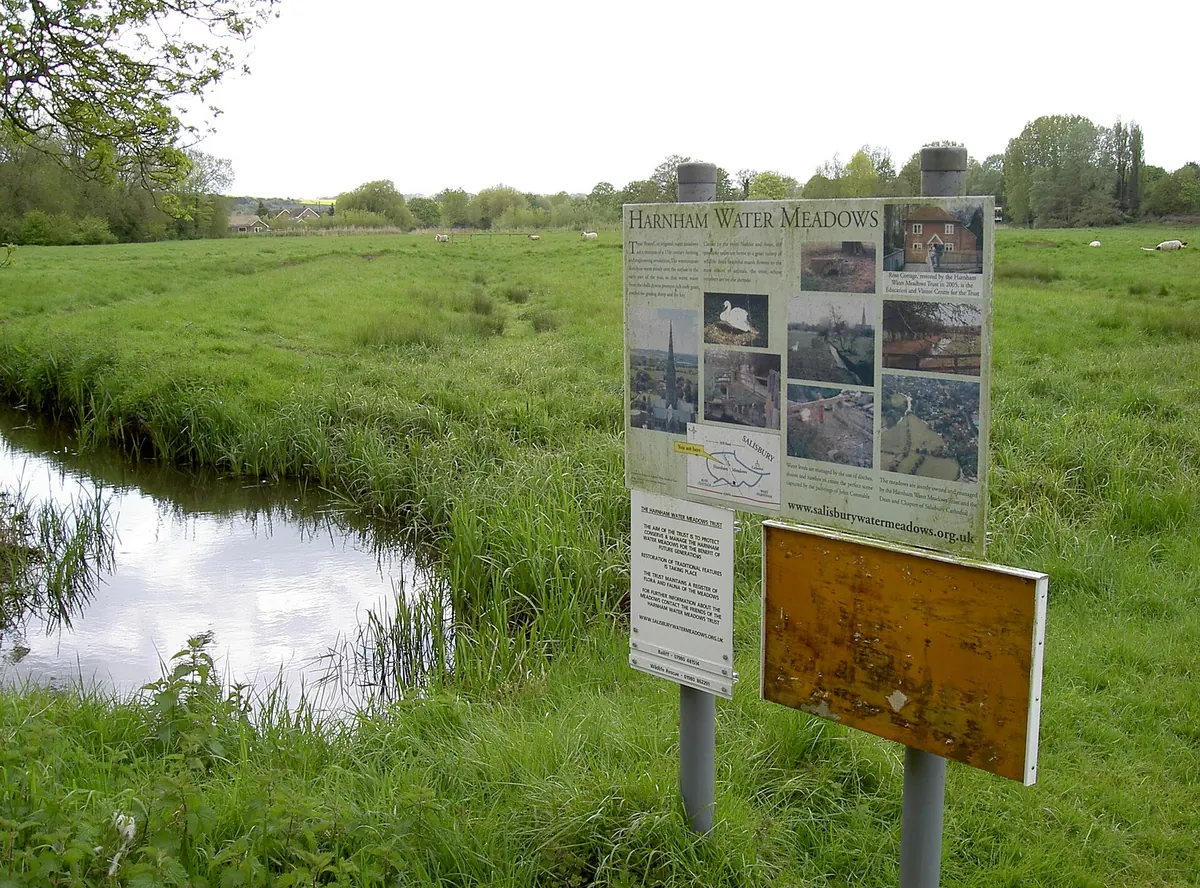
Harnham’s history records later economic difficulties, labour costs and competition from other fodder and fertilising arrangements. The establishment of the Harnham Water Meadows Trust in 1990 gave conservation a lasting organisational form. A surviving channel is not automatically a functioning system, however. Maintaining flow still depends on suitable levels, unobstructed connections and people who understand the hatches. Conserving an outline on a map is different from retaining the ability to operate it.
The 2004 assessment of Turnastone, presented as a draft report, combined interest in surviving structures with the history of land use and the transmission of skills. Heritage consequently includes small channels, traces of alterations and knowledge of the whole arrangement. It extends beyond the most conspicuous engineered features.5101
Questions and answers
Is a water meadow simply a field flooded by a river?
Not in the sense used here. This article concerns meadows with structures for deliberately supplying, distributing and removing water. A natural river flood is different from a controlled irrigation flow.1
Did Rowland Vaughan invent meadow irrigation in 1610?
That cannot be established. He published his experiences in 1610. The book documents the circulation of an account, not the first use of the technique in England or worldwide.2
Why did an irrigated meadow need drains?
Supplying water was only part of the arrangement. Effective drainage kept water moving through the meadow and limited the stagnation that historical practitioners sought to avoid.1
Sources
- Encyclopaedia Britannica, fourth edition; accounts of George Boswell and Thomas Wright (1810). Agriculture: watering meadows, contemporary discussion and practical descriptions; transcription of the 1810 edition
- Ellen Beatrice Wood; Ewyas Lacy Study Group transcription (1897). Introduction to the 1897 reprint of Rowland Vaughan’s Most Approved and Long Experienced Water-Workes, first published in 1610
- Joseph Bettey (2003). The development of water meadows on the Salisbury Avon, 1665–1690; published abstract
- Downton Heritage Trail (n.d.). The Water Meadows
- Harnham Water Meadows Trust (n.d.). History
- Roger L. Cutting, Hadrian F. Cook, Ian P. F. Cummings (2003). Hydraulic conditions, oxygenation, temperatures and sediment relationships of bedwork watermeadows; published abstract
- H. F. Cook, R. L. Cutting, W. Buhler, I. P. F. Cummings; FAO AGRIS record (2004). Productivity and soil nutrient relations of bedwork watermeadows in southern England; abstract supplied by the National Agricultural Library
- Susanna Wade Martins, Thomas Williamson; University of East Anglia (1994). Floated water-meadows in Norfolk: a misplaced innovation; institutional repository abstract
- Heather Wallis (2014). Excavation of Test Pits, River Nar Restoration Project, Castle Acre, Norfolk, Phase 2; archaeological field report
- Katherine Stearne and collaborators; Green Mark International (2004). Turnastone Court Farm: an assessment of the historical, landscape, ecological and agricultural importance of the water meadows; draft report, historical discussion and survey
- George Boswell; Wellcome Library collection catalogued on Wikimedia Commons (1779). A treatise on watering meadows; bibliographic record of the 1779 edition, not the full text
Approximate dates (c.) describe the nature of the evidence: archaeology dates settlements, layers and remains, not single moments of invention.