

Key dates
- after 1585 · dating modelProbable later construction of investigated Banaue-area terraces; not the date of every terrace.3
- 1919 · publicationBarton publishes Ifugao Law, documenting rules concerning land and water.9
- 1995Five terrace clusters are inscribed on the UNESCO World Heritage List.141
- 2001The terraces enter the List of World Heritage in Danger.1
- 2009 · publicationBayesian modelling supports revision of the traditional chronology of investigated terraces.3
- 2012Removal from the Danger List, accompanied by recommendations for continued conservation.13
A landscape extending well beyond the terraces
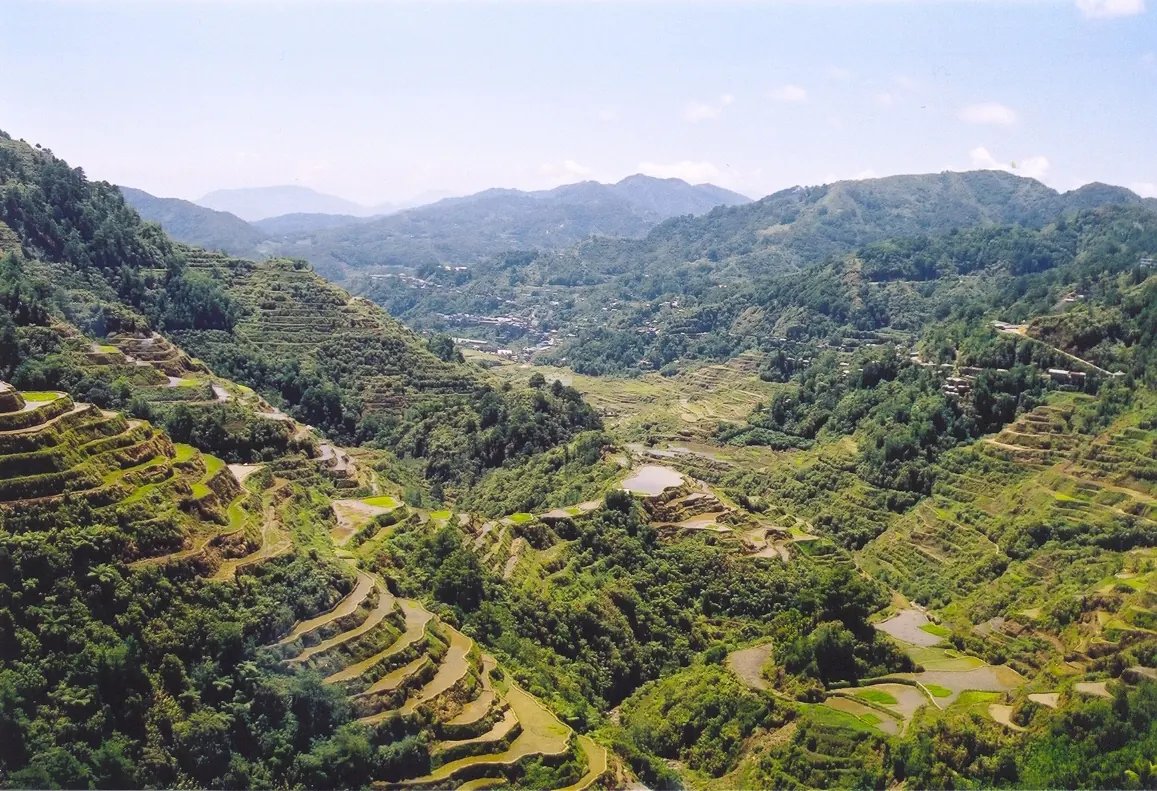
Ifugao lies in the Cordillera mountains of northern Luzon in the Philippines. The 1995 UNESCO inscription includes five terrace clusters: Nagacadan in Kiangan, Hungduan, Mayoyao, Bangaan and Batad. It does not designate every field in the province or every viewpoint promoted to visitors as the Banaue terraces. Stone or earthen structures retain cultivated surfaces on slopes, while water supplies connect them to higher parts of their catchments. An individual field is therefore one component of a much wider functioning system.
The FAO description identifies the coexistence of communal forests, managed woodlots, cultivation on slopes, terraces, settlements and water resources. These elements have different functions, and a field boundary is not the boundary of the farming economy as a whole. Households also required fuel, building materials and ground for other crops. This relationship is central to agricultural history: maintaining a terrace depended on resources and work beyond its bund. Preserving only the appearance of the steps would leave unanswered the question of how their inhabitants sustained production.1214
What new dating has changed
A two-thousand-year history for the rice terraces was long repeated in textbooks and heritage descriptions. Stephen Acabado’s 2009 study, combining radiocarbon dates with a model of stratigraphic sequence, instead indicated probable construction of the investigated Banaue-area terraces after 1585 CE. This result cannot become a single founding date for all Ifugao fields. It demonstrates that comparatively late landscape transformation may have been much more significant than an older model of continuous, essentially unchanged cultivation allowed.
Settlement, terracing and intensive wet-rice agriculture are three distinct developments that need not have begun together. In a 2012 study, Acabado considered earlier cultivation of irrigated surfaces with taro. Old charcoal incorporated in a terrace fill may derive from a previous settlement or have been moved during construction. Its age does not automatically date rice farming on that spot. Separating these processes makes it possible to recognise a deep history of human occupation while investigating the relatively recent expansion of a particular agricultural system.34
Expanding fields in response to the colonial world
Acabado uses pericolonialism to describe transformation in places beyond sustained direct colonial administration that nevertheless experienced its political and economic effects. Spanish power in neighbouring lowlands altered conditions in the mountains as well. In this interpretation, the growing importance of wet-rice cultivation formed part of local responses to pressure and changes in the surrounding region. It does not mean that Spaniards constructed the terraces or supplied the Ifugao with a ready-made agricultural system. The historical actors were inhabitants reorganising their own resources.
A collaborative publication in 2019 combined dates, plant remains, evidence concerning animals and people, and spatial analysis in support of a later transition to intensive wet-rice farming. The image of highland isolation is also misleading. Imported glass beads and trade ceramics recovered at Old Kiyyangan demonstrate connections beyond its valley. Maintaining political autonomy did not require withdrawal from exchange. Farming, contact and local identity developed together, while resistance to colonial expansion included the organisation of food supplies. The resulting landscape records an active engagement with changing circumstances rather than survival outside history.5611
Rice, root crops and woodland within one farming economy
Irrigated terraces known as payo coexisted with unirrigated cultivation and managed woodlots called muyong. The latter supplied materials and helped protect lower slopes against runoff and erosion. Landscape analysis published in 2012 challenges a simple sequence in which intensive agriculture completely replaces other production strategies. Farmers could combine methods with different requirements for land, water and labour. Less visually dramatic root-crop plots remained important alongside prestigious rice terraces. This combination matters when evaluating productivity: the output of one kind of field cannot stand for everything a household produced or consumed.
A land-use model for Old Kiyyangan comparing scenarios around 1570 and 1800 showed how intensification and diversification could operate together. Under its assumptions, greater use of rice and sweet potatoes allowed a larger population without a proportional expansion of all food-procuring areas. This was a calculation based on dietary and yield assumptions, not a surviving register of actual harvests. Its contribution is to clarify a mechanism: additional labour invested in selected surfaces could coexist with continued woodland and other land uses. The model should inform questions about historical possibilities, rather than supply invented statistics for individual villages.78
Water: a right to use and an obligation to maintain
Roy Franklin Barton’s Ifugao Law, published in 1919, provides a detailed external account of local rules, written in a colonial setting. He described arrangements in which established use of a supply limited an individual’s freedom to redirect it. An owner with two fields separated by somebody else’s plot could not simply carry water past the intervening neighbour in a trough to serve only the lower property. Access depended on prior rights and relationships, rather than merely on who happened to occupy the ground nearest the source. A physical advantage upstream was therefore not equivalent to an unlimited entitlement.
Barton distinguished ownership of a spring, rights to its surplus water and a share in a conveying ditch. He described the permanent transfer of a portion of the flow independently of later changes in ownership of the land containing the spring. Acquiring a share in a ditch also brought a burden of maintenance. In the arrangement he recorded, shortages were apportioned according to the area of rice fields being supplied. Such rules linked the benefit of infrastructure to responsibilities for keeping it usable. Excavating a channel once was insufficient: recognised claims, negotiation and recurring repairs were also necessary. This is historical testimony involving regional variation, not an account of present-day law universally applicable to all Ifugao communities.9
Family property, inheritance and restoring abandoned fields
In Barton’s account, rice fields and certain valuable possessions connected an owner with relatives and succeeding generations. Control over land did not amount to complete independence from the family. Selling a valuable field required consideration of kin interests and recognised procedures. Inheritance could give an older child a larger share while connecting that position with obligations to relatives. The local scope of these observations must be retained. Nevertheless, the record helps explain how a terrace could be a productive surface, a lasting asset and a relationship between generations at the same time. Its social significance was not exhausted by its market value.
Barton also described provisions for returning an abandoned field to cultivation. A person clearing vegetation, repairing dikes and levelling the ground acquired a temporary right of use, with its duration linked to the preceding period of neglect. If the former owner sought an earlier return, recovering possession required a settlement. The arrangement recognised the value of restoration work while retaining a memory of prior claims. It reveals a landscape that was never a once-completed construction project: plots could be neglected, repaired and brought back into production. Continuity in farming did not require every terrace to remain unchanged, but depended on the ability to restore ground and settle who could benefit from it.9
Rice within social relationships and oral tradition
The significance of a field cannot be reduced to the quantity of grain harvested. Barton’s descriptions show relatives and intermediaries participating in property transfers and the resolution of claims. Achieving an agreement recognised by others belonged to the functioning of the economy. Dependence on neighbours did not erase separate family rights: common work on a water supply could serve plots held by different people. This combination of cooperation and differentiated claims is more informative than a simplified picture of either completely communal land or isolated, self-sufficient holdings. It also explains why knowing a channel’s route cannot reveal all the relationships sustained by its water.
Narrative chants called hudhud are connected with agricultural work as well. UNESCO’s documentary description identifies performances during the rice sowing season and harvest, alongside funerary and ritual settings. The same landscape thus supported food production and the transmission of stories. The association between chants and rice cannot independently date the construction of a particular terrace or prove that present cultivation methods existed at the beginning of the tradition. Material evidence and oral memory contribute different kinds of knowledge. Reading them together is most productive when neither is reduced to a decorative illustration of the other.910
Conserving a working landscape with its communities
The terraces appeared on the List of World Heritage in Danger from 2001 until 2012. The 2012 decision to remove them recognised progress while calling for continued financing, planning and assessment of new developments. It did not announce that conservation was complete. Working fields require successive seasons of labour and people able to continue providing it. Their protection therefore connects the upkeep of earthworks with livelihoods, water management and decisions over land use. A terrace can retain its familiar outline while the conditions enabling cultivation change substantially.
New dating raised questions among communities familiar with the two-thousand-year account. Archaeological work developed with Ifugao authors and partners involved inhabitants in research and interpretation. A shorter chronology for intensive rice cultivation does not diminish the builders’ expertise: it demonstrates the capacity to reorganise landscapes rapidly in demanding historical circumstances. The heritage includes both surviving fields and the ability to explain their transformations on the communities’ own terms. Ifugao history is consequently best understood through continuing work, changing relationships and local decisions, rather than as an immobile monument outside the events that shaped the Philippines.1131211
Questions and answers
Are all Ifugao terraces 2,000 years old?
There is no basis for assigning every field the same age. Dating and crop research indicate important later rice expansion, alongside earlier settlement and the use of other plants.64
Does later dating mean the Spanish built the terraces?
No. The pericolonial interpretation concerns local responses to the effects of colonialism. Ifugao inhabitants built and managed the landscape.5
Why do historical water rules matter for terrace history?
The 1919 account connects flow entitlements with ditch maintenance, neighbours and field area. Earthworks alone cannot explain how agricultural production was organised.9
Sources
- UNESCO World Heritage Centre (n.d.; accessed 2026). Rice Terraces of the Philippine Cordilleras — official listing and description
- Food and Agriculture Organization of the United Nations (n.d.; accessed 2026). Ifugao Rice Terraces, Philippines — GIAHS system description
- Stephen B. Acabado (2009). A Bayesian Approach to Dating Agricultural Terraces: A Case from the Philippines
- Stephen B. Acabado (2012). Taro Before Rice Terraces: Implications of Radiocarbon Determinations, Ethnohistoric Reconstructions, and Ethnography in Dating the Ifugao Terraces
- Stephen B. Acabado (2017). The Archaeology of Pericolonialism: Responses of the “Unconquered” to Spanish Conquest and Colonialism in Ifugao, Philippines — abstract
- Stephen B. Acabado et al. (2019). The Short History of the Ifugao Rice Terraces: A Local Response to the Spanish Conquest — abstract
- Stephen B. Acabado (2012). The Ifugao Agricultural Landscapes: Agro-cultural Complexes and the Intensification Debate
- D. M. Findley et al. (2022). Land Use Change in a Pericolonial Society: Intensification and Diversification in Ifugao, Philippines Between 1570 and 1800 CE
- Roy Franklin Barton (1919). Ifugao Law
- UNESCO Multimedia Archives; Philippines National Commission (2008). The Hudhud Chants of the Ifugao — documentary description
- Stephen Acabado, Marlon Martin and Adam J. Lauer (2014). Rethinking History, Conserving Heritage: Archaeology and Community Engagement in Ifugao, Philippines
- Stephen Acabado, Marlon Martin and Francisco Datar (2017). Ifugao Archaeology: Collaborative and Indigenous Archaeology in the Northern Philippines
- UNESCO World Heritage Committee (2012). Decision 36 COM 7A.29: Rice Terraces of the Philippine Cordilleras (Philippines)
- UNESCO World Heritage Committee (1995). Decision 19 COM VIII.C.1: Inscription of the Rice Terraces of the Philippine Cordilleras
Approximate dates (c.) describe the nature of the evidence: archaeology dates settlements, layers and remains, not single moments of invention.