

Key dates
- 1939DDT’s insecticidal properties are recognised; the compound itself was known earlier.16
- 1959Publication of research on integrated control of the spotted alfalfa aphid.9
- June–autumn 1962Serial publication in The New Yorker, followed by Silent Spring in book form.21
- 15 May 1963Use of Pesticides recommends research, monitoring and changes in oversight.8
- 14 June / 31 December 1972EPA announces its decision; the principal US DDT restrictions take effect at year-end.6
- 11 August 1975EPA reports an assessment of environmental and economic consequences of restrictions.14
Why post-war agriculture placed confidence in DDT
DDT was synthesised in the nineteenth century, but its insecticidal properties were recognised only in 1939. Wartime use against insects transmitting disease gave it a reputation as an exceptionally effective tool. Agricultural and commercial applications spread after 1945. For producers, its appeal included relatively low cost, broad activity and effects that persisted after treatment. The immediate value of a protected harvest was visible. Consequences developing outside the farm, or over several subsequent seasons, were more difficult to observe and to include in the original calculation of success.
The same properties subsequently became reasons for concern. Persistence, initially attractive because an application continued to work, also meant that residues could remain in the environment. Extensive use was accompanied by the emergence of resistance in insect populations. The later controversy therefore cannot be reduced to the rejection of an effective product following the appearance of one book. Evidence of ecological costs was changing, and so was the practical usefulness of available treatments. Farmers, scientists and administrators increasingly faced a comparison between immediate gains and consequences that a simple count of dead pests could not capture.16175
A biologist, an editor and a network of evidence
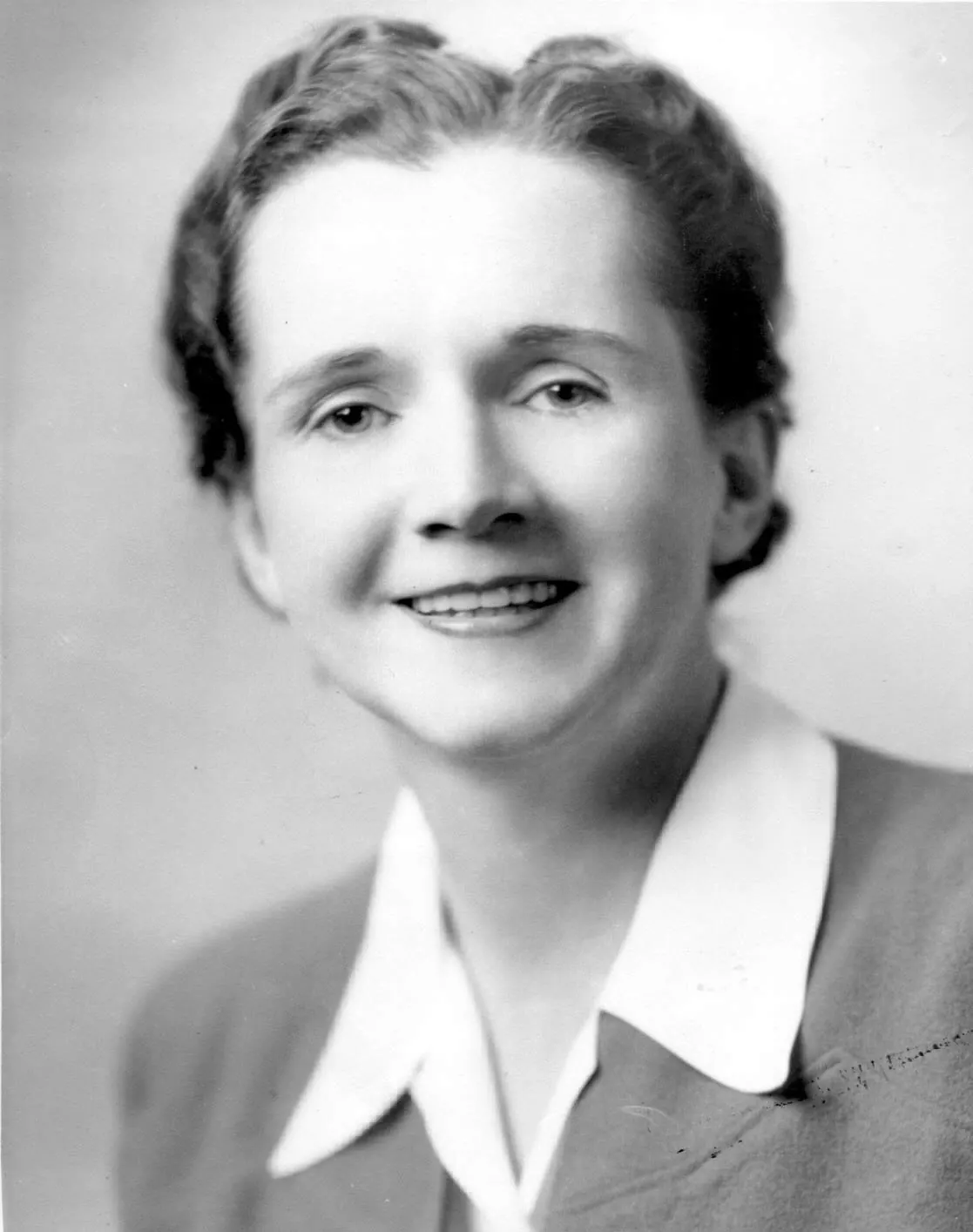
Carson entered this discussion with substantial professional experience. In 1936 she became a biologist with the federal Bureau of Fisheries, later editing publications for the U.S. Fish and Wildlife Service. Her work combined scientific information, observation and the communication of specialised knowledge to a wider audience. Former colleagues and collaborators, including Shirley Briggs and Clarence Cottam, also helped her obtain material on pesticides. The strength of the undertaking lay partly in connecting evidence scattered across different disciplines and institutions, rather than presenting a single isolated experiment as the complete answer.
The success of The Sea Around Us allowed Carson to leave government service in 1952 and devote more time to writing. She worked on Silent Spring at her home in Silver Spring, Maryland, beginning the project in 1958. The house provides a geographical anchor for a story whose subject extended across agricultural, forest and urban landscapes. The form of communication was equally important. Carson could make ecological relationships intelligible to people unlikely to read technical reports. Scientific concerns consequently reached beyond laboratories, government offices and chemical manufacturers, becoming questions that a much broader public could recognise and discuss.43
The treated field belonged to a larger ecosystem
Assessing a spray only within a field’s boundaries overlooks movement through water, air and living organisms. DDT and some of its transformation products can persist and accumulate in tissues. Predators consume numerous organisms containing residues, allowing concentrations to increase through successive levels of a food web under suitable conditions. This process differs from accumulation within a single organism. Nor does every pesticide behave in the same way: a broad category cannot substitute for investigating the properties of a particular substance. The relevant unit of study became larger than the patch of ground where treatment began.
Biological consequences also extended beyond finding dead animals immediately after application. A study published in 1972 analysed 23 bald eagle eggs collected in several states during 1969–1970. The samples contained several contaminants, including DDE, and eggshell thinning was evident across most major areas examined. This was one part of a wider research effort, not a claim that a single chemical explained every reproductive failure. For agricultural history, the change in perspective is significant. The consequences of crop protection could be investigated through bird reproduction and environmental conditions far from the original application, requiring connections between agricultural observations and wildlife research.1311
1962: publication brought a technical debate into public life
The text appeared in three instalments in The New Yorker in June 1962, followed by publication as a book. Silent Spring combined a compelling narrative with information drawn from research and consultation. Public interest was accompanied by sharp criticism from parts of industry and the scientific community. The argument concerned evidence, but also the authority of a woman asking for established practices to be reconsidered. Attempts to discredit Carson became entangled with substantive questions about alternatives to chemical protection and the costs of adopting them. The dispute was simultaneously scientific, economic and public.
Carson did not call for the complete abandonment of every agricultural chemical. She sought more cautious use, further investigation and alternative methods. That distinction is essential: questioning indiscriminate application does not mean claiming that every treatment under every circumstance has exclusively harmful effects. The book enlarged the public audience for these issues, but it was neither an administrative order nor a complete operating programme for farms. Its influence came from translating scattered findings into questions that citizens, politicians and scientists could pursue. Publication changed who participated in the discussion as well as the language in which the problem was described.21
The 1963 report and the organisation of responsibility
The President’s Science Advisory Committee released Use of Pesticides on 15 May 1963. It acknowledged the benefits of chemical protection while calling for stronger evidence, supervision and measures to reduce persistent residues. Recommendations covered monitoring, research into more selective approaches and public information. The report also recognised the importance of Carson’s book in public awareness. It was not a blanket endorsement of every statement in Silent Spring: it translated a broader problem into an administrative and research agenda. Evaluating consequences required sustained institutions as well as a persuasive public argument.
An important question was who should assess the overall balance of a treatment. An organisation charged with increasing agricultural output could place different emphasis on evidence from an agency responsible for wildlife. Created in 1970, the Environmental Protection Agency inherited staff and responsibilities from several bodies, including pesticide regulation previously located in the Department of Agriculture. Its early history shows that change involved reorganising authority. Public concern alone could not supply laboratories, inspection procedures or agreed methods for resolving conflicts between interested parties. The institutional setting shaped which evidence was gathered, how it was weighed and who could challenge a decision.815
Resistance and the earlier roots of integrated control
The shift in agricultural thinking did not begin exclusively with Carson. In 1959, California researchers described integrated control of the spotted alfalfa aphid. Their approach combined observation of pest numbers, an economic threshold, natural enemies and limited chemical intervention. The objective was to keep damage within acceptable bounds, rather than necessarily eliminate every aphid. This specific case demonstrates that alternative approaches were developing within agricultural science before the public controversy of 1962. Biological knowledge and chemical treatment were being examined together as components of a system, rather than treated as mutually exclusive choices.
In the later framework known as integrated pest management, or IPM, identification, field monitoring, prevention and a response proportionate to the threat remain central. Seeing an insect does not automatically establish the need to spray; some species help suppress pests. IPM is consequently neither the name of one product nor a synonym for farming without chemicals. Historically, the important change was to make an application part of a decision process rather than a routine response. Resistance and unintended effects made knowledge of the population and the field more valuable. Access to another pesticide alone could not answer every question about when intervention would produce a worthwhile result.9105
The 1972 decision: geographical scope and transition
On 14 June 1972, EPA administrator William D. Ruckelshaus announced cancellation of nearly all remaining federal registrations for DDT products, with the principal change taking effect at the end of the year. The 31 December announcement identified exceptions for public health, quarantine, a few minor crop uses and exports. This was a United States decision, not a simultaneous worldwide prohibition. Its scope should also be distinguished from later emergency authorisations and from the rules adopted in other countries. The familiar expression “the DDT ban” compresses a more specific administrative history.
The decision followed a contested regulatory process and assessment of scientific material, rather than occurring automatically because a book had succeeded ten years earlier. Delaying implementation allowed time to move towards alternatives. EPA’s historical survey also describes education concerning substitutes: lower environmental persistence did not mean the absence of other hazards associated with their use. From a farm’s perspective, availability, expense and new working requirements were therefore part of the transition. Regulation cannot be separated from the history of agricultural labour and management. Producers had to adapt the protection of particular crops while institutions evaluated both environmental concerns and the practical consequences of change.67
After cancellation: measuring consequences rather than declaring an ending
In 1975, EPA reported to Congress on the effects of restrictions. It described declining DDT residues in monitored parts of the environment and maintained production for most crops, alongside increased costs in some circumstances. This was the agency’s assessment of evidence available for particular places and years, not proof that adjustment was effortless everywhere. Observation remained necessary after the decision. Persistent contamination did not disappear on the date a registration ended, and economic consequences required their own investigation. A regulatory milestone was therefore followed by further measurement rather than providing a self-contained conclusion.
Ecological research continued too. An analysis published in 1997 compared experimental American kestrel data and observations of brown pelicans to examine the relationship between DDE and eggshell thinning. The authors distinguished changes in shell thickness from changes in egg size and shape. The example shows how mechanisms were refined and competing explanations tested long after the original public controversy. Silent Spring’s agricultural legacy lies in this expanded accounting of consequences. Yield, persistence, resistance, beneficial organisms and effects beyond the farm boundary became parts of a shared assessment. The historical lesson concerns how evidence is assembled and decisions are revised, rather than a division of all farming technologies into inherently good or bad categories.1412
Questions and answers
Did Silent Spring call for a ban on every pesticide?
No. Carson challenged indiscriminate and insufficiently investigated uses, advocating research and alternative methods. She did not reject every chemical intervention.34
Was DDT banned throughout the world in 1972?
No. This was a US EPA decision concerning registrations in the United States, with specified exceptions. Its scope was not identical to the rules of other countries.6
Sources
- American Chemical Society (2012). Legacy of Rachel Carson’s Silent Spring; National Historic Chemical Landmark
- Jade Ryerson / National Park Service (updated 2025). Rachel Carson; biographical interpretation
- National Park Service (n.d.). Rachel Carson House; historic-place interpretation
- U.S. Fish and Wildlife Service (n.d.). Rachel Carson (1907–1964), Author of the Modern Environmental Movement; career biography
- U.S. Environmental Protection Agency (updated 2026). DDT — A Brief History and Status; historical sections
- U.S. Environmental Protection Agency (1972). DDT Ban Takes Effect; press release, 31 December 1972
- U.S. Environmental Protection Agency (1975). DDT Regulatory History: A Brief Survey (to 1975); excerpt from EPA-540/1-75-022
- President’s Science Advisory Committee (1963). Use of Pesticides; original report, 15 May 1963, university-hosted scan
- Vernon M. Stern; Ray F. Smith; Robert van den Bosch; Kenneth S. Hagen (1959). The Integration of Chemical and Biological Control of the Spotted Alfalfa Aphid: The Integrated Control Concept; Hilgardia 29(2), 81–101, author abstract in RePEc
- U.S. Environmental Protection Agency (n.d.). Integrated Pest Management (IPM) Principles; official explanation of the approach
- Stanley N. Wiemeyer et al. (1972). Residues of Organochlorine Pesticides, Polychlorinated Biphenyls, and Mercury in Bald Eagle Eggs and Changes in Shell Thickness—1969 and 1970; author abstract, USGS
- Lawrence J. Blus; Stanley N. Wiemeyer; Christine M. Bunck (1997). Clarification of Effects of DDE on Shell Thickness, Size, Mass, and Shape of Avian Eggs; author abstract, USGS
- National Pesticide Information Center / Oregon State University (1999). DDT: General Fact Sheet; archived 1999 background on environmental persistence and food chains
- U.S. Environmental Protection Agency (1975). New DDT Report Confirms Data Supporting 1972 Ban, Finds Situation Improving; press release, 11 August 1975
- Dennis C. Williams / U.S. Environmental Protection Agency (1993). The Guardian: EPA’s Formative Years, 1970–1973; sections on agency formation and pesticides
- Secretariat of the Stockholm Convention (n.d.). DDT Overview; historical introduction
- Peter Thompson / Science History Institute (n.d.). Biting Words: The Culture of Insect Fear in the Mid-20th Century United States; museum exhibition
Approximate dates (c.) describe the nature of the evidence: archaeology dates settlements, layers and remains, not single moments of invention.