

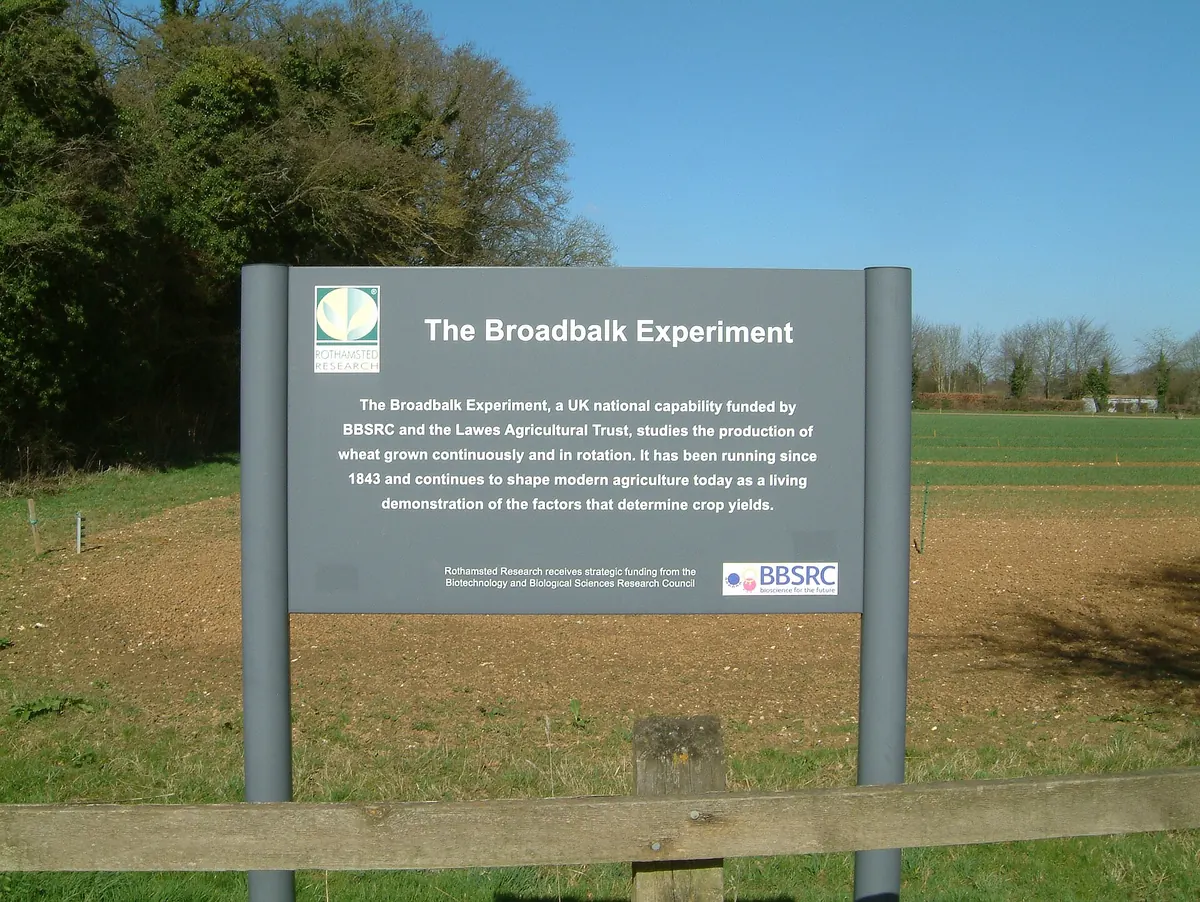
1843 and 1844: two dates marking one beginning
Broadbalk was established on a field with a long agricultural history at Harpenden, north of London. Sowing in autumn 1843 must be distinguished from harvesting in the following year when the experiment’s history is compared with its yield records. Researchers examined treatments including mineral fertilisers, farmyard manure and an unfertilised comparison. This was not an experiment on untouched soil: the field’s previous management formed part of its starting conditions.
That apparently small qualification carries considerable methodological weight. A result always belongs to a particular place and its history. If soil has accumulated or lost nutrients over many years, the crop’s response does not begin from a blank slate when plots are marked out. Describing an old experiment consequently requires a distinction between its establishment date, harvest years and the period during which treatments took shape. A well-documented beginning makes later comparisons possible; it is more than a label to place on a historical timeline.19
What does an untreated comparison reveal?
A control makes it possible to ask what would happen without the input under study under broadly similar weather conditions. Broadbalk included an unfertilised strip alongside strips receiving different treatments. Interpreting a difference still requires knowledge of the particular strip’s full history. The documentation records changes in numbering, subdivisions and the periods during which treatments applied. A three-part illustration labelled “control–fertiliser–manure” can explain the idea, but it is not a historical plan of the complete experiment.
The presence of a control does not solve every problem. Adjacent parts of a field can differ in soil properties, and successive years of observations from one location do not substitute for several independent plots. Repeated measurements reveal the course of change; spatial replication has a different purpose. Distinguishing these roles prevents every yield difference from being attributed to one input. The strength of the evidence depends on the research design, rather than simply on how many numbers appear in the results table.128
Why compare field plots?: A reference treatment helps assess the effect being studied. A control does not mean that the soil contains no naturally available nutrients. The diagram explains the principle of comparison; it is not a map of the plots, and no yields are shown.
Continuity does not mean that nothing changes
Broadbalk preserves a long history of comparisons, but it has not been managed through an identical set of operations throughout its existence. Cultivars, cultivation methods and crop protection changed; liming and rotations were introduced. The documentation distinguishes fertiliser strips from management sections. In 1968, division into ten sections enabled comparisons between continuously grown wheat and wheat in rotation. These developments should remain visible, even when an unchanged field would make a simpler historical story.
Scientific value requires a balance. Continuing treatments allows their long-term effects to be followed, while considered modifications can protect the experiment and maintain its relevance. A change creates particular interpretive problems when it is undocumented or ignored in analysis. Comparing distant decades requires checking whether apparently similar treatment names still represent the same operations. Continuity is therefore an achievement of record-keeping and institutional organisation, rather than a promise that the agricultural world has remained frozen in the nineteenth century.32
Why measure an agricultural system for decades?
Processes involving soil reserves and properties can unfold more slowly than the response of a single harvest. An early yield increase does not establish that the advantage will persist. Equally, a poor year may reflect weather conditions rather than a lasting deterioration of the site. Long records allow researchers to distinguish questions about immediate crop responses, trends through time and the cumulative consequences of management. Each question requires an appropriate comparison and a clear definition of the outcome being investigated.
Meteorological observations provide an important complement. An openly available monthly rainfall dataset covers continuous observations from March 1853 to July 2018. Linking rainfall with yield requires more than placing annual averages side by side: the timing of rain also matters to a growing crop. This illustrates a broader analytical principle. A longer record creates more opportunities to ask questions, but it also increases the importance of information about units, observation dates and changes in the way measurements were made.569
The sample archive: evidence for questions not yet imagined
Lawes and Gilbert retained material after analysis, and subsequent generations continued adding samples. The archive includes grain, straw, grassland vegetation and soil. Broadbalk wheat grain survives from the first harvest in 1844. Coverage is not uniform across materials and dates, however: soil was sampled in particular years, and not every plot was sampled annually. The inventory of available material therefore forms part of the evidence rather than a minor technical appendix to the experiment’s story.
The value of such a collection is comparable to preserving an original document instead of keeping only a note of what it once revealed. A new analytical method can return to material from the past and address a question that earlier researchers could not resolve. This depends on reliable identification of the sample, its location and collection date, together with an assessment of storage conditions. Not every property is equally well preserved. An archive expands scientific possibilities without removing the need to evaluate the physical evidence critically.4
Park Grass: from hay production to ecological questions
Park Grass began at Rothamsted in 1856 on permanent grassland. Its initial purpose was to investigate ways of increasing hay yields through different soil additions. It soon became apparent that treatments also altered the composition of the vegetation. The same ground consequently supported questions about the number and abundance of species, soil properties and relationships between nutrient additions and plant communities. Botanical records were collected at different intervals and through different kinds of observation.
Park Grass shows why agricultural history needs more than one measure of success. A larger quantity of harvested material is not the same outcome as greater species diversity. One measure cannot substitute for the other, and yield alone does not establish the overall performance of a system. A chart likewise needs to explain whether it represents species counts, their contribution to biomass, or the total crop. Broadening the research questions gave an old experiment a significance extending well beyond its original production objective.75
Statistics and data that retain their context
Ronald A. Fisher began working at Rothamsted in 1919, having been hired to analyse its extensive experimental records. Statistical development became an important part of the institution’s history. This does not mean that an experiment established in 1843 already possessed every feature of a later randomised and replicated design. Methods of analysis and principles of experimental planning developed progressively, partly through encounters with the actual variability of fields, crops and weather.
The electronic Rothamsted Archive, e-RA, connects results with the documentation needed to interpret them. A file of numbers alone cannot explain which operations were carried out, the units used to report yield, or whether an empty entry means zero or a missing observation. From a reader’s perspective, a well-published dataset resembles a carefully catalogued museum collection: every object needs context. That principle enables later checking of calculations and guards against apparently precise comparisons that actually concern different things.85
A scientific legacy with explicit limits
Rothamsted’s central achievement is the preservation of a research infrastructure across generations: fields, records, samples and the expertise of the people responsible for them. A long-term experiment can reveal consequences of decisions that remain inaccessible to short projects. Its value nevertheless depends on describing its limitations carefully. A result obtained at one location does not automatically apply to every soil, climate or farm. Some processes also require investigation at the scale of an entire landscape.
Responsible interpretation therefore asks three questions together: what was compared, over which period, and how far may the result be generalised? These questions also apply to historical charts intended for a broad audience. Treatment, unit, date range and changes affecting comparison should be identified. Rothamsted demonstrates that confidence in agricultural science does not arise from one record-breaking number. It grows through maintaining the conditions in which later researchers can check earlier findings and ask more precisely formulated questions about the same evidence.395
Questions and answers
Did Broadbalk begin in 1843 or 1844?
The experiment was established and sown in autumn 1843; its first crop was harvested in summer 1844. The dates refer to different events.1
Have all operations remained unchanged since the nineteenth century?
No. Important long-term comparisons continued, but cultivars, cultivation methods, crop protection and parts of the experimental arrangement changed.32
Why preserve old soil and grain samples?
New analytical methods can revisit material from the past. Conclusions depend on sample identification, availability and storage history.4
Sources
- Electronic Rothamsted Archive, Rothamsted Research (n.d.). Broadbalk: experiment description, history and design
- Electronic Rothamsted Archive, Rothamsted Research (n.d.). Broadbalk section names
- Rothamsted Research (2024). Why do we make changes to the long-term experiments at Rothamsted?
- Electronic Rothamsted Archive, Rothamsted Research (n.d.). Rothamsted Sample Archive
- Sarah A. M. Perryman et al. (2018). The electronic Rothamsted Archive (e-RA), an online resource for data from the Rothamsted long-term experiments CC BY 4.0
- Sarah Perryman, Tony Scott, Chris Hall (2018). Dataset: Total Monthly Rainfall at Rothamsted March 1853–July 2018 CC BY 4.0
- Jonathan Silvertown et al. (2006). The Park Grass Experiment 1856–2006: its contribution to ecology
- Rothamsted Research (2019). Surprising birthplace of modern data analysis celebrates 100 years
- Rothamsted Research (2019). Rothamsted Long-term Experiments: Guidebook
Contains data supplied by Rothamsted Research. The Electronic Rothamsted Archive (e-RA), its datasets, information and other resources, are part of the Rothamsted Long-Term Experiments - National Bioscience Research Infrastructure (RLTE-NBRI), funded by the UK Research and Innovation - Biotechnology and Biological Sciences Research Council (UKRI-BBSRC) under award BBS/E/RH/23NB0007 (2023-2028). The RLTE-NBRI is also supported by the Lawes Agricultural Trust.
Approximate dates (c.) describe the nature of the evidence: archaeology dates settlements, layers and remains, not single moments of invention.