

Key dates
- 1835–1836Bassi publishes work on fungal muscardine, a disease distinct from pébrine.43
- 1849Pasteur later records widespread rearing failures in this year and an expanding egg trade.1
- 1865Pasteur begins his investigation around Alès.928
- 1868–1869Further selection trials and successive rearings test the method’s usefulness.15
- 1870Publication of the two-volume Études sur la maladie des vers à soie.111
- 1870The sericulture congress at Gorizia supports international circulation of knowledge about selection.6
Silk began with mulberry trees and farm labour
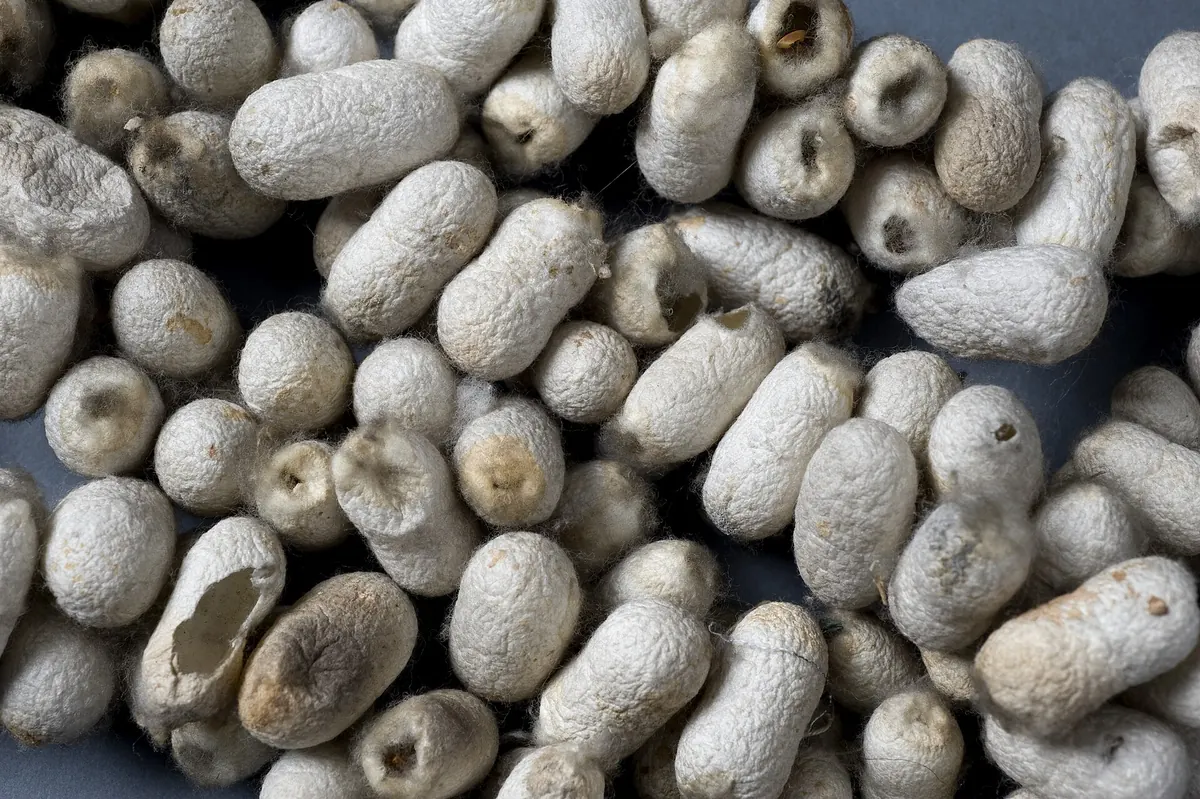
The mulberry silkworm, Bombyx mori, connected fibre production to the rhythm of vegetation. Its caterpillars required mulberry leaves, so rearing depended on trees, suitable indoor space and the labour of collecting and delivering food. After growing, the larvae spun cocoons in which further metamorphosis took place. Some insects were retained for reproduction; other cocoons entered processing. Agricultural cocoon production and the industrial reeling of silk thread were connected but distinct stages, with different tasks and sources of income.
In the Cévennes, sericulture supplemented farm earnings and gave value to mulberry plantations. Losing a rearing meant losing work already invested in trees and feeding. The consequences also reached factories employing many women. The Maison Rouge museum records 23 establishments working with silk in Saint-Jean-du-Gard in 1856, employing 1,090 women and 150 men. This is a local industrial workforce count, not a total of silkworm rearers. Nevertheless, it demonstrates why the disease of an insect could become a problem for an entire local economy.11013
The crisis was established before Pasteur arrived
Pasteur entered a region already familiar with repeated failures. In his 1870 book he recorded recollections of losses in the mid-1840s and conspicuous failures from 1849 onwards. The epidemic therefore began before his official mission. Disease did not appear everywhere simultaneously, and its spread did not immediately have to reduce the national harvest. Expanding production and purchasing eggs from other districts could temporarily conceal the damage, creating the apparent contradiction of increasing output alongside worsening local experience.
Merchants sought healthy stock in Lombardy and then in further silk-producing areas. Imports of Japanese eggs later became significant. Distance from an affected district did not itself guarantee safety, however, and material with an uncertain history entered the trade. Pasteur described successful rearings that produced apparently promising cocoons but disappointing offspring in the following generation. The problem concerned the continuity of reproduction, rather than the appearance of a single harvest. Buyers needed information about the health of a future rearing that could not simply be inferred from attractive eggs or the value of the previous crop.1
Muscardine, pébrine and flacherie were different problems
Pasteur’s investigations had an important predecessor. In 1835–1836 Agostino Bassi published his work on muscardine, a silkworm disease caused by the fungus now called Beauveria bassiana. He associated its transmission with the movement of fungal spores. This was a different disease from the pébrine subsequently investigated by Pasteur. Merging both episodes into one silkworm plague obscures a significant part of the history of understanding infection and the contributions made before the French investigations.
Pébrine is associated with the microsporidian Nosema bombycis. Nineteenth-century microscopists observed distinctive small bodies, but disagreed about their nature and significance. Flacherie, meanwhile, covered episodes in which caterpillars became flaccid and died, without pébrine alone explaining the losses. Modern knowledge identifies a more complex set of causes, including bacterial and viral agents. The historical term should therefore not be equated with one simple diagnosis. Distinguishing these problems helped explain why a method effective against one disease did not automatically guarantee a successful rearing in every respect.4315
Alès: a laboratory within the landscape of sericulture
In 1865, following the intervention of Jean-Baptiste Dumas and the French government, Pasteur began work in southern France. Alès, also written Alais in contemporary publications, became the main centre of the investigation. The house at Pont-Gisquet, in present-day Saint-Jean-du-Pin, is associated with this work. Laboratory and rearing spaces stood close to working sericultural communities, allowing microscopic findings to be compared with events in actual production. The landscape of the research included houses, mulberry trees and farmers as well as scientific instruments.
Work extended across successive seasons and followed larvae, cocoons, pupae, moths and their offspring. Collaborators included Duclaux, Gernez, Maillot and Raulin. It was not a complete diagnosis delivered at the first glance through a microscope: Pasteur initially misinterpreted the nature of the bodies associated with pébrine and revised his views. Surviving cocoons in the Science Museum Group collection and records in the Alès archives recall the material work behind the investigation. Samples, comparison groups, identifying labels and the time needed for another generation were all necessary to test an explanation.9871512
Cellular grainage and the identity of an egg batch
In the language of sericulture, graine meant silkworm eggs, while grainage referred to producing eggs for subsequent rearing. Cellular selection separated moths or parental pairs and preserved the connection between those parents and their batch of eggs. After laying, the parent insects underwent microscopic examination. Material associated with the characteristic pébrine bodies was rejected; batches with an acceptable examination result were retained. “Cellular” referred to this separated arrangement, not to the laboratory culture of biological cells in its present-day sense.
The identifying procedure was as important as the instrument. If eggs from different families were mixed before the preparations were assessed, the result could no longer identify which batch to discard. Separate containers, labels and records were therefore essential. The criterion of quality changed: a large, marketable cocoon was insufficient proof that its insect should become a parent. Inspection addressed material on which the next season depended. It selected reproductive families rather than attempting to recover every loss only after visibly sick caterpillars had appeared in a commercial rearing.261
Why a single examination could not solve every difficulty
The investigations showed that infection could pass between generations with reproductive material, while also spreading during rearing. In experiments described by Pasteur, food, contaminated material and surroundings occupied by diseased insects mattered. Nineteenth-century references to the “heredity” of disease must be understood in that setting. They describe the transmission of infection between parents and offspring, rather than demonstrating the inheritance of a trait according to genetic laws. The distinction explains why selecting parental stock could interrupt an apparent family history of illness.
Another essential distinction separated the health of breeding material from the success of a current cocoon harvest. Larvae could produce valuable cocoons while a later developmental stage revealed infection. Conversely, failure in the absence of the characteristic bodies encouraged investigation of another disease, including flacherie. These complications made rearing conditions and comparison through time significant. Egg selection was a powerful means of limiting pébrine, but it neither demonstrated immunity to every disease nor cured an already infected silkworm. The achievement was a more dependable starting point for husbandry, not the removal of every biological uncertainty.123
From the microscope to an organised market in breeding stock
Introducing the method required more than acquiring an instrument. Someone had to prepare a specimen, recognise the relevant bodies, record the result and maintain the separation of batches. An egg producer and the farmer using that material in the following season both had to trust those operations. Quality assessment partly moved from the appearance of goods and a merchant’s reputation towards a repeatable examination. Early discussions even considered making microscopes available within local communities so that access to inspection need not depend solely on an individual household’s equipment.
Experiments, publications and specialised organisations carried the practice further. The State Silk Museum in Tbilisi points to the international sericulture congress at Gorizia in 1870 and to stations, including those in the Caucasus, that examined and distributed healthy eggs. This later development does not imply identical adoption in every country. It shows that the technique could travel together with a working procedure. Its usefulness depended on maintaining a link between the recorded examination and the actual material delivered to a rearer. Laboratory knowledge became effective through an organised chain of people, labels and transactions.16
Scientific achievement and the limits of a rescue narrative
In 1870 Pasteur published the two-volume Études sur la maladie des vers à soie. The first volume discussed pébrine and flacherie; the second collected notes and documents. The publication preserved experiments and disputes from which a practical preventive system had emerged. Its illustrations and descriptions of rearings showed how a farming problem could be investigated by combining detailed laboratory observations with comparison across production cycles. The work became an important stage in the development of a microbial understanding of disease.
Saying that Pasteur “saved sericulture” conveys the importance of his contribution but simplifies the industry’s subsequent history. Limiting pébrine could not automatically restore every mulberry plantation, farm income or job, and his own description of the crisis documented dependence on international trade. French processing establishments had a separate, longer history: Maison Rouge did not close until 1965. The enduring legacy is more precise than a single moment of rescue. The health of reproductive material became an object of systematic investigation and quality control, rather than merely a buyer’s hope about the coming season.1111012
Questions and answers
Did Pasteur vaccinate silkworms against pébrine?
No. The central method examined parent moths and selected the batches of eggs connected to them. It aimed to limit transmission into the next rearing, rather than vaccinating silkworms or treating every sick caterpillar.21
Sources
- Louis Pasteur (1870). Études sur la maladie des vers à soie. Tome I: La pébrine et la flacherie; Wellcome Library copy
- Institut Pasteur (2016). The middle years 1862–1877 — Silkworm diseases
- Brian Lovett / American Society for Microbiology (2019). Sick or Silk: How Silkworms Spun the Germ Theory of Disease
- William B. Ashworth Jr. / Linda Hall Library (2024). Agostino Bassi — Scientist of the Day
- Yves Carton (2022). Louis Pasteur face à la maladie du ver à soie (1865–1870): du chimiste au biologiste; author-deposited full text, DOI 10.5802/crchim.204
- State Silk Museum, Tbilisi (n.d.). Louis Pasteur
- Science Museum Group (n.d.). String of silkworm cocoons, used by Louis Pasteur, 1865–1870; object A63336
- Archives municipales d’Alès (2017). Grainage et industrie de la soie; CD 1/20, related Pathéorama film no. 147
- Cévennes Tourisme / SPL Alès Cévennes (2026). La Maison Pasteur à St Jean du Pin
- Maison Rouge — Musée des vallées cévenoles (n.d.). Le bâtiment
- Wellcome Collection (1870). Études sur la maladie des vers à soie / par L. Pasteur — bibliographic record
- Institut Diversité, Écologie et Évolution du Vivant, Université Paris-Saclay (2023). Louis Pasteur face à la maladie du ver à soie (1865–1870): du chimiste au biologiste — Yves Carton seminar
- Musée de la Soie, Saint-Hippolyte-du-Fort (n.d.). Élevage — cycle du ver à soie et alimentation par feuilles de mûrier
Approximate dates (c.) describe the nature of the evidence: archaeology dates settlements, layers and remains, not single moments of invention.