

Key dates
- 1881–1882Kamieński publishes research on Monotropa and its fungal association.2
- 1885Frank introduces the mycorrhiza concept in an interpretation of tree nutrition.1
- 1950Melin and Nilsson publish on radioactive phosphorus transfer to pine seedlings.5
- 1962Mosse reports arbuscular mycorrhiza in a controlled two-partner culture.8
- 1995Harrison and van Buuren identify a fungal phosphate transporter.11
- 2017Keymer and colleagues document lipid transfer from the plant.14
Root fungi were observed before mycorrhiza was named
Frank was not the first researcher to notice fungi associated with roots. Franciszek Kamieński occupies an important place in the earlier history through his work on the non-green plant Monotropa hypopitys. He published a preliminary account in 1881 and a fuller study in 1882. Investigating a plant without the usual photosynthetic equipment encouraged questions about its fungal connections.
In a further paper in 1885, Frank explicitly discussed Kamieński’s research and the resulting priority dispute. He recognised the earlier interpretation of Monotropa while claiming a distinct contribution through his generalisation concerning trees. The exchange reveals several separate achievements: seeing fungal threads, recognising an organised association and explaining its function. The year 1885 therefore identifies an important conceptual and publishing milestone. It does not mark the biological origin of the association, nor the beginning of every scientific observation of root fungi.23
Truffles, Prussian forestry and a new term
A commission from the Prussian minister responsible for agriculture, domains and forests directed Frank towards the possibilities of truffle cultivation. Examining the fine roots of associated trees, he found that fungal tissue frequently enclosed their outer surfaces. Instead of treating this covering simply as disease, he proposed that root and fungus constituted a functional association. His paper, received on 17 April 1885, used the term Mycorhiza, combining the ideas of fungus and root.
Frank did not rely on a single unusual specimen. He drew on roots supplied from forest districts across Prussia and on plants in Berlin’s botanical garden, comparing trees of different ages and growing in different conditions. Foresters who collected and supplied material were part of this research infrastructure. Repeated observations supported the contention that the association was widespread and connected with the ordinary life of trees. An economic interest in a valuable fungus had opened a fundamental question about how plants lived below ground.1
What a section through a root could reveal
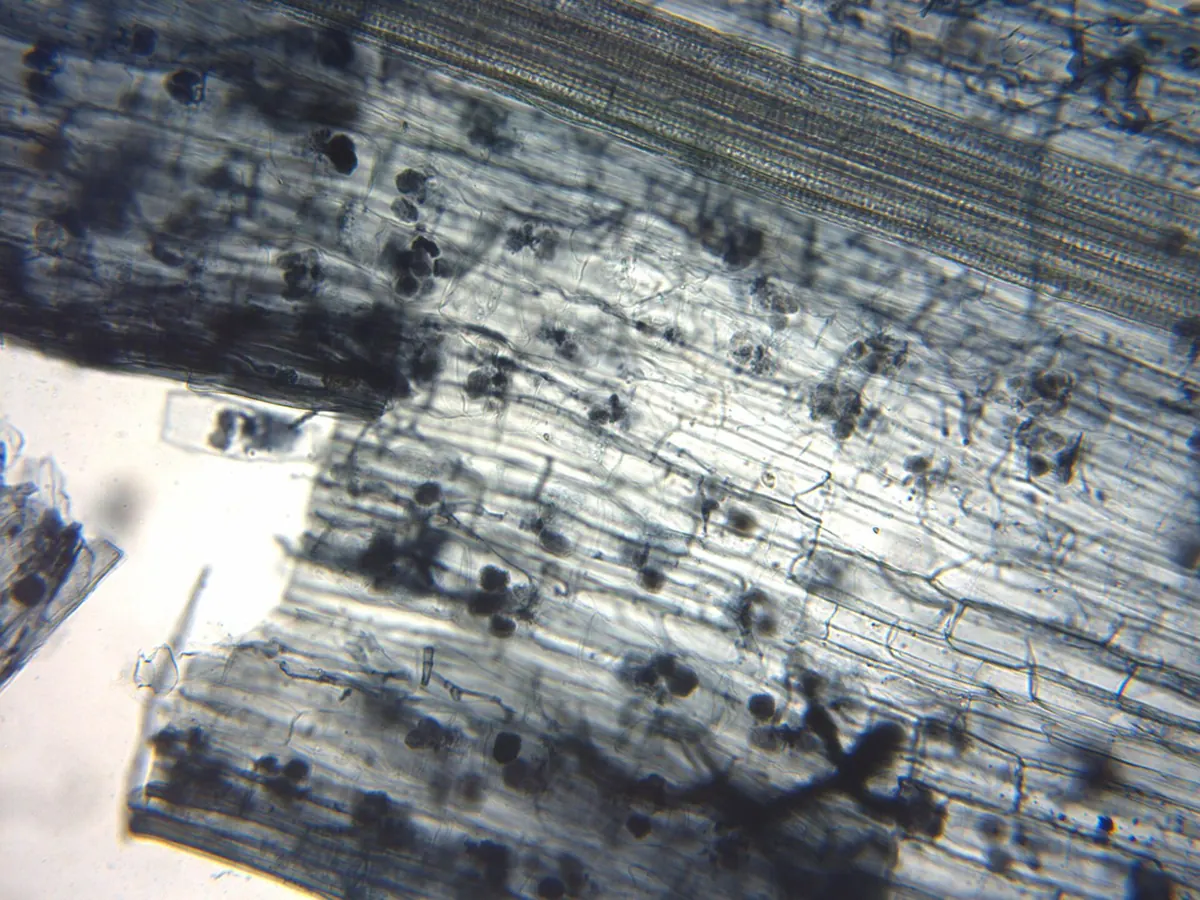
Under the microscope, Frank distinguished plant tissue from the surrounding fungal threads and traced their course between cells in the outer root tissues. He also described differences between ordinary root hairs and the fine roots enclosed by fungi. These arrangements suggested something more organised than incidental soil material adhering to a surface. Anatomy alone, however, could not demonstrate which substances moved between partners or establish the direction of movement.
Modern distinctions between association types clarify that problem. Ectomycorrhizas typically possess a fungal mantle and a network between root cells and occur in many trees. Arbuscular mycorrhizas develop finely branched exchange structures within root cortical cells. They are one form traditionally included under endomycorrhiza, rather than a synonym for every association given that broader name. Orchids and members of the heath family have other distinctive relationships. A shared term therefore does not imply identical anatomy, the same fungal partners or a single nutritional arrangement throughout the plant kingdom.14
Following elements from fungus to plant
Frank gave the nutritional interpretation considerable scope: the fungal covering was to mediate uptake by the trees he examined. His later paper in 1885 nevertheless acknowledged that decisive experimental work would require time. The presence of a fungus could not establish a benefit, and the healthy appearance of a tree could not identify the route taken by nutrients. The historical achievement was to formulate a physiological hypothesis that could be tested, including by evidence that would qualify its most sweeping expressions.
Later research by Elias Melin and Harald Nilsson at Uppsala brought tracers into that investigation. Their 1950 publication concerned radioactive phosphorus reaching pine seedlings through mycorrhizal hyphae. In a 1953 paper they recalled an earlier experiment in which labelled nitrogen was supplied to fungal mycelium and subsequently detected in different parts of a seedling. A tracer distinguished the coexistence of two organisms from the movement of an element between them.256
Barbara Mosse and the challenge of growing an association
Studying mycorrhiza in crop plants presented a particular experimental obstacle: transferring a piece of fungus to an ordinary laboratory medium did not necessarily reproduce the relationship. Writing in 1953 about structures associated with mycorrhizal strawberry roots, Barbara Mosse described earlier failures to isolate the responsible fungus from colonised tissue. Researchers had to preserve its connection with a living host and establish what they were introducing into an experiment. Otherwise a comparison between treated and untreated plants could remain biologically ambiguous.
In 1962 Mosse reported the establishment of vesicular-arbuscular mycorrhiza under aseptic conditions. This was a controlled culture containing two living partners, plant and fungus, rather than an independently growing fungus. In that experimental system, medium composition and bacterial products also affected establishment. Arbuscules and the later development of vesicles could be related to the condition of the host. The achievement made more precise experiments possible by reducing uncertainty about the organisms involved, while emphasising how difficult it was to reconstruct an interaction outside its original soil environment.78
Crop experiments produced different kinds of result
In 1971 Mosse and D. S. Hayman compared onion plants in four soils containing little soluble phosphorus. Plants given the experimental mycorrhizal association grew better even in unsterilised soil. Indigenous fungi nevertheless had different effects in two of the soils: in one they assisted phosphorus uptake, while in the other they did not. The quantity of root colonised was therefore only part of the problem. The identities of the partners and the actual movement of nutrients in a particular soil also mattered.
McGonigle and Miller’s maize research, published in 1993, added a field-management dimension. Their Ontario experiments in 1990–1991 associated reduced tillage with greater early root colonisation and phosphorus uptake than annual mouldboard ploughing. Differences in plant phosphorus later disappeared, however, and final yields did not differ significantly. The authors pointed to the relatively high availability of phosphorus in the experimental soil. A measurable change below ground did not automatically produce an equally measurable increase in harvested grain. Root colonisation, shoot nutrition and final yield were distinct outcomes requiring separate observations.910
Why symbiosis does not guarantee a larger harvest
In 1997 Nancy Collins Johnson, James Graham and Andrew Smith framed mycorrhizal functioning in terms of changing costs and benefits. A plant allocates resources to its partner while receiving access to particular nutrients. The balance changes with environmental conditions, genotype and development. Consequently, visible colonisation is not an independent measure of success, and a short-term increase in biomass does not encompass every possible biological benefit. This framework helped explain why apparently similar associations could perform differently under agricultural conditions.
Experiments published by Toby Kiers and colleagues in 2011 demonstrated regulation on both sides of the exchange. Plants allocated more carbon to better nutrient suppliers, while fungi increased nutrient transfer to roots providing more carbon. The language of rewards describes physiological responses rather than conscious choices. For agronomy, the question had shifted from establishing that mycorrhiza existed to discovering when and how it functioned. Some plants do not form mycorrhizal associations at all. Even among those that do, results obtained for one plant–fungus combination cannot simply be transferred to every other crop or environment.12134
Transport proteins, lipids and a different view of soil
In 1995 Maria Harrison and Marianne van Buuren identified a phosphate transporter from the fungus Glomus versiforme. Its function was tested using a yeast mutant with impaired phosphate transport, and expression of the corresponding gene was associated with fungal threads outside the root. Research could now investigate particular components of the mechanism rather than treating the whole seedling as an experimental unit. Soil nutrition involved a biological intermediary with its own transport machinery, not just a root withdrawing ready-made nutrients from a store.
In 2017 Anika Keymer and colleagues provided evidence that Lotus japonicus transferred lipids to its arbuscular mycorrhizal partner. Mutants and carbon labelling expanded a model previously described chiefly through sugars and mineral nutrients. The scale of observation had changed dramatically since Frank, while the underlying question of dependence between partners remained. Mycorrhiza belongs in agricultural history because it exposed living processes behind plant nutrition and connected microscopy, experimental physiology and field research.1114
Questions and answers
Was Frank the first person to discover mycorrhiza?
In 1885 he named the association and developed an influential interpretation involving tree roots. Earlier observations, including Kamieński’s work on Monotropa in 1881–1882, form a distinct part of the history.12
What did isotope experiments establish?
They allowed researchers to follow a labelled element from fungal mycelium into the plant, providing evidence of nutrient transfer.6
Does greater mycorrhizal colonisation always increase yield?
No. Colonisation, nutrient uptake and harvested yield are different measurements. In the maize experiment discussed here, greater early phosphorus uptake did not produce a significantly higher final yield.10
Sources
- Albert Bernhard Frank (1885). Ueber die auf Wurzelsymbiose beruhende Ernährung gewisser Bäume durch unterirdische Pilze — tekst z 1885 r., transkrypcja Universität Hamburg
- Albert Bernhard Frank (1885). Neue Mittheilungen über die Mycorhiza der Bäume und der Monotropa hypopitys — tekst z 1885 r., transkrypcja Universität Hamburg
- Paola Bonfante (2018). The future has roots in the past: the ideas and scientists that shaped mycorrhizal research
- Mark C. Brundrett; Leho Tedersoo (2018). Evolutionary history of mycorrhizal symbioses and global host plant diversity
- Elias Melin; Harald Nilsson (1950). Transfer of Radioactive Phosphorus to Pine Seedlings by Means of Mycorrhizal Hyphae — rekord wydawcy / publisher record
- Elias Melin; Harald Nilsson (1953). Transfer of Labelled Nitrogen from Glutamic Acid to Pine Seedlings through the Mycelium of Boletus variegatus (Sw.) Fr. — fragment wydawcy / publisher preview
- Barbara Mosse (1953). Fructifications associated with Mycorrhizal Strawberry Roots — abstrakt / abstract
- Barbara Mosse (1962). The Establishment of Vesicular-Arbuscular Mycorrhiza under Aseptic Conditions — abstrakt autorski / author abstract
- Barbara Mosse; D. S. Hayman (1971). Plant Growth Responses to Vesicular-Arbuscular Mycorrhiza. II. In Unsterilized Field Soils — autorskie podsumowanie / author summary
- Terence P. McGonigle; Murray H. Miller (1993). Mycorrhizal Development and Phosphorus Absorption in Maize under Conventional and Reduced Tillage — abstrakt w AGRIS / abstract in AGRIS
- Maria J. Harrison; Marianne L. van Buuren (1995). A phosphate transporter from the mycorrhizal fungus Glomus versiforme — abstrakt autorski / author abstract
- Nancy Collins Johnson; James H. Graham; F. Andrew Smith (1997). Functioning of mycorrhizal associations along the mutualism–parasitism continuum — abstrakt / abstract
- E. Toby Kiers i in. / et al. (2011). Reciprocal rewards stabilize cooperation in the mycorrhizal symbiosis — abstrakt w repozytorium University of Groningen / author abstract
- Anika Keymer i in. / et al. (2017). Lipid transfer from plants to arbuscular mycorrhiza fungi
Approximate dates (c.) describe the nature of the evidence: archaeology dates settlements, layers and remains, not single moments of invention.