

Key dates
- 18 May – 3 June 1943 · Hot SpringsThe food and agriculture conference initiates preparations for a permanent organisation.19
- 16 October 1945 · Quebec CityFAO is established and its first Conference session begins.2
- 1950 · census roundThe agricultural census programme develops international statistical cooperation.85
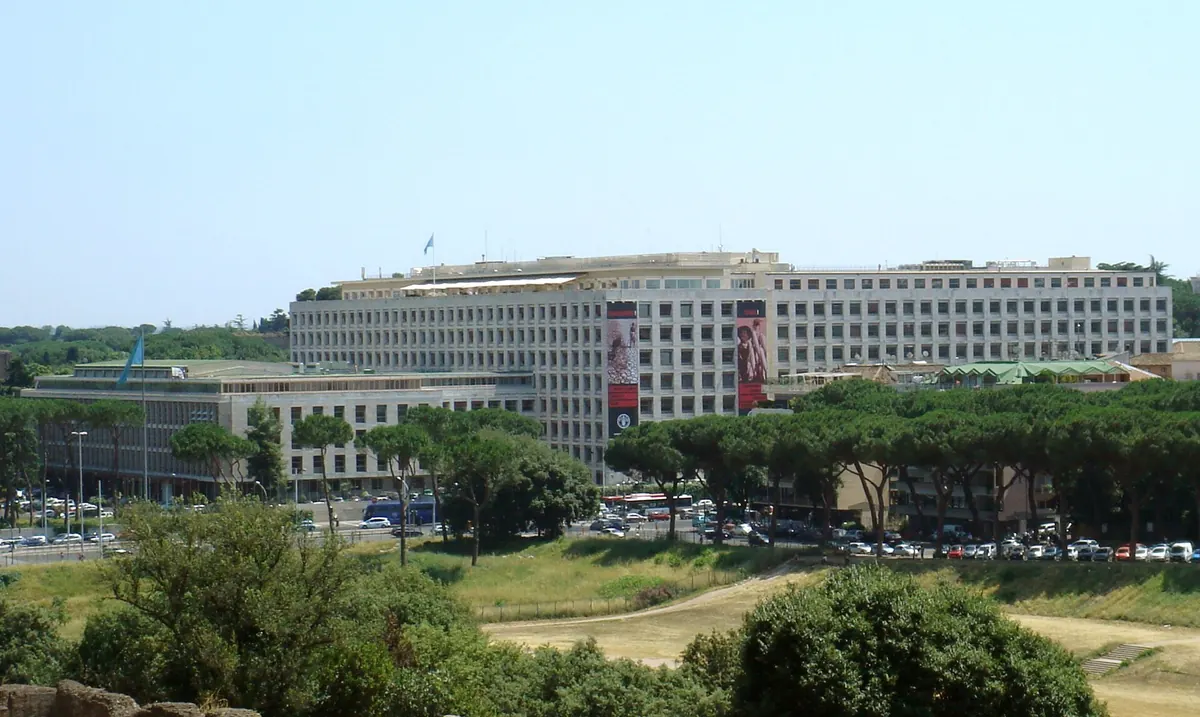
- 1951 · RomeFAO headquarters moves from Washington to Rome.9
International agriculture before FAO
FAO did not begin with an empty institutional landscape. The International Institute of Agriculture had existed in Rome since 1905, following the initiative of David Lubin. It assembled agricultural knowledge across national borders, and its collections and experience became part of FAO’s inheritance. The precedent mattered because harvests, prices and trade in one region could affect producers and consumers elsewhere. International cooperation required information that people could compare, interpret and exchange beyond the country in which it had originally been collected.
The new organisation nevertheless adopted a perspective broader than the comparison of harvest totals. Nutrition also involved income, the quality of diets and the organisation of supplies. A large volume of production did not determine who could afford the food they needed. Improvements in diets depended on farmers, transport, processing and public policy acting within the same system. Bringing those concerns into a common forum made it possible to examine the relationships between a holding and a household meal. It encouraged discussion of a connected set of problems instead of treating each stage as a separate technical question.104
Hot Springs in 1943: planning during the war
Government representatives met at Hot Springs, Virginia, from 18 May to 3 June 1943 for a conference on food and agriculture. The war was still being fought, but participants were already considering the foundations of cooperation afterwards. Their discussion extended beyond the immediate reconstruction of damaged farms. They envisaged a permanent organisation able to investigate relationships between production and nutritional needs and to facilitate joint action. An interim commission subsequently prepared documents and institutional arrangements that made a founding conference possible.
The expression United Nations needs careful interpretation in sources from this period. In the context of the 1943 meeting, it referred to wartime cooperation among the Allied powers; it should not be taken to mean that the later United Nations organisation was already operating in its postwar form. Keeping this distinction prevents the institutional chronology from slipping backwards by two years. Hot Springs marks the beginning of the immediate preparations for FAO. The establishment of FAO itself belongs to Quebec in 1945, when its constitution entered into force and preparatory work gave way to a permanent body.192
Quebec City, 16 October 1945
FAO’s first Conference session opened in Quebec City on 16 October 1945 and continued until 1 November. Governments accepted the constitution, established operating arrangements and selected the organisation’s leadership. John Boyd Orr became the first Director-General. His reputation as a researcher in nutrition helps explain the connection between agricultural concerns and the health and living conditions of consumers. The new institution was to consider not only the quantity of agricultural products but also how those products contributed to human wellbeing.
The places associated with FAO’s beginnings performed different roles. Quebec hosted the formal founding, whereas Washington served as the temporary headquarters. Rome became the headquarters only in 1951. Membership totals also require care: the governments signing at the opening and the membership recorded at the end of the session were not identical groups. More significant than a simplified founding total was the change in the nature of cooperation. The interim commission was replaced by a permanent institution with governing bodies, administrative responsibilities and an agreed programme of work.21910
The mandate: knowledge, recommendations and assistance
The original constitution connected better nutrition and living standards with more effective production and distribution and improved conditions for rural people. FAO was to collect and interpret information, encourage research and recommend action. It could also provide technical assistance when governments requested it. The constitutional meaning of agriculture included fisheries and forestry, placing the institution within a wider discussion of food supplies, livelihoods and the use of natural resources. Its task extended beyond the cultivation of crops.
These provisions did not create a world ministry empowered to give binding instructions to every farm. Governments retained responsibility for implementing policies, while FAO could supply knowledge and help them coordinate. Between a recommendation and its execution stood political decisions, finance and administrative capacity. This distinction matters when assessing the first years of the organisation. An adopted programme demonstrates the scale of an ambition; it does not establish that every proposed activity was financed or completed. Institutional history must therefore compare intended functions with the work that available resources and political agreements actually made possible.324
Understanding nutrition required better information
Reports from the first Conference linked agricultural production to nutrition and the circumstances of families. Useful information had to identify where shortages occurred and whom they affected. Harvest totals alone could not describe the meals eaten in a particular household. Analysts also needed to consider the distribution of food, purchasing power and differences among groups. This encouraged attention to consumption statistics, nutrition surveys and cooperation with specialists concerned with health. The production of food and the assessment of human needs became related fields of inquiry.
A basic methodological distinction illustrates the difficulty: average food availability per person is not a direct measurement of what every individual eats. Similarly, a reduction in total supply does not reveal which households experience the largest losses. International comparisons require compatible definitions, explanations of collection methods and an understanding of missing observations. The 1945 statistical report explicitly treated improvements in methods as part of the proposed programme. FAO’s informational role therefore involved more than putting numbers into print. It also meant helping create conditions under which readers in different countries could understand what those numbers described.45
The World Food Board proposal and the limits of agreement
In 1946 John Boyd Orr proposed a World Food Board. Discussion focused on connecting nutritional needs with production and distribution and on stabilising prices at levels regarded as fair to both producers and consumers. These proposals contemplated more direct coordination than the exchange of information alone. The conference documents record consideration of the scheme and arrangements for further preparatory work. They must not be mistaken for evidence that the proposed system was already operating. A recommendation to examine a mechanism is different from a decision establishing that mechanism.
The World Food Board was not established in its proposed form. Addresses at FAO’s tenth anniversary in 1955 recalled its rejection. The episode exposes a central problem of international cooperation: agreement on desirable outcomes does not necessarily produce agreement about responsibilities, costs and powers. Exporters, importers, farmers and consumers could judge the consequences of the same arrangement differently. The failure of this proposal did not end FAO. It demonstrated that the organisation’s practical role would have to develop within the boundaries of what governments were prepared to support.67
The 1950 census programme: a shared language for farming
The agricultural census programme associated with the 1950 round became a practical expression of statistical cooperation. The 1945 report had already called for investigating such a project and developing schedules suited to the different capacities of national statistical services. Information about agricultural holdings, their size and the status of their operators was central to the proposal. A common framework did not mean that an international team would visit every farm on the planet on a single day. Countries organised their own work within a process of coordination and methodological guidance.
The value of that effort becomes clear in a seemingly simple comparison. If one country counts holdings according to ownership while another follows the actual operation of production, their figures may describe different units. Different size thresholds or reference periods create similar difficulties. Agreeing on terminology cannot eliminate every difference, but it can make those differences visible. Census history consequently reveals a less spectacular aspect of agricultural development: improving the information on which research, planning and the assessment of structural change depend. Knowing what has been counted is as necessary as knowing the final total.58
From postwar initiative to enduring institution
The transfer of headquarters from Washington to Rome in 1951 ended the initial phase of operating from the United States, but it did not settle every question about FAO’s purposes. The organisation developed informational and technical cooperation in a world of highly varied agricultural conditions. Advice suited to one climate, landholding structure or income level could not necessarily be transferred directly to another. Effective exchange required an understanding of local constraints and cooperation with national institutions and the people expected to use the knowledge.
The lasting significance of 1945 was the creation of a permanent setting for considering relationships between agriculture and nutrition. It did not automatically abolish hunger or remove conflicts of interest. It did, however, enable work to continue between conferences, preserve a documentary record and sustain shared procedures. Founding sources should consequently be read both as expressions of hope and as administrative designs. Only by comparing declarations with implementation can historians assess how international ambitions became practical knowledge, institutions and changes in agricultural life. The distinction allows both achievements and limitations to remain visible.947
Questions and answers
Was FAO founded in Rome?
No. It was formally established in Quebec City, Canada, on 16 October 1945. Washington was its temporary headquarters, and the organisation moved to Rome in 1951.29
Sources
- Ralph W. Phillips / Food and Agriculture Organization of the United Nations (1981). FAO: its origins, formation and evolution 1945–1981, chapter 4: The founding of FAO
- L. B. Pearson / FAO (1946). Report of the First Session of the Conference: Letter to governments, 15 January 1946
- Food and Agriculture Organization of the United Nations (1945). Constitution of FAO, original text reproduced in the First Session report
- Food and Agriculture Organization of the United Nations (1945). First Session of the Conference: Report of Commission A
- Food and Agriculture Organization of the United Nations (1945). First Session of the Conference: G. Statistics
- Food and Agriculture Organization of the United Nations (1946). Second Session of the Conference: Report of Commission C, World Food Board and the 1946–47 food situation
- Clifford R. Hope and other speakers / FAO (1955). Program of the tenth anniversary celebrations: addresses of 4 November 1955
- Food and Agriculture Organization of the United Nations (n.d.). World Programme for the Census of Agriculture: Previous rounds, 1930–1980
- Food and Agriculture Organization of the United Nations (1996). A short history of FAO
- David Lubin Memorial Library / FAO (n.d.). Print collections: David Lubin Archive, International Institute of Agriculture and John Boyd Orr collections
Approximate dates (c.) describe the nature of the evidence: archaeology dates settlements, layers and remains, not single moments of invention.