

Key dates
- 12 June 1848Kemp’s Deed predates refrigeration; Ngāi Tahu identify unfulfilled commitments over land and mahinga kai.10
- 2 February 1880Strathleven reaches London with a successful Australian frozen-meat cargo.3
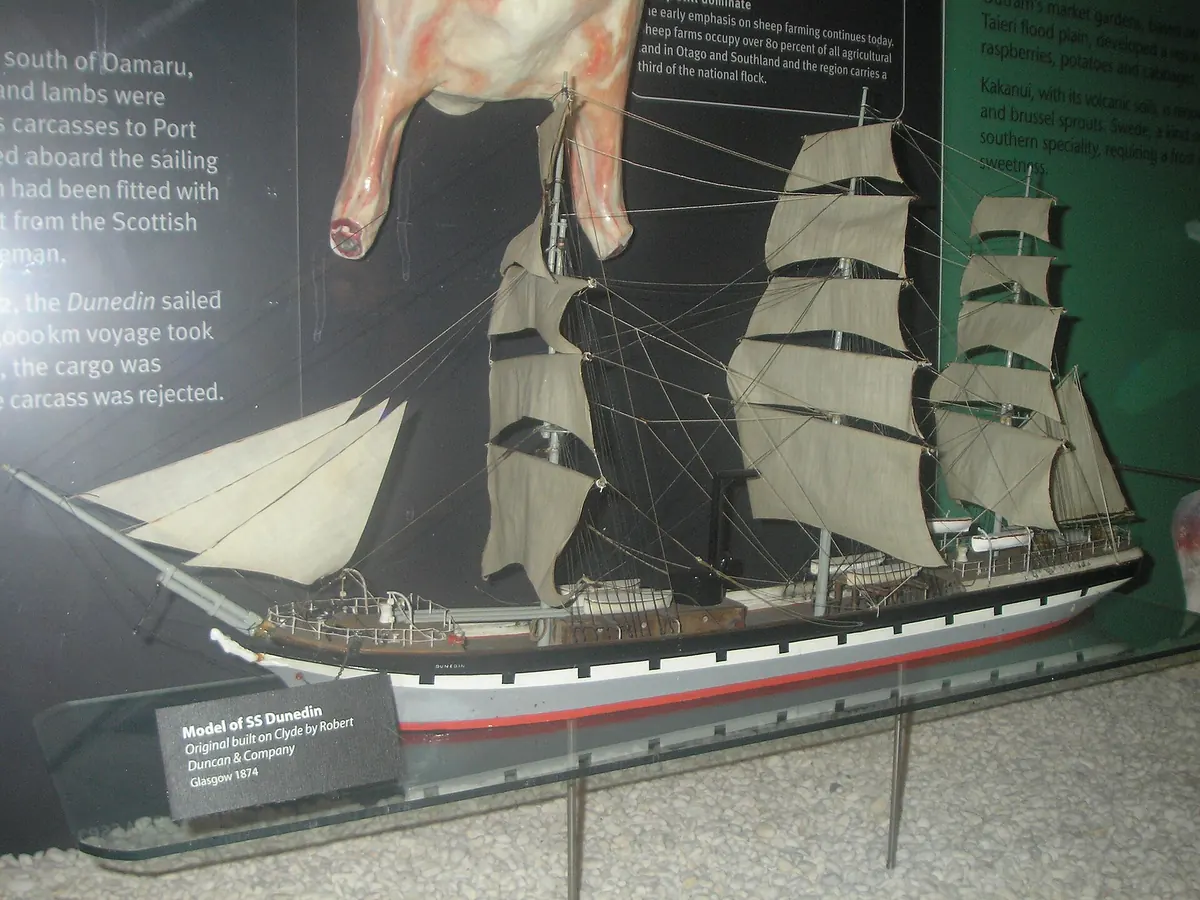
- 15 February 1882Dunedin leaves Port Chalmers with meat frozen aboard.12
- May 1882The cargo reaches London, demonstrating the feasibility of the New Zealand route.1
- 1913The Great Strike in ports and coal mines reveals the social dependencies of the export economy.14
- March 1915Britain begins purchasing New Zealand frozen meat available beyond domestic needs.15
Before Dunedin: international trials and a New Zealand problem
Dunedin was not the world’s first ship to carry meat under refrigeration. Experimental shipments had already travelled from South America to Europe during the 1870s. The technological history published by the Australian academy distinguishes a chilled consignment in 1876 from subsequent frozen cargoes. This distinction matters: chilling and freezing describe different conditions of the product and do not entail identical requirements for its transport. A broad claim about the first refrigerated shipment can obscure that difference.
Strathleven left Melbourne on 6 December 1879 and reached London on 2 February 1880 with a successful cargo of frozen meat. The New Zealand venture therefore drew on previous experience. Local pastoralists also had a compelling reason to investigate it: wool could be sold over long distances, whereas the market for meat was restricted by perishability. Some sheep were boiled down for tallow. Refrigeration promised to make more of the animal commercially useful, extending its value beyond the fleece and the products of rendering.313
Totara Estate prepares a supply line across the world
The venture was backed by the New Zealand and Australian Land Company, with extensive estates and financial connections in Britain. William Soltau Davidson managed the company from the British side, while Thomas Brydone organised operations in New Zealand. Slaughtering facilities were prepared at Totara Estate near Ōamaru. Brydone’s museum biography emphasises stock selection, construction and the movement of carcasses: these practical arrangements mattered as much as the idea of sending meat overseas.
The carcasses were cooled at the estate, carried by railway to Port Chalmers and frozen aboard Dunedin. Necessary harbour works at Ōamaru had not yet been completed. Using a more distant port added handling stages and required close coordination. An account published in the New Zealand Journal of Agriculture in 1947 describes carcasses cooling overnight and being loaded early in the morning into railway vans with ice on their floors. The inaugural voyage did not simply use an established network of freezing works. It tested how the separate parts of a supply chain could be made to function together.6212
A sailing ship with machinery: keeping the cargo cold
The ship belonged to the Albion Line. Its equipment included a Bell–Coleman machine using air compression and expansion, together with an insulated cargo space. Although sails propelled the vessel, maintaining low temperatures required machinery powered through the burning of coal. The sailing ship was therefore also a floating processing plant. Navigating an ocean and preserving a cargo of food were separate technical tasks, each with its own demands on equipment and the people operating it.
Low temperature alone was insufficient: cold air also had to circulate effectively. Circulation difficulties arose during the voyage, requiring interventions by Captain John Whitson in the refrigerated space. Surviving accounts differ over the details of the dramatic episode, but agree that the crew had to act to protect the cargo. Installing a machine had not concluded the experiment. Reliability, operation and the arrangement of carcasses all mattered, because failure at one stage could threaten the value of work already undertaken on the farm and at slaughter. Preservation was an active process throughout the journey.1113
London: turning a successful crossing into a viable market
Dunedin reached London in late May 1882. Almost the entire cargo was suitable for sale; NZ History records that one carcass was condemned. The achievement demonstrated that the distance between a New Zealand farm and a British purchaser could be crossed without destroying the meat’s commercial value. It did not remove freight, insurance, storage or distribution costs. Technical success was a condition of entering the market, rather than a complete calculation of profitability for every participant in the trade.
Davidson arranged shipping, insurance and London distribution, and after the first success developed commercial connections for regular consignments. His biography shows how much work this involved: producers needed more than space in a vessel’s hold, because the cargo also required a dependable sales structure after arrival. Seen in this way, the 1882 voyage tested an export undertaking as a whole. Only repeatable deliveries could make British demand a useful basis for decisions taken many months earlier by livestock farmers. A promising demonstration had to become a service on which suppliers could plan.14
Producing meat changes the flock and the farm
Refrigeration did not abruptly replace wool production with a meat economy. Sheep cross-breeding and the introduction of European grasses were already being investigated on the South Island before 1882. Te Ara stresses that these earlier developments helped farmers take advantage of the new opportunity. As exports expanded, lamb became more important and Canterbury acquired a prominent commercial position. An animal’s prospects as food now contributed to its market value alongside the wool it could produce.
Broader opportunities to sell meat encouraged more intensive land use and the subdivision of some large estates into smaller farms. This was not the automatic result of a single machine: land, capital, pasture and access to processing remained necessary. Economic accounts place substantial national benefits only in the 1890s. Years of building supply networks and adapting production separated the successful demonstration from changes in the structure of agriculture. Smaller farms also relied on outside services, helping rural settlements to develop. Refrigeration was powerful partly because other agricultural and commercial changes enabled producers to use it.89
Freezing works and the people who kept exports moving
Slaughter, carcass preparation and freezing increasingly took place in works on land. Where those works were distant from a wharf, insulated railway wagons provided the onward connection. An industrial infrastructure linked agricultural districts with their ports. Brydone participated in the development of the Burnside works near Dunedin. Such investments transferred tasks previously performed aboard ship into specialised establishments able to serve multiple suppliers and successive sailings. The export economy required substantial activity beyond the farm gate.
The expression “agricultural exports” concealed the contributions of slaughtermen, labourers, railway workers, stokers and dock workers. Employment in freezing works followed a seasonal rhythm. Before the processing chain was introduced, a skilled solo slaughterman carried out successive operations on an animal. The wider export economy’s exposure to labour conflict became especially visible during the Great Strike of 1913, which affected ports and coal mines. Farmers’ organisations opposed the strikers alongside employers and the government. Reliable food movements therefore rested on social relations as well as machinery, and the interests of agricultural producers and transport workers did not always coincide.7514
Land and colonisation: access to the new opportunities
The new market developed within a settler economy founded on earlier transfers of Māori land. On the South Island, Kemp’s Deed of 1848 provides important context. Ngāi Tahu describe unfulfilled commitments over adequate reserves and the protection of mahinga kai, places associated with obtaining food and other resources. Restrictions on ownership and access altered the material basis of community life long before Dunedin made its celebrated voyage. Agricultural expansion occurred within that existing and unequal distribution of land.
The 1882 crossing should not be treated as the cause of earlier land loss. It is nevertheless necessary to recognise the property relations on which subsequent growth depended. Davidson’s biography demonstrates the importance of land purchases and the conversion of leasehold to freehold within the company’s business. New outlets for produce could make such investments more attractive. Rising exports therefore measured only one aspect of change: they did not reveal how benefits were distributed or account for losses associated with the colonial land system and the replacement of native vegetation by introduced pastures.1049
From experiment to an imperial food-supply system
The scale of the resulting export network became particularly evident during the First World War. In March 1915 the British government began purchasing New Zealand’s frozen-meat output available beyond domestic requirements. New Zealand’s administration connected local producers with this government customer. Subsequent shortages of ships left meat accumulating in cold stores despite continuing demand. Preserved food still needed available cargo space and a viable ocean route; maintaining supplies required more than the ability to keep a carcass frozen.
Dunedin’s history thus reveals exports as a sequence of dependencies. Pasture required a connection to slaughter, slaughter to preservation, and stored stocks to transport and sale. This system widened the possibilities available to New Zealand producers while exposing them to shipping decisions and events on the other side of the world. Its enduring innovation was to connect the biological rhythm of livestock farming with industrial preservation and long-distance trade. That is why the 1882 voyage occupies an important place in agricultural history even though it was not the global beginning of refrigerated shipping.1525
Questions and answers
Did Dunedin carry the world’s first frozen-meat cargo?
No. Its 1882 voyage was New Zealand’s first successful shipment of this kind to Britain. Earlier experiments involved South America and Australia.13
Sources
- Manatū Taonga — Ministry for Culture and Heritage (2021). First frozen meat shipment leaves New Zealand
- Gavin McLean / NZ History (2013; updated 2024). Totara Estate
- Australian Academy of Technological Sciences and Engineering (1988; online 2000). Technology in Australia 1788–1988: Refrigeration and the Export of Meat, online p. 90
- Mervyn Palmer (1993). Davidson, William Soltau. Dictionary of New Zealand Biography
- Mervyn Palmer (1993). Brydone, Thomas. Dictionary of New Zealand Biography
- Toitū Otago Settlers Museum (n.d.). Thomas Brydone: Smith Gallery
- Manatū Taonga / Te Ara (2010). Agricultural processing industries: Freezing works, 1880s to the 1970s
- Manatū Taonga / Te Ara (n.d.). Farming in the economy: Refrigeration and sheep farming
- Manatū Taonga / Te Ara (2010). Economic history: Refrigeration, dairying and the Liberal boom
- Te Rūnanga o Ngāi Tahu (2017). Kemp’s Deed, 1848
- Matthew Wright and Megan Cook / Te Ara (2010). Dunedin, 1882: Freight and warehousing
- New Zealand Journal of Agriculture; National Library, Papers Past (1947). Farming in New Zealand: Refrigeration, 16 June 1947
- Sydney David Waters (1966). Refrigeration. An Encyclopaedia of New Zealand
- Manatū Taonga — Ministry for Culture and Heritage (n.d.). The 1913 Great Strike: Introduction
- Tim Shoebridge and Gavin McLean / NZ History (updated 2025). Feeding Britain
Approximate dates (c.) describe the nature of the evidence: archaeology dates settlements, layers and remains, not single moments of invention.