

Key dates
- 1873An earlier British attempt to propagate rubber and send plants to India fails to establish lasting success.4
- 1876Seeds carried by Wickham reach Kew; propagated material is subsequently dispatched to Asia, including Ceylon.45
- 1877Successful planting in Singapore provides material for further experiments and propagation.7
- 1888Ridley becomes director in Singapore and develops research and promotion of rubber cultivation.8
- 1896Tan Chay Yan undertakes a pioneering cultivation trial at Bukit Lintang near Malacca.11
- 19 July 1912The House of Commons debates responsibility for atrocities in the Putumayo rubber region.17
Rubber history does not begin with a European discoverer
Hevea brasiliensis is native to tropical South America. Its familiar name, the Brazilian rubber tree, should not obscure a wider native range that includes parts of other Amazonian countries. Indigenous communities used latex before European plantation economies developed. They made objects and exploited the material’s waterproof properties. The transfer to Asia therefore concerned an already known useful plant and its commercial possibilities, rather than the discovery of a resource without an earlier human history.
Rubber-producing species must also be distinguished. Ancient Mesoamerican objects and balls discussed in studies of early processing were made from Castilla elastica latex combined with another plant material. They were not products of nineteenth-century Hevea plantations. This distinction recognises the achievements of earlier makers without merging distant regions and different technologies. The agricultural significance of later expansion lay in a changing supply system: deliberately planted trees, harvested systematically over time, became increasingly important to industrial markets.132
1876: living material within an imperial network
Wickham brought seeds from Brazil to Britain, where they were germinated at the Royal Botanic Gardens, Kew. The year 1876 is a well-documented point in this history; the Science Museum Group preserves two seeds catalogued as originating from his shipment. This was not the first British attempt to establish Hevea outside the Americas. An earlier experiment in 1873 failed to produce lasting success from plants sent to India. The importance of the later undertaking lay in obtaining material that could be propagated further.
Kew seedlings reached Ceylon, now Sri Lanka, among other destinations. Protecting living plants during transport and maintaining them after arrival mattered as much as collecting seeds. Modern accounts often describe the transfer as biopiracy, emphasising the appropriation of a resource for a competing colonial economy. The explanation need not depend on a sensational pursuit story or a single heroic individual. What matters is the imbalance of power: institutions seeking imperial commercial advantage determined how the plants would subsequently be used and where the resulting opportunities would develop.4536
Botanic gardens as agricultural infrastructure
Singapore was more than a stop on a shipping route. Its botanic garden became a centre for developing and distributing planting material, linking research to the requirements of growers. Successful planting in 1877 must be distinguished from the earlier failed consignment. A living specimen in a garden was only the start of a long process: suitable growing conditions, nursery methods and the translation of a local experiment into repeatable production still had to be established. Biological survival and commercial viability were separate achievements.
Historical research on colonial botany emphasises how networks of gardens sustained experimentation and circulated information. In this interpretation, plantations emerged from connections among science, government and trade. UNESCO similarly describes Singapore’s contribution through research and the expansion of plantation rubber across Southeast Asia. This does not mean that botanical staff created the entire industry by themselves. Investors and plantation workers had to apply the knowledge under conditions far larger than a living collection, while administrative institutions made land and labour available on unequal terms.7910
Harvesting latex without destroying the future crop
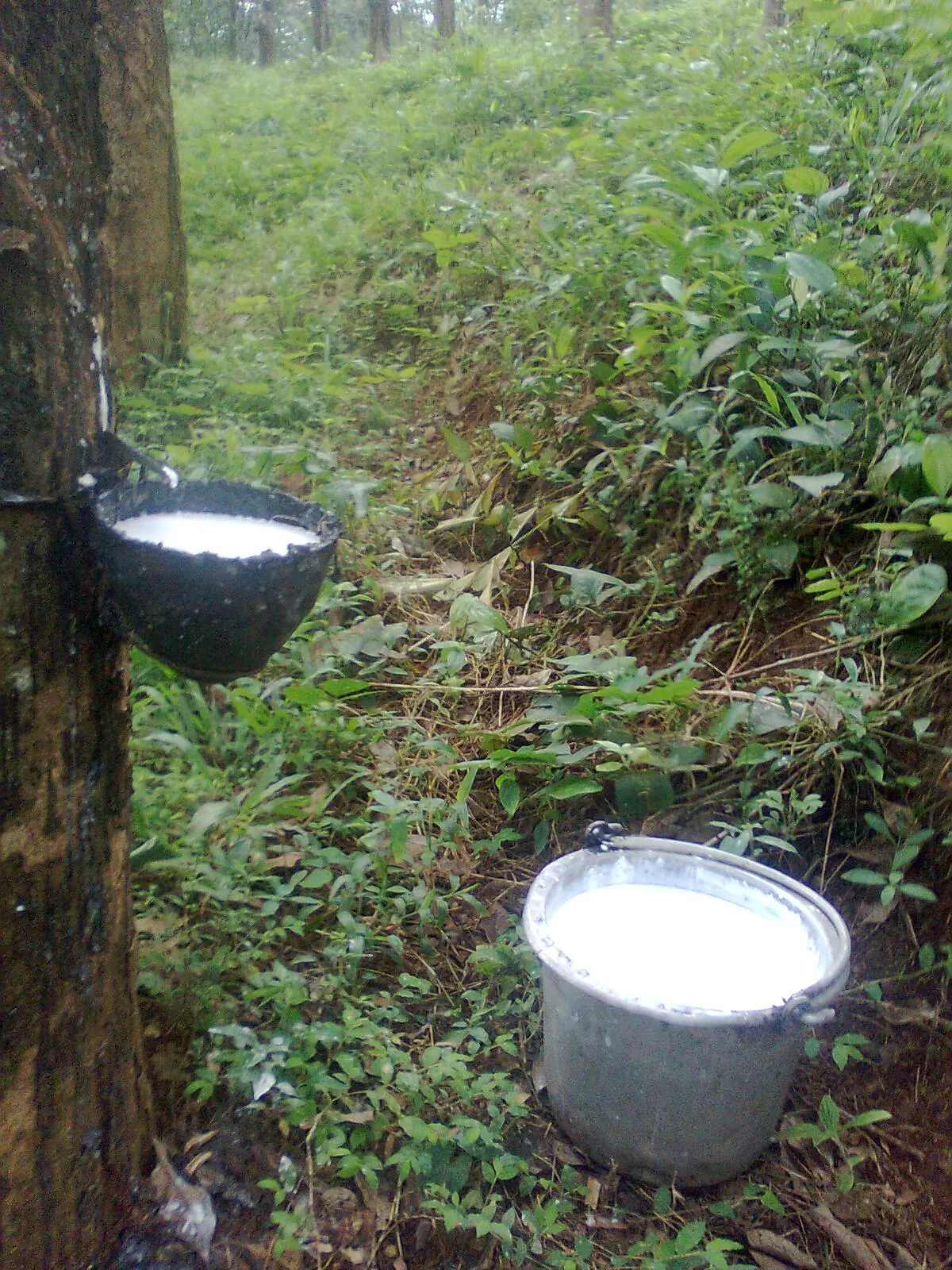
Henry Nicholas Ridley became director of the Singapore Botanic Gardens in 1888. He investigated the commercial possibilities of rubber trees and promoted cultivation among growers. Refining the cutting of bark mattered because latex needed to be harvested repeatedly. His work developed earlier experience, including techniques already known in Ceylon; crediting him with inventing every method from nothing obscures successive improvements. In a perennial crop, excessive damage to the tree meant sacrificing future harvests, making skilled work central to the economics of production.
Growers also faced a waiting period before young trees yielded a useful crop. Land and labour still cost money during those immature years. Some entrepreneurs combined rubber with other crops: Lim Nee Soon planted pineapples between young trees. Such practices remind us that a plantation was not necessarily a uniform, mature monoculture from its first day. Latex collection was also only one part of a chain that included processing, storage and preparation for shipment. Commercial success depended on coordinating these stages, rather than simply maximising the amount cut from a tree on one occasion.8712
Asian entrepreneurs and plantation finance
The industry’s development was not exclusively a story of British botanists and European companies. Tan Chay Yan undertook an important cultivation trial at Bukit Lintang near Malacca in 1896 and subsequently expanded his rubber ventures. His activities show the role of local trading networks and entrepreneurs of Chinese descent. Lim Nee Soon combined plantations with factory ownership, trading and advice to other estate owners. New crops attracted people able to secure land, workers and buyers, and to carry risks that botanical demonstrations alone could not remove.
Growing demand for tyres later drew in much larger amounts of capital. Establishing estates required heavy expenditure before trees generated income, making companies and shareholding significant. In Singapore, businesses developed by local merchants were also acquired by London companies, sometimes with shares forming part of the payment to former owners. This was more than a change of name: decisions about land and production became embedded in wider financial markets. An increasing valuation of an enterprise nevertheless says little by itself about the earnings or bargaining power of the worker tapping its trees.111213
Migration and the control of plantation labour
Large Malayan estates relied heavily on migrant workers, particularly from southern India. Recruitment involved colonial administrations, employers and intermediaries. A contract or an advance for travel could bind a worker to a particular place, while limited resources made independent changes of employment difficult. It is therefore insufficient to say that people moved wherever demand for labour increased. The conditions under which they could travel, work and leave were fundamental to the production system, and were shaped by institutions as well as individual decisions.
Alongside indentured recruitment, the kangani system developed around recruiters and supervisors who used village or family connections to bring additional workers. Such networks could assist migration while also deepening dependence on an intermediary. Research documents deceptive recruitment, coercion and unequal wage relationships. Women and men worked within a structure whose rules were largely determined by others. Plantation productivity consequently reflected the organisation and control of labour as well as the quality of a tree or tapping implement. Cheap supplies for distant factories had a social history on the estate itself.1415
Amazonia: export wealth and coercion
The growth of Asian plantations should not obscure conditions in the earlier Amazonian rubber economy. Prosperity in trading centres coexisted with coercion and abuses against Indigenous communities. The Putumayo region is a particularly well-documented example. Roger Casement’s investigations exposed a systemic problem involving the organisation of extraction and power over people. The issue extended beyond an exceptionally brutal overseer to relationships in which commercial interests undermined the security and autonomy of communities supplying the commodity.
A debate in the British House of Commons on 19 July 1912 addressed responsibility for atrocities and possible action against people associated with a rubber enterprise. It documents political responses and their limitations, rather than proving that abuses were promptly remedied. Set beside the later plantation story, it shows why a cheaper source of raw material did not automatically create an equitable production system. Amazonia and Malaya had different institutions, but in both places export prices need to be interpreted alongside the treatment of workers and local populations.16176
What changed between forest extraction and plantations?
Harvesting rubber from trees dispersed through a forest and producing it on an estate organise space differently. Plantations concentrated trees and labour, facilitated planning and linked collection to processing facilities. Their expansion could also entail forest clearance and the replacement of a complex environment with a simpler crop system. Yet Asian cultivation should not be reduced to a single model of the large estate: different scales of farming existed alongside corporate enterprises. Forest latex extraction likewise did not disappear completely when the Amazonian boom weakened.
The legacy therefore extends beyond a shift in the leading export region. Research gardens, nurseries, estates, workers’ settlements, factories and ports became connected elements of production. In Singapore, later military and urban development again changed the use of rubber land. Following the story from 1876 makes it possible to trace both the movement of living material and changing control over territory. A seed opened biological possibilities, but institutions, capital and labour relations determined how those possibilities were realised. Agricultural history here reaches well beyond food crops into the material foundations of industrial life.1810139
Questions and answers
Did Wickham discover rubber?
No. Indigenous peoples in the Americas knew it earlier. His role concerned transferring Hevea seeds into colonial botanical and agricultural networks.234
Sources
- Royal Botanic Gardens, Kew (n.d.). Hevea brasiliensis: Plants of the World Online
- Massachusetts Institute of Technology; Dorothy Hosler (n.d.). Rubber Processing in Ancient Mesoamerica: Summer Institute in Materials Science and Material Culture
- Fernando B. Matos; CRIA — Centro de Referência em Informação Ambiental (n.d.). The Rubber Tree: source of natural rubber
- Royal Botanic Gardens, Kew, Joseph Dalton Hooker Correspondence Project (n.d.). Letter transcription and editorial notes: rubber transfer, asset 2287
- Science Museum Group (n.d.). Two original rubber seeds brought by Sir Henry Wickham from Brazil in 1876, object 1934-678
- Alexandre Antonelli; Royal Botanic Gardens, Kew (2020). It’s time to re-examine the history of botanical collections
- National Library Board Singapore (2011). First rubber trees are planted in Singapore
- Vernon Cornelius; National Library Board Singapore (n.d.). Henry Nicholas Ridley
- UNESCO World Heritage Centre (2015). Singapore Botanic Gardens: Statement of Outstanding Universal Value
- George K. T. / Tharian Kadavil (2016). Colonial Botany and Plant Transfer: The Case of Natural Rubber (1850 to 1910). Rubber Science 29(3), 215–223; abstract
- Duncan Sutherland; National Library Board Singapore (n.d.). Tan Chay Yan
- Vernon Cornelius; National Library Board Singapore (n.d.). Lim Nee Soon
- Timothy Pwee; National Library Singapore (2021). Plantation Agriculture in Singapore. BiblioAsia 17(1)
- Economic History Malaysia (n.d.). South Indian labour in Malayan rubber estates: Profits over people, 1884–1941
- Amarjit Kaur; New Mandala (2013). Indian migrant workers in Malaysia — part 1
- Séamas Ó Síocháin (2011). “More power to the Indians”: Roger Casement, the Putumayo, and indigenous rights. Irish Journal of Anthropology 14(2), 5–12; abstract
- UK Parliament, House of Commons (1912). Putumayo District, Peru (Rubber Collectors), 19 July 1912
- Partner Forest Program (n.d.). Rubber: commodity history, forest footprint and forest production
Approximate dates (c.) describe the nature of the evidence: archaeology dates settlements, layers and remains, not single moments of invention.