

Key dates
- c. AD 985Norse agricultural settlement begins.4
- c. 1100–1200Maximum settlement extent identified in the Vatnahverfi study.5
- 13th centuryThe King's Mirror describes Greenlandic dairying and trade.2
- after c. 1350Vatnahverfi research indicates further contraction of farming.5
- 16 September 1408The Hvalsey wedding records continuing community life.15
- 15th centuryNorse settlements disappear; the plotted year is a representative point within the century.116
Settlement between fjord and pasture
Settlers arriving from Iceland did not establish fields on the ice sheet. They selected sheltered valleys and the shores of southwestern fjords where vegetation supported grazing and fodder collection. The Eastern and Western Settlements were two principal concentrations of Norse farms, rather than colonies on opposite coasts of Greenland. Managed meadows lay near farmsteads, with more scattered grazing beyond them.
This was no uniform society of equally endowed farmers. Research in Vatnahverfi identifies a strongly hierarchical settlement network and seasonally used pastoral facilities. Favourable locations were occupied early; expansion later reached more marginal ground before contracting again. Settlement geography therefore changed well before the final abandonment. The modern Kujataa heritage landscape also incorporates a distinct history of Inuit farming developing from the late eighteenth century. Its shared designation does not establish uninterrupted occupation of medieval Norse farms.1541617
Hay and the problem of overwintering livestock
Keeping cattle required a store of fodder for the period when summer grazing was unavailable. The decisive issue was not simply meadow area but the ability to cut, dry and secure the crop. Hay reserves consequently linked the biological needs of livestock to weather and available labour. In interpreting Norse farming, a byre or fodder-storage facility matters as much as the dwelling itself.
Garðar, now Igaliku, offers a particularly revealing example because it contained the bishop's farm. Deposits dated approximately AD 1110–1370 combined meadow remains with insects associated with houses and animal accommodation. Researchers interpreted this as strong evidence that household and byre waste had been spread on fields to increase hay yields. Archaeological channels and dams also indicate manipulation of water supplies. The farm was therefore not merely harvesting whatever grass happened to grow: it invested in the productive ground needed to support a demanding herd.6418
Milk, meat and the value of a living herd
The thirteenth-century King's Mirror describes Greenland's farms through cattle, sheep, butter and cheese. This records how a Norwegian writer represented a distant society, rather than supplying a census of every household. Nevertheless, his account illuminates the logic of dairying. An animal could remain valuable across successive seasons, so a farmer's calculation was not limited to the meat obtainable at slaughter. Processing milk also allowed some summer production to be used beyond the period when fresh food was most abundant.
Animal bones from farm Ø34 in the Qorlortoq valley demonstrate the coexistence of domestic livestock and seals. Species and age profiles help reconstruct herd management, but bone counts cannot automatically be converted into numbers of meals. Large and small animals leave different archaeological signatures. Evidence that whole seal carcasses reached an inland farm also matters: agricultural households were linked to the transport and distribution of marine resources. A farmstead was thus part of a wider provisioning network, rather than an entirely self-sufficient island of cattle and grass.28
Was grain grown in Greenland?
The King's Mirror portrays bread as unfamiliar to much of the population, yet also mentions experiments in sowing grain by wealthy farmers. Even this medieval text is therefore not straightforward evidence that nobody ever cultivated cereals. Its author combines reports of good pasture with limited knowledge of a vast island and repeatedly acknowledges questions he cannot resolve. His account is best understood as a description of a predominantly pastoral economy, rather than a measurement of the absolute climatic limit of agriculture.
Peter Steen Henriksen's archaeobotanical work identified charred barley grains and threshing remains at several Norse sites. Crop-processing waste is particularly significant because it strengthens the interpretation that some grain was grown locally. It does not establish extensive cereal fields or grain self-sufficiency across the settlements. Land management likewise varied between locations: phosphate investigations of selected fields did not reveal the same pattern of deliberate manuring reconstructed at episcopal Garðar. Evidence from a prominent estate should not be imposed automatically on every smaller farm or every century of occupation.276
Spring seals and the composition of the diet
Hunting migratory seals was not merely a desperate response by the final inhabitants to starvation. It supplied food when winter stores could be depleted and the busy summer season had yet to begin. Collective hunts required boats, participants and arrangements for sharing the catch. Dugmore and colleagues interpret the strong emphasis on seals as a practical adjustment of the working calendar to available resources. The scarcity of fish bones cannot sustain a story about a society that categorically rejected everything obtained from the sea.
Isotopic studies of human remains confirm an important marine contribution to diet, while revealing variation between individuals and sites. Collagen analysis primarily illuminates sources of dietary protein over an extended period; it does not reconstruct the exact contents of a particular day's meals. The dietary research programme compared people with animal samples and material from Inuit communities. This provides a stronger basis for understanding mixed provisioning than a simple picture of cattle-dependent settlers.3910
Walrus tusks connected farms to European workshops
According to the King's Mirror, merchants supplied needed goods, iron and timber and took away hides, walrus tusks and strong leather ropes. The account explicitly connects hazardous distant voyages with high prices and the prospect of profit. Exports were therefore closely connected to farming life, helping sustain access to materials used in tools and construction. A voyage also removed people from their farms when a short productive season presented several competing demands. Livestock husbandry and commercial hunting belonged to the same household economy.
Ancient DNA from walrus remains recovered in Europe can identify sources of ivory more precisely than the style of a finished object alone. Star and colleagues demonstrated the connection between European trade and walrus populations accessible to Greenlanders. More recent work by Ruiz-Puerta and her team traces material far into the High Arctic. A specimen from a northern population does not necessarily prove that a Norse hunter personally reached the animal's original location. Exchange with other communities could also have moved valuable material through wider Arctic networks.21112
Churches, inequality and cooperation between farms
The King's Mirror explains the existence of a bishop for Greenland's small population through its distance from other countries. Churches and priests appear in the writer's description as ordinary components of local life, alongside farms and trade. Religious institutions connected the inhabitants to Latin Christianity while also requiring their own economic foundations. The substantial livestock establishment at Garðar is a reminder that the standing of an ecclesiastical centre depended partly on land, fodder and the ability to maintain animals.
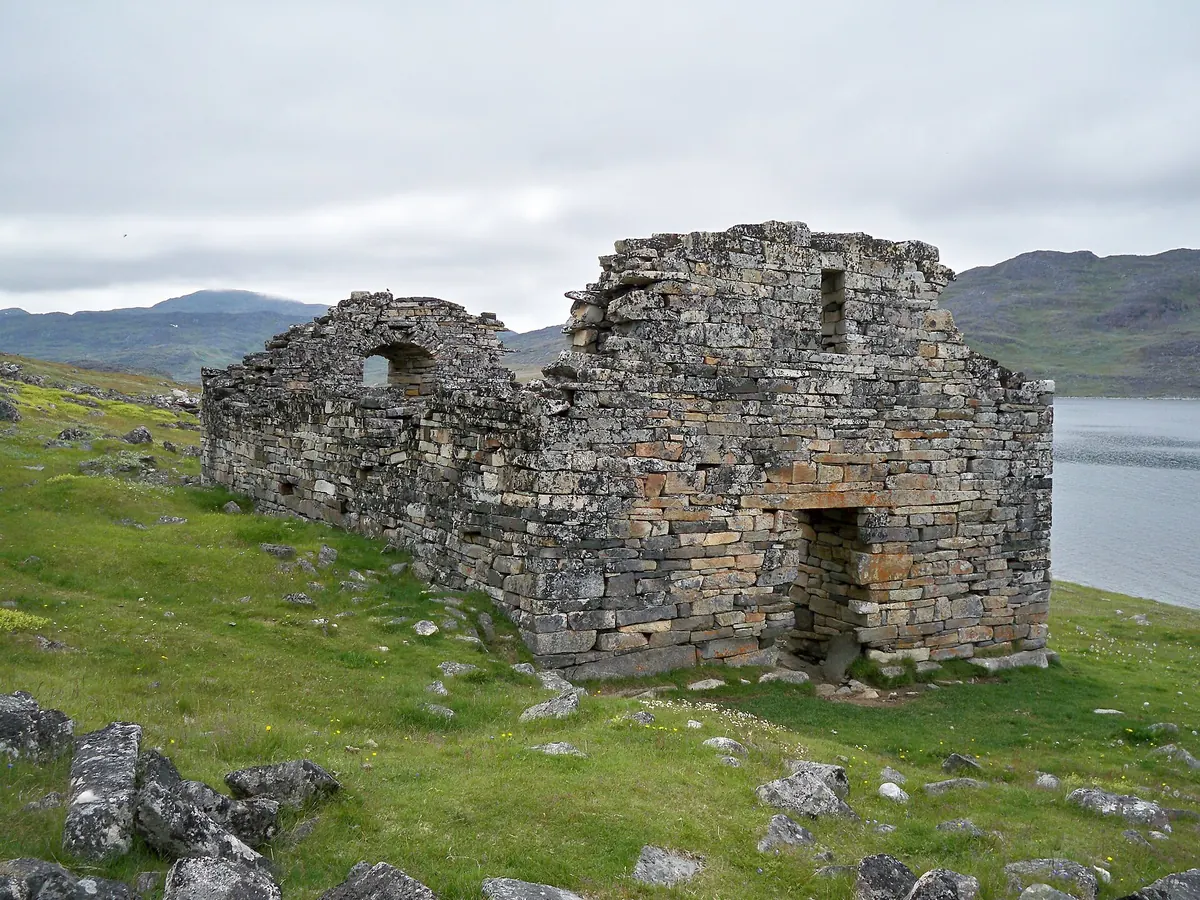
The remains at Hvalsey include residential and agricultural buildings as well as the church. The record of a wedding on 16 September 1408 documents an active community maintaining religious practices and connections with Iceland. It is not the date of the settlement's destruction. At regional scale, the contraction of farming in Vatnahverfi and concentration of resources indicate unequal access to favourable land. Such differences could affect households' ability to survive a difficult season even when neighbouring farms used broadly comparable technologies.261551718
Why did the farms disappear?
No single documented disaster explains the end of all Norse settlement. Research on walrus ivory considers increasing procurement costs alongside changes in European demand, including competition from elephant ivory. This is a hypothesis about economic vulnerability, rather than proof that trade alone determined every family's fate. Studies of relative sea level add another pressure: growth of the ice mass could depress nearby land and attract seawater, exposing low coastal ground to inundation. Such local mechanisms matter more than a generic statement that a colder climate must always lower the sea.
These pressures affected an economy that had to maintain herds, reserves and coordinated work at the same time. Centuries of occupation testify to the settlers' skills; eventual abandonment does not erase that long record of adjustment. Thule Inuit communities possessed distinct technological traditions and ways of using Arctic environments, rather than representing another stage of the Norse colony. For agricultural history, the central issue is the combination of constraints. Successful fodder production and a mixed diet could sustain farms for generations without guaranteeing their continuation when commercial connections and access to land and other resources also changed.13144116
Questions and answers
Were Greenland's Norse inhabitants exclusively farmers?
No. Livestock husbandry and dairying coexisted with hunting, especially for seals, and with trade. Archaeological finds and dietary research show an economy combining terrestrial and marine resources.98
Sources
- UNESCO World Heritage Centre (2017). Kujataa Greenland: Norse and Inuit Farming at the Edge of the Ice Cap — opis dobra
- Anonim; tłum. Laurence Marcellus Larson (ok. 1250; przekład 1917). The King's Mirror (Speculum Regale–Konungs Skuggsjá), rozdziały XVI–XIX — źródło XIII-wieczne, przekład w domenie publicznej
- Andrew J. Dugmore i in. (2012). Cultural adaptation, compounding vulnerabilities and conjunctures in Norse Greenland
- Rowan Jackson i in. (2018). Disequilibrium, Adaptation, and the Norse Settlement of Greenland
- Christian Koch Madsen (2014). Pastoral Settlement. Farming and Hierarchy in Norse Vatnahverfi, South Greenland — abstrakt rozprawy
- Paul C. Buckland, Kevin J. Edwards, Eva Panagiotakopulu, J. Edward Schofield (2009). Palaeoecological and historical evidence for manuring and irrigation at Garðar (Igaliku), Norse Eastern Settlement, Greenland — abstrakt
- Peter Steen Henriksen (2016). Norse agriculture in Greenland? Farming in a remote medieval landscape — abstrakt autora
- Georg Nyegaard (2018). Dairy Farmers and Seal Hunters: Subsistence on a Norse Farm in the Eastern Settlement, Greenland
- D. Erle Nelson i in. (2012). An Isotopic Analysis of the Diet of the Greenland Norse — abstrakt autora
- Jette Arneborg i in. (2012). Norse Greenland Dietary Economy ca. AD 980–ca. AD 1450: Introduction — abstrakt autorów
- Bastiaan Star, James H. Barrett, Agata T. Gondek, Sanne Boessenkool (2018). Ancient DNA reveals the chronology of walrus ivory trade from Norse Greenland — abstrakt w repozytorium
- Emily J. Ruiz-Puerta i in. (2024). Greenland Norse walrus exploitation deep into the Arctic — abstrakt i podpisy rycin
- University of Cambridge (2020). Over-hunting walruses contributed to the collapse of Norse Greenland, study suggests — komunikat autorów przedrukowany przez Phys.org
- Clea Simon; Harvard Gazette (2023). Did rising seas drive Vikings out of Greenland? — omówienie badań zespołu Marisy Borreggine
- Visit Greenland (b.d.). Hvalsey Church Ruin — opis historyczny i świadectwo ślubu z 1408 r.
- Jette Arneborg (2023). The Norse Settlement of Greenland, The Cambridge History of the Polar Regions — streszczenie rozdziału
- Orri Vésteinsson, Michelle Hegmon, Jette Arneborg, Glen Rice, Will G. Russell (2019). Dimensions of inequality. Comparing the North Atlantic and the US Southwest — abstrakt w repozytorium autorów
- Eva Panagiotakopulu, Malcolm T. Greenwood, Paul C. Buckland (2012). Insect fossils and irrigation in medieval Greenland — abstrakt
Approximate dates (c.) describe the nature of the evidence: archaeology dates settlements, layers and remains, not single moments of invention.