

The origins of arabica are not the invention of a drink
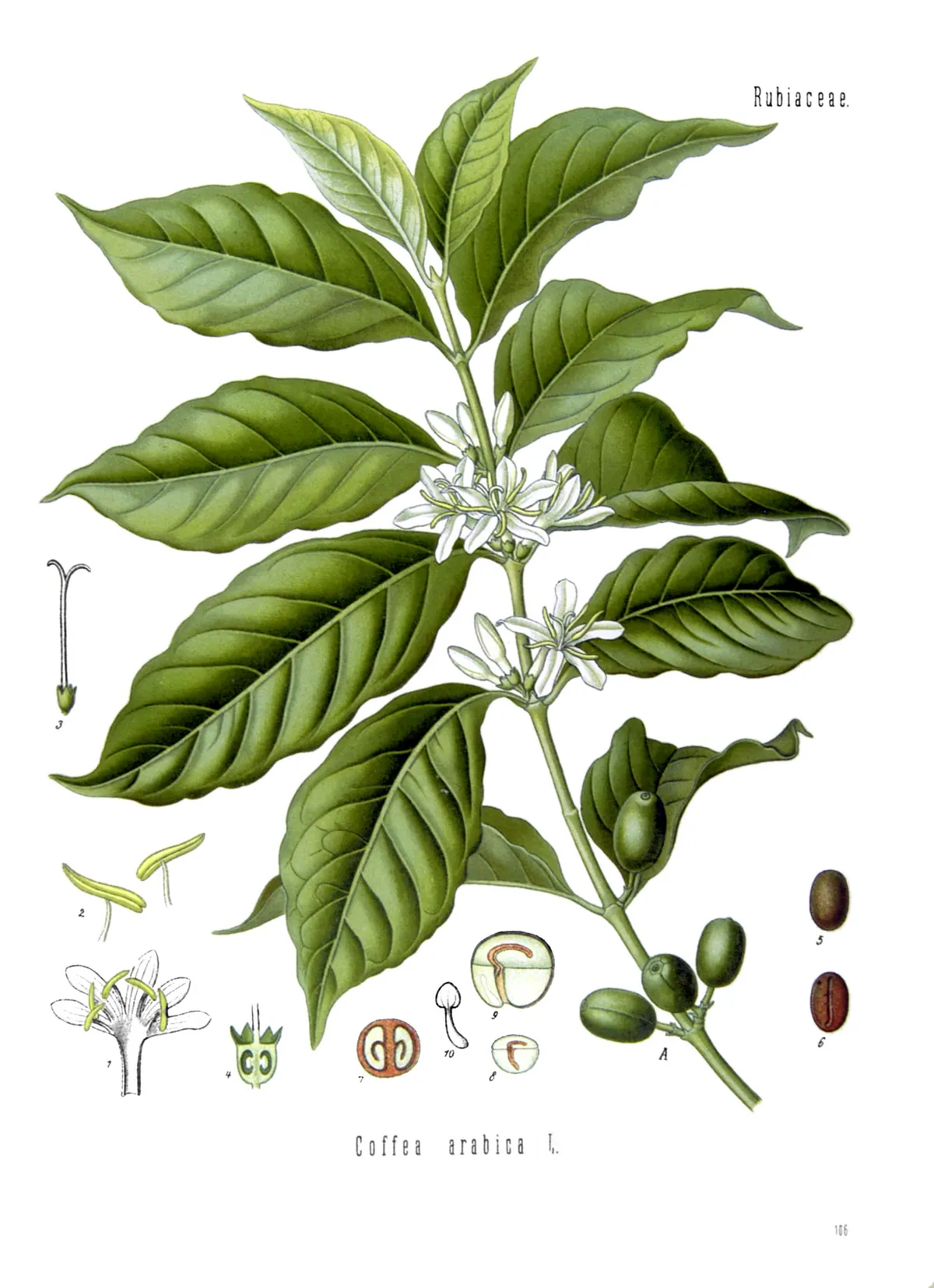
Arabica, Coffea arabica, is an African species of shrub or small tree. Kew’s botanical database places its native range in southwestern Ethiopia, eastern South Sudan and Mount Marsabit in northern Kenya. The Latin name does not establish an origin on the Arabian Peninsula. Coffee history must distinguish the natural presence of the plant, gathering its fruit, transporting seeds, cultivating trees and preparing a beverage. Each activity can have a different geography and chronology.
Ethiopian forests and diverse coffee populations provide a starting point for investigating these processes. The boundary between gathering a wild plant and tending it need not be sharp: people can protect selected trees, move seeds and gradually alter vegetation. Such management cannot automatically be dated from coffee’s present distribution. Finding a wild coffee tree demonstrates the presence of a species; it does not by itself establish medieval roasting or the sale of a prepared drink. Botanical evidence answers a different question from an account of consumption.152
The fifteenth century: drinking, written evidence and origin stories
Historical accounts associate the spread of coffee drinking in fifteenth-century Yemen with Sufi circles, where the stimulating beverage helped sustain nighttime devotional activity. The habit entered everyday life and reached other towns. Sources examined by Ralph Hattox trace its presence in the Hijaz and Cairo in the early sixteenth century. They do not identify humanity’s first cup. A reference establishes that a practice existed by a particular time; earlier stages may still be poorly documented.
The familiar tale of the herder Kaldi and his energetic goats is a legend, rather than a verified record of discovery. Uneven evidence encourages these neat stories: early Ethiopian written references to coffee are rare, and many accounts of beginnings are considerably later. A sound chronology must distinguish what a writer describes from when the writer lived. Drinking created demand, but the presence of coffee in a town does not establish local cultivation. Likewise, an account of someone bringing coffee need not describe the movement of viable planting material.42
The sixteenth century: expanding cultivation in Yemen’s highlands
The second half of the sixteenth century saw a marked expansion of the Yemeni coffee economy. Farmers intensified cultivation on terraces in the mountains above the coastal Tihama plain. This involved more than adopting an imported commodity: coffee had to be propagated and maintained in conditions different from its African habitats. Genetic research supports Yemen’s importance as a centre of domestication and diversification of cultivated material, although it cannot provide the opening date of the first coffee garden.
A perennial tree makes different demands on a farm from a crop sown for a single season. Planting commits land and work for several years, and maintaining the trees continues between harvests. Expanding commerce can therefore be understood as an incentive to invest in plants and cultivated ground over the longer term. This is an inference from the crop’s characteristics and documented market growth, rather than a reading of a particular farmer’s accounts. There is no basis for assigning every sixteenth-century holding an identical size, household structure or system of land tenure.365
Terraces, water and work on the harvested fruit
In the mountains, productivity depended on maintaining places where trees could grow. A terrace created cultivable ground and helped retain soil and water; it also required repairs and management of runoff. A modern FAO and IFC assessment describes both rainfed and irrigated coffee cultivation in Yemen, mostly on terraces. This helps explain environmental constraints, but does not establish that each surviving wall, reservoir or irrigation arrangement was already present in the sixteenth century.
Coffee “beans” are seeds inside a fruit. Between harvesting and drinking come the separation and preparation of the crop, including drying, removal of surrounding material and, later, roasting and grinding. Yemeni tradition also uses dried fruit coverings to prepare qishr. The coffee economy therefore encompasses more than a single familiar modern product. Details of present-day processing and export standards cannot be assigned without separate evidence to every lot traded in the seventeenth century.941
From mountain farms to Jeddah and Cairo
Commerce connected producing districts with local markets, ports and more distant consumers. Routes linking Yemeni ports with Jeddah and Cairo developed during the sixteenth century, and by the seventeenth coffee held an important place in exchange between the Indian Ocean and the Mediterranean. This was not a single straightforward journey from tree to ship. Changes in elevation, inland transport, the assembly of smaller lots and transfer to carriers formed distinct stages in a wider network.
For a farm, trade extended the reach of demand while requiring harvest and preparation to meet the needs of later participants. Growers, intermediaries and maritime merchants performed different tasks, and a price recorded in a distant port is not automatically a producer’s income. The distinction also matters when reading evidence: a ship’s cargo records exports, rather than the entire harvest of a district. Without consistent information on local consumption and losses, it cannot reveal total production. The scale of commerce and the scale of cultivation are related questions, but they require different measurements.379
Mocha: a port name that obscured a wider network
Al-Mukha, commonly known as Mocha or Mokha, became prominent as a seaport under Ottoman rule in the mid-sixteenth century. After the Qasimi imams expelled the Ottomans from Yemen in 1635, its connections with the Indian Ocean and India acquired particular importance. Nancy Um’s research places the town within relationships linking overseas partners, agricultural hinterlands and inland centres. Merchant houses and trading spaces reveal a physical infrastructure of commerce that maps of shipping routes alone cannot convey.
The name’s fame nevertheless requires qualification. Research on early seventeenth-century trade challenges the image of Mocha as exclusively or primarily a coffee port, or Yemen’s only export gateway. Textiles, spices and other goods also circulated there, and merchants came from many regions. A port’s name could become a product designation in a distant market even though the coffee trees grew in the highlands. The point of shipment, the harvest district and the plant’s botanical homeland are three different pieces of information. They should not collapse into a single dot on a map.78
What genetics reveals about movement from Ethiopia to Yemen
A study published in 2022 compared 555 arabica samples from Ethiopia and Yemen. Researchers identified groups of related plants and proposed a scenario for early movements of planting material. Parts of southern Ethiopia were suggested as a possible source for a population linking wild resources with coffee undergoing domestication. The authors also considered a complex history for Hararghe, including reintroduction of cultivated coffee from Yemen. This is a model interpreting modern diversity, rather than a surviving register of historical seed shipments.
The 2021 and 2022 studies demonstrate that Yemeni material should not be treated as one uniform variety. They distinguish groups connected with lines subsequently spread beyond the region and local groups, including one the researchers named “New-Yemen”. A modern sample can preserve traces of selection, a limited founding population and subsequent crossing. It does not identify the person who carried a particular seed or the year of transport. Nor is a genetic cluster automatically equivalent to a variety name used by earlier farmers. These findings complement historical research while leaving some of its most precise questions unanswered.56
Farmers’ legacies and the early coffee economy
Yemen’s role extends beyond acting as an intermediary between Africa and distant markets. Cultivation involved keeping plants alive, selecting propagation material and adapting it to local conditions. Decisions repeated over generations helped shape the diversity that geneticists now investigate. This is a different kind of evidence from a list of merchants in a port: it recalls the contribution of producers who often remain unnamed in surviving records. It does not, however, allow every detected plant characteristic to be attributed to a specific conscious human choice.
By the end of the seventeenth century, coffee participated in extensive networks of consumption and exchange rooted in eastern Africa and southern Arabia. Its expansion connected changing habits with perennial cultivation and transport. A well-supported history preserves all these levels instead of concentrating only on the first European purchaser. Farms, terraces, plant populations and ports together explain the making of an agricultural commodity. Uneven sources require uncertainty to be marked, but do not erase the significance of local agricultural knowledge or the work through which an increasingly distant market was supplied.6523
Questions and answers
Does coffee come from Ethiopia or Yemen?
Arabica has an African native range, and Ethiopia is central to its origins and diversity. Yemen played a major role in domestication, cultivation and early commerce. These are distinct, complementary stages of coffee history.15
Did Kaldi really discover coffee?
The story of Kaldi and his goats is a legend. It is not reliable evidence identifying a particular person, place and date for the discovery of the beverage.2
Sources
- Royal Botanic Gardens, Kew (Continuously updated; accessed 2026). Coffea arabica L. — Plants of the World Online
- Michel Tuchscherer (2024). The Ethiopian and Yemeni Roots of Coffee
- Michel Tuchscherer (2003; online edition 2009). Coffee in the Red Sea Area from the Sixteenth to the Nineteenth Century, in The Global Coffee Economy in Africa, Asia, and Latin America, 1500–1989
- Ralph S. Hattox (1985). Coffee and Coffeehouses: The Origins of a Social Beverage in the Medieval Near East
- Christophe Montagnon, Faris Sheibani, Tadesse Benti, Darrin Daniel and Adugna Debela Bote (2022). Deciphering Early Movements and Domestication of Coffea arabica through a Comprehensive Genetic Diversity Study Covering Ethiopia and Yemen CC BY 4.0; https://creativecommons.org/licenses/by/4.0/; findings are paraphrased and synthesised
- C. Montagnon, A. Mahyoub, W. Solano and F. Sheibani (2021). Unveiling a unique genetic diversity of cultivated Coffea arabica L. in its main domestication center: Yemen CC BY 4.0; https://creativecommons.org/licenses/by/4.0/; findings are paraphrased and synthesised
- Nancy Um (2009). The Merchant Houses of Mocha: Trade and Architecture in an Indian Ocean Port
- C. G. Brouwer (2008). Storehouse of Stimulants: Opium in the Market of al-Mukhâ at the Turn of the Seventeenth Century: Statements by Dutch Eyewitnesses
- Food and Agriculture Organization of the United Nations and International Finance Corporation (2023; UN web release 2025). Coffee value chain in Yemen: export potential and investment opportunities Report: CC BY-NC-SA 3.0 IGO; used here for a brief factual comparison, not reproduced or translated
Approximate dates (c.) describe the nature of the evidence: archaeology dates settlements, layers and remains, not single moments of invention.