

Where was the Fertile Crescent?
The name describes a broad arc of Southwest Asian landscapes: the Levant, northern Mesopotamia, southeastern Anatolia and the foothills of the Zagros Mountains. It was neither a uniform garden nor an ancient state. Rainfall, elevation, vegetation and seasonal access to water differed substantially across it. Farming possibilities in the Jordan Valley were therefore unlike those at the foot of mountains in present-day Iran.
Wild cereals and animals that could be domesticated occurred in different parts of this area. Research at Chogha Golan in the Zagros expanded the evidence for early cultivation in the eastern region. Rather than looking for a single point from which every development spread, it is more useful to trace a network of local experiments and exchanges.87
Gathering, cultivation and domestication are different
Gathering wild grain is not yet farming. Cultivation means deliberate action involving plants or their habitats: sowing, tending or preparing places where they grow. Domestication concerns inherited changes in populations that become established through relationships with people. Plants can consequently be cultivated for a long time while still resembling wild forms in their physical characteristics.
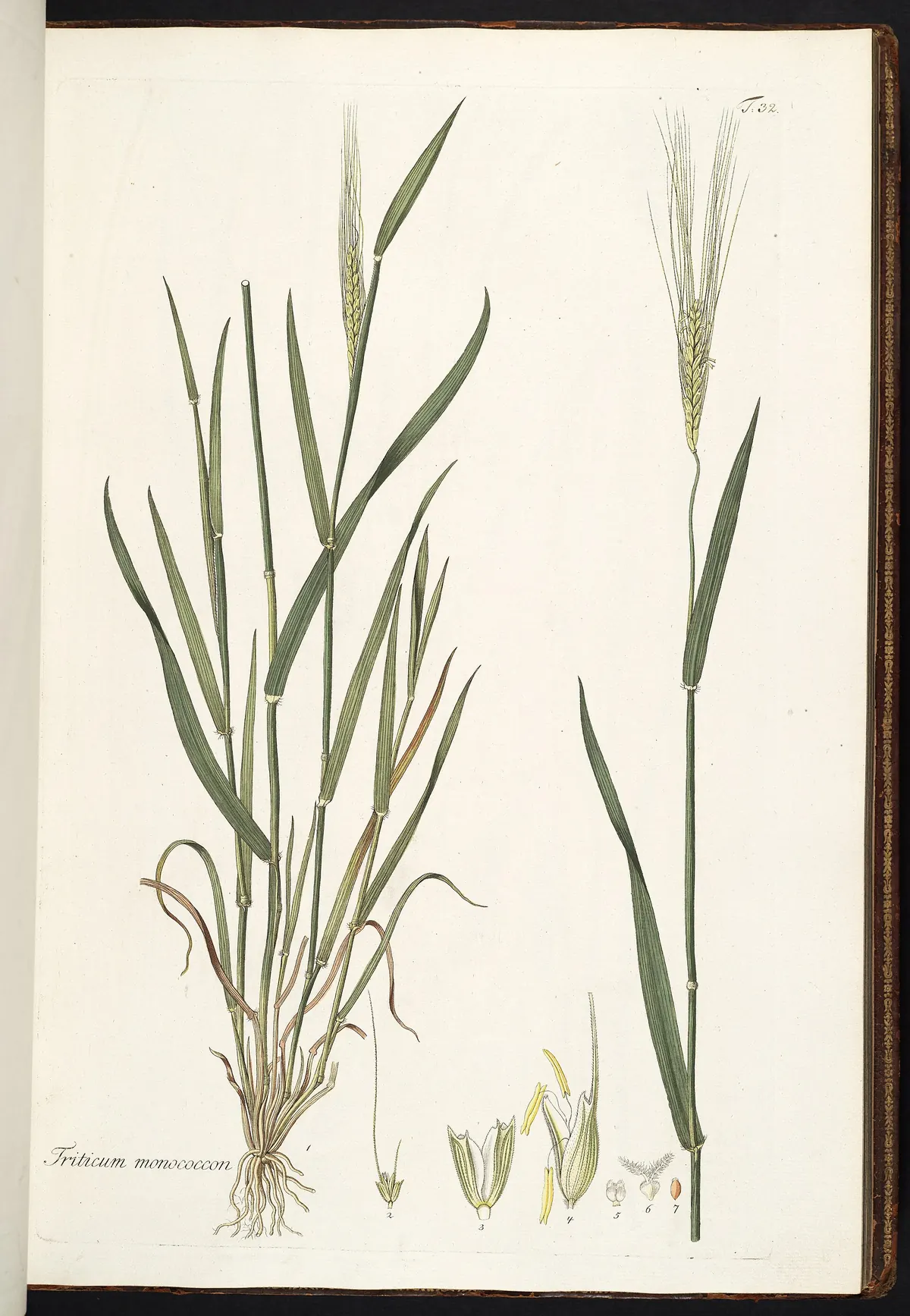
The strength of a cereal ear’s central axis provides a useful example. In wild cereals, breaking apart helps seeds disperse. Ears that retain their grain may be easier to harvest, yet less able to spread without human assistance. Changes in the proportions of these traits across archaeological samples matter more than one unusual grain. The development of agriculture therefore combines changing working practices with a lengthy history of biological transformation.13
People knew cereals before farming villages existed
Early Neolithic communities did not begin without knowledge. Earlier groups already understood when plants ripened, where they grew, and how to grind and prepare them. Ohalo II, beside the Sea of Galilee, preserved plant remains from around 23,000 years ago. Researchers interpret part of this assemblage as evidence for small cultivation trials. That interpretation does not establish a continuous farming economy extending from that early date.
At Shubayqa 1 in northeastern Jordan, remains of flat bread-like foods date to about 14,400 years ago. Hunter-gatherers made them using wild plants. The discovery shows that the history of bread and the history of domesticated wheat do not begin at the same moment. Skills in processing food could precede dependence on fields managed by the people who consumed it.45
Early crops changed at different rates
Wheats, barley and pulses frequently appear in accounts of Southwest Asian agricultural origins. They did not, however, form a ready-made package adopted everywhere at once. The contribution of each species depended on environmental conditions and local practices, while cultivated plants coexisted with resources gathered elsewhere. The appearance of one cereal does not prove that a settlement’s entire economy had already changed.
Comparative research identifies regional differences in the beginning of cultivation and in the establishment of domestication traits. Contact between cultivated plants and wild populations could further complicate that history. The phrase ‘Neolithic Revolution’ describes the magnitude of the long-term consequences, rather than the speed of one event. On the scale of individual lives, the change often involved routine work and gradual adjustments to established practices.71
Storage: a harvest had to last
Harvesting completed only part of the farming cycle. Grain needed drying, protection from pests, and storage for later consumption or the next sowing. At Dhra′ near the Dead Sea in Jordan, structures interpreted as granaries date to approximately 11,300–11,175 calibrated years BP. Raised floors helped air circulate and restricted access by rodents.
These stores preceded the full establishment of morphologically domesticated cereals in the local economy. Storage was consequently more than an accessory to an already completed agricultural system. It changed the possibilities for planning. Reserves connected present labour with future needs and raised practical questions about access to food, the division of responsibilities, and how much grain to eat immediately or retain. Successful production depended on managing that interval between one harvest and the next.6
Animals and settlements formed a mosaic
Cultivation developed alongside changing relationships with sheep, goats, cattle and pigs. This does not mean every settlement possessed a complete set of livestock from its first farming season. Herd management could alter the ages at which animals were killed before clear changes appeared in body size. Animal bones therefore help researchers investigate both biological change and the decisions made by people.
Farming communities existed in northern Mesopotamia by about 8000 BCE. More enduring settlement encouraged investment in houses and facilities used for food production. It did not automatically end hunting, gathering or mobility. A community might combine several ways of obtaining food, while different households followed strategies that varied with the season and the resources available to them. The archaeological picture is more complicated than a sudden replacement of one uniform lifestyle by another.32
How did everyday life change?
Agriculture organised work around recurring tasks: preparing land, sowing, protecting crops, harvesting and storing food. Its consequences extended beyond the kitchen. A field and a store were investments whose value became apparent only after an interval. Planning, teaching practical skills and maintaining access to particular places therefore acquired greater significance.
Over long periods, increased food production could support population growth and larger settlements, but it did not guarantee security for every household. There is no simple direct line from the first field to the first city or state. Thousands of years of local developments separated these phenomena. Farming created new possibilities while also creating dependencies on seasonal conditions, stored food and cooperation. Recognising both sides helps avoid treating early agriculture as an automatic and universal improvement in individual wellbeing.92
How can archaeology identify early farming?
No single artefact supplies a complete answer. A sickle can cut wild cereals, and a grinding stone can process uncultivated plants. Researchers therefore combine several kinds of evidence: grains and ear fragments, accompanying plant species, animal bones, stores, tool wear and the position of finds in successive settlement layers. Agreement among these observations makes an interpretation more convincing.
Radiocarbon dates also require care. BP is conventionally measured from 1950, while calibrated calendar ages differ from raw radiocarbon measurements. A settlement’s dated occupation does not necessarily identify the first cultivation anywhere in its region. ‘Approximately’ therefore describes the nature of the evidence. It is not a missing degree of precision that can simply be supplied by choosing an exact-looking year.487
Why does this transformation still matter?
The legacy of early farmers includes more than crop species. It also includes the relationship between selection, practical knowledge and the organisation of work. Saving seed linked successive growing seasons, while sharing experience linked generations. Seen this way, agricultural history concerns a long collaboration between people and living populations whose properties changed through repeated everyday actions.
The Fertile Crescent is a key region in that history, but it is not the universal starting point for all crops. Other world regions developed their own routes towards food production. Comparison with rice in East Asia or maize in the Americas reveals how a broadly similar outcome — farming — could develop from different plants, environments and social choices. Studying those differences makes the history more informative than a search for a single moment when humanity supposedly became agricultural.19
Questions and answers
When did agriculture begin in the Fertile Crescent?
Major early changes are commonly described within the broad period around 10,000–8000 BCE. Gathering cereals, trial cultivation, domestication and full dependence on food production followed different chronologies. There is no single starting year shared by every species and archaeological site.27
Was bread invented only after wheat was domesticated?
No. Finds at Shubayqa 1 show that hunter-gatherers prepared flat bread-like products. Such foods could be made with wild plants. The presence of bread is therefore not, by itself, evidence that a community had a farming economy.5
Did farming immediately replace hunting and gathering?
No. Early economies could combine cultivation and animal management with wild resources for extended periods. Researchers need to establish proportions and changes through time, rather than assign an entire community to one category on the strength of a single discovery.36
Sources
- Terence A. Brown (2018). The Role of Humans in a Protracted Transition From Hunting-Gathering to Plant Domestication in the Fertile Crescent CC BY
- The Metropolitan Museum of Art (2000). Mesopotamia, 8000–2000 B.C.
- Melinda A. Zeder (2008). Domestication and early agriculture in the Mediterranean Basin: Origins, diffusion, and impact
- Ainit Snir et al. (2015). The Origin of Cultivation and Proto-Weeds, Long Before Neolithic Farming
- Amaia Arranz-Otaegui et al. (2018). Archaeobotanical evidence reveals the origins of bread 14,400 years ago in northeastern Jordan
- Ian Kuijt and Bill Finlayson (2009). Evidence for food storage and predomestication granaries 11,000 years ago in the Jordan Valley
- Amaia Arranz-Otaegui et al. (2016). Regional diversity on the timing for the initial appearance of cereal cultivation and domestication in southwest Asia
- Simone Riehl, Mohsen Zeidi and Nicholas J. Conard (2013). Emergence of Agriculture in the Foothills of the Zagros Mountains of Iran
- Smithsonian Human Origins Program (2022). Humans Change the World
Approximate dates (c.) describe the nature of the evidence: archaeology dates settlements, layers and remains, not single moments of invention.