

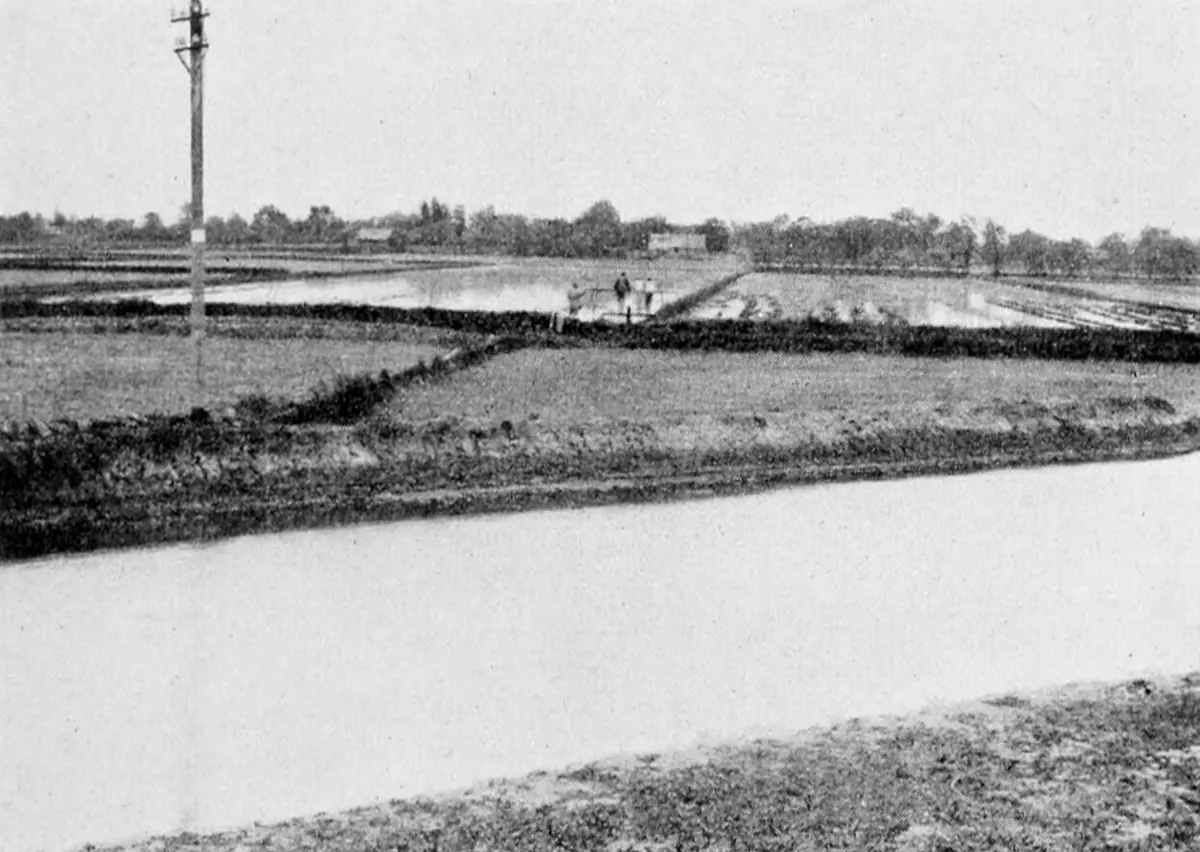
The Yangtze basin: a landscape of possibilities
The Yangtze connects very different environments. Its middle and lower basin, with lakes, floodplains and wet depressions, is particularly important for early rice history. These places were not ready-made fields. Their usefulness changed with water levels, seasons and local vegetation. Communities used this landscape in several ways, combining plants with resources from aquatic environments.
Archaeologists distinguish evidence of rice use from evidence of managing its growth. Grains found at a settlement may have been gathered from natural stands rather than harvested from a field. ‘Where was the earliest rice found?’ is therefore a different question from ‘Where did people begin cultivating it?’ This distinction explains why new discoveries can change chronological models without making earlier research irrelevant. The importance of a site depends on what it demonstrates, not simply whether its date is the oldest.15
What does rice domestication mean?
Cultivation describes human activity, whereas domestication includes inherited changes in plant characteristics. One important rice trait is reduced shedding of ripe grain. A wild plant benefits from dispersing its offspring; a harvester may benefit from grain remaining on the panicle until collection. The interests of a plant in a natural environment and those of a farmer are therefore not necessarily identical.
This history should not be reduced to a single mutation. Experimental research demonstrates interactions between genes affecting grain shedding and panicle shape. Under particular experimental conditions, reduced shedding alone did not produce a larger harvest. The interpretative lesson is useful: combinations of traits, harvesting practices and growing conditions need to be considered together. Assigning the entire transformation to one ‘farming gene’ conceals the processes that made domestication possible.68
Baligang: early rice within a mixed economy
Baligang, in the Nanyang basin associated with the middle Yangtze system, provides a long sequence of plant remains. Research published in 2015 identifies rice cultivation around 6700–6300 BCE. Spikelet bases in the earliest material already suggest reduced grain shedding, although grain shape does not yet fully resemble later cultivated populations.
The inhabitants also used wild foods, including acorns. Rice with domestication traits was consequently not necessarily the community’s sole dietary foundation. The combination of plants used at Baligang changed over time. This sequence demonstrates why cultivation should be reconstructed as the changing economy of a particular community, rather than as a simple list of dates when individual species first appeared. Evidence for one crop needs to be understood alongside the other foods, activities and environments that supported daily life.2
Tianluoshan: change recorded in numbers
Tianluoshan in the lower Yangtze basin preserved spikelet bases whose separation scars help distinguish wild and domesticated forms. Fuller and colleagues described an increase in non-shattering forms from 27% to 39% within a sequence dating to about 6900–6600 years ago. Over the same period, rice remains increased from 8% to 24% of all plant remains.
These are two different indicators, each with a defined scope. The first describes a characteristic of the studied rice material; the second describes the composition of a plant assemblage. Neither directly measures crop yield, field area or the proportion of dietary calories supplied by rice. The chart on this page keeps that distinction. A rising proportion of archaeological remains should not be presented as a measurement of how productive an ancient farm had become.3
How did rice become a crop at Tianluoshan?: Evidence from one site. These indicators describe archaeological remains, not crop yields or rice’s share of the entire diet. Chart adapted from Fuller et al. (2009).
Why is one indicator not enough?
Archaeobotanists study large remains, such as grains and spikelet bases, together with microscopic phytoliths: mineral structures formed in plant tissues. Each kind of evidence answers slightly different questions. Grain dimensions can change for several reasons, while identifying a characteristic from a fragment requires comparison with appropriate reference material.
Ma and colleagues compared several indicators from Neolithic sites in the lower Yangtze region. Their results suggest that individual traits stabilised at different times. A plant therefore did not cross from ‘wild’ to ‘domesticated’ in every aspect of its form at one instant. Using multiple observations reduces the risk that an unusual preservation process or a single selected feature will be mistaken for the history of an entire population. It also helps explain why researchers working with different kinds of remains may propose different chronological boundaries.48
Water and work: from habitat to field
The modern image of rice as a crop permanently standing in water can obscure its earliest history. Initial cultivation did not necessarily resemble later, regularly divided paddy fields. At Baligang, accompanying plants have been interpreted as evidence for a transition from using natural floodplains and some rain-fed cultivation towards more systematic water management.
Preparing a growing area, controlling competing vegetation, choosing when to harvest and retaining seed formed a connected cycle of work. That cycle helps explain why rice history is not exclusively a history of genetic change. Plants, techniques and the organisation of everyday activities affected one another. Later rice landscapes emerged through the development of these relationships; they were not a pre-existing requirement for the first cultivation trials. Separating plant domestication from the construction of elaborate field systems allows both processes to be investigated on their own evidence.25
What can genetics reveal about japonica, indica and aus?
Asian rice, Oryza sativa, includes diverse groups whose past cannot be reconstructed from one simple family tree. Archaeology and genetics examine different traces. Archaeology documents plants in particular places and periods; genetics compares relationships and the movement of gene variants. Their findings need to be brought together rather than allowing one type of evidence to replace the other.
In the model presented by Choi and colleagues, different ancestral populations contributed to japonica, indica and aus, while important domestication variants moved between them through crossing. The divergence of ancestors is not the same event as the beginning of cultivation. A very early date produced by a genetic model therefore does not automatically establish an equally ancient rice field. Careful interpretation separates the ancestry of a population from the human practices that later transformed it.71
Reading the dates and maps of early cultivation
Dates associated with a site may refer to different events: human occupation, the burning of grain, the formation of a sediment layer or the use of a field. It is necessary to ask what was actually dated and how that sample relates to cultivation. BP conventionally measures time from 1950, not from the moment a reader opens this page. A calibrated calendar age also needs to be distinguished from an uncalibrated radiocarbon result.
A point on a map has a similarly defined purpose. The Yangtze marker on the Husfarm map identifies the area of the account, not the boundary of a single culture or the precise extent of every ancient field. Scattered sites sample a much larger history. A lack of finds in one place does not prove that rice was never used there; it may instead reflect the extent of investigation or different conditions for preserving plant remains.45
What rice history teaches us about agriculture
Rice domestication demonstrates that biological and economic changes need not happen simultaneously. A community may rely more heavily on a plant before all its cultivation-related traits have become established. It may also retain diverse food sources after domesticated forms appear. This is not an inconsistency: it provides valuable information about the flexibility of earlier subsistence strategies.
The most revealing account connects different scales: a microscopic scar on a spikelet base, a harvesting choice, a working season and the centuries-long history of an entire river basin. Such an account recognises the expertise of anonymous cultivators without attributing modern genetic concepts to them. Each season involved decisions about gathering and sowing. Their accumulated effects helped shape the plants and landscapes encountered in later periods, illustrating how ordinary practices can contribute to very large historical transformations.681
Questions and answers
Where was rice domesticated?
The middle and lower Yangtze basin in China are central to research on the early domestication of Asian rice, especially japonica. The later history of diverse rice groups also involved contact, crossing and cultivation in other regions. A single map marker cannot explain the entire process.17
Were all early rice crops grown in flooded fields?
That should not be assumed. Early practices involved different environments and ways of using water. Plant domestication and the development of elaborate paddy systems are related but distinct processes, each requiring its own archaeological evidence and chronology.25
What does the increase from 27% to 39% at Tianluoshan mean?
It describes a change in the share of identified non-shattering forms within the studied spikelet-base material. It is not a 12% increase in crop yield or a measure of rice’s share of the diet. The figures track a domestication-related trait through the sequence of one archaeological site.3
Sources
- Briana L. Gross and Zhijun Zhao (2014). Archaeological and genetic insights into the origins of domesticated rice
- Zhenhua Deng et al. (2015). From Early Domesticated Rice of the Middle Yangtze Basin to Millet, Rice and Wheat Agriculture: Archaeobotanical Macro-Remains from Baligang, Nanyang Basin, Central China (6700–500 BC)
- Dorian Q. Fuller et al. (2009). The domestication process and domestication rate in rice: Spikelet bases from the Lower Yangtze
- Yongchao Ma et al. (2018). Multiple indicators of rice remains and the process of rice domestication: A case study in the lower Yangtze River region, China CC BY
- Yan Pan (2023). Revisiting the archaeological investigations of rice domestication in China during 10,000–7,000 BP in a human behavioral context CC BY
- Ryo Ishikawa et al. (2022). A stepwise route to domesticate rice by controlling seed shattering and panicle shape
- Jae Young Choi et al. (2017). The Rice Paradox: Multiple Origins but Single Domestication in Asian Rice
- Dorian Q. Fuller et al. (2014). Convergent evolution and parallelism in plant domestication revealed by an expanding archaeological record
Approximate dates (c.) describe the nature of the evidence: archaeology dates settlements, layers and remains, not single moments of invention.