

When did agriculture begin in the lands of Poland?
No single date can be applied without qualification to the whole territory of present-day Poland. Early farming settlements are associated with the Linear Pottery culture, commonly abbreviated as LBK from the German Linearbandkeramik. Its communities appeared in different regions at different times. Recognising several early sites therefore does not automatically establish the beginning of permanent farming in every valley or landscape.
For Gwoździec, a study published in 2020 places occupation approximately between 5350/5300 and 5100/5050 BCE. This notation expresses ranges derived from the interpretation of dating evidence, rather than four precise dates for separate events. The authors also discuss possible earlier, occasional appearances of LBK communities elsewhere. The chronology of the settlement belongs within a debate about a regional process; it should not be converted into a definitive national starting date.1
A new economy involved people as well as ideas
Ancient DNA research shows that the spread of farming in Europe involved substantial movement of people. Early farming populations in Central Europe have connections with farmers of the Aegean and Anatolia. This is a continental pattern. It is not a direct genetic analysis of every inhabitant of Gwoździec, and it does not reconstruct the individual journey of each family that lived at the settlement.
Establishing a household in a new area required familiar practices to be adapted to local conditions. Settlers needed a suitable location, water and raw materials, and had to learn how crops performed. Alongside seeds and objects came practical skills: recognising soils, manufacturing tools and preparing food. Adaptation should not be assumed to have been immediate or identical everywhere. The presence of broadly similar material culture does not eliminate differences between the environments in which communities made their living.21
Gwoździec: why the location of a village matters
Gwoździec site 2 lies in the municipality of Zakliczyn, in the Carpathian foothills. It occupies loess ground on a slope descending towards the valley of a small stream. Its importance partly comes from this sub-mountainous setting, which was less commonly chosen than more typical areas of early farming settlement. It should therefore not be treated as a simple template for every Neolithic village in the region.
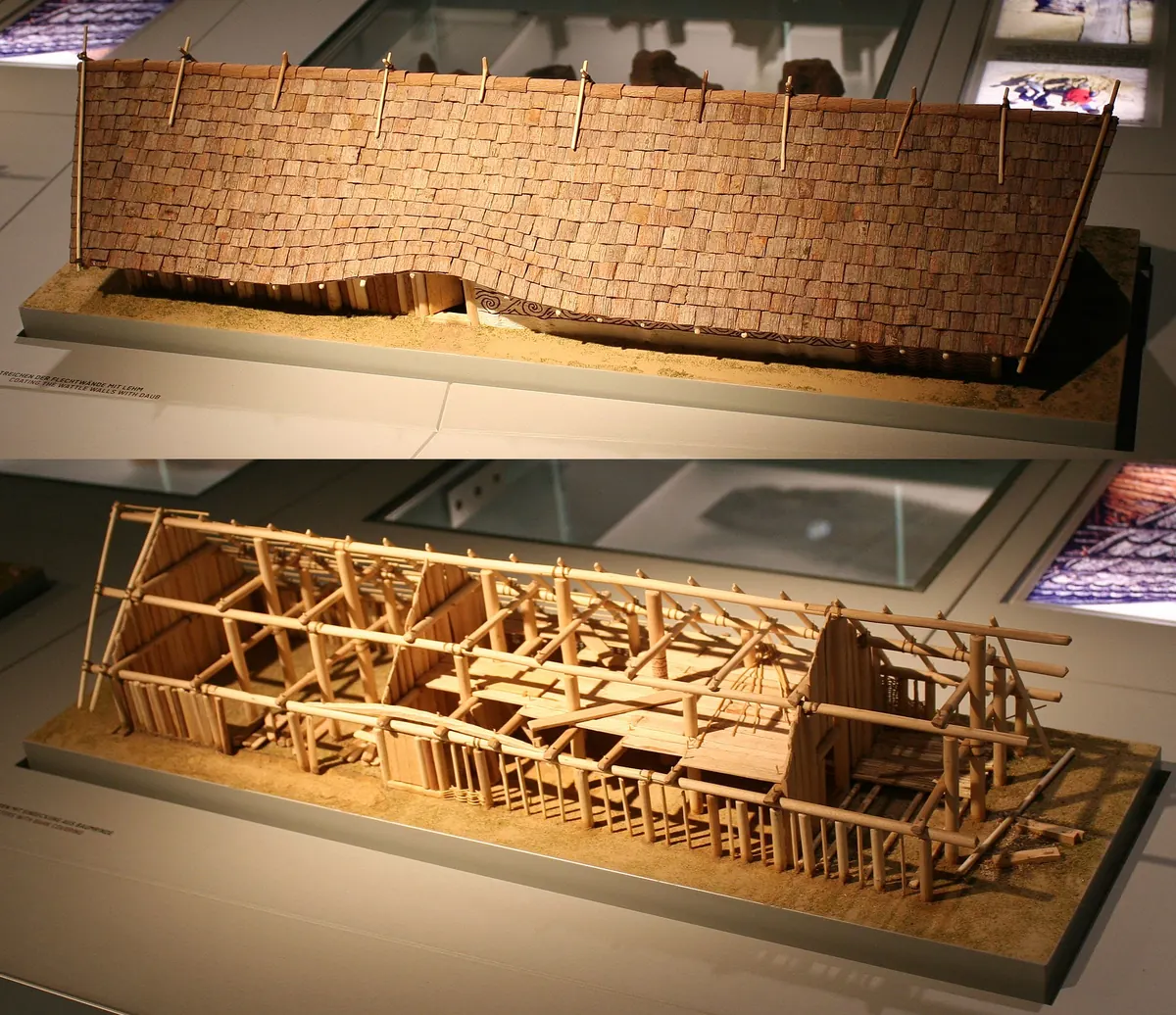
Excavation revealed traces of post-built structures, pits and other settlement features. A pattern of postholes is indirect evidence for a building: the timber generally disappears, but altered soil remains. Combining the building plan with the distribution of finds makes it possible to investigate work around a household. An archaeological house is nevertheless not a photograph of a single day. It is a surviving record of activities that may have accumulated, overlapped or been disturbed over considerable time.1
What was grown: emmer, einkorn and uncertain identifications
Emmer wheat predominated among the identified cereal remains from Gwoździec, followed by einkorn. These are hulled wheats, whose processing differs from that of many modern wheat forms. Preserved grains and fragments of spikelets establish that the inhabitants handled and used cereals at the settlement. On their own, however, these remains cannot reveal the size of a field or the amount harvested in a particular year.
Some material survives too poorly to identify beyond a genus or a broader plant group. A responsible reconstruction retains those uncertain classifications rather than turning an ambiguous seed into a definite crop list. Weeds accompanying cereals can help researchers investigate the cultivated environment and farming practice. Their abundance also depends on burning, deposition and archaeological sampling. The material recovered from a pit is therefore not an unfiltered inventory of everything growing around the settlement.1
Flint tools preserve traces of work
Flint survives well, but a tool does not remain unchanged when used. Its edge may develop polish, scratches and small fractures. Use-wear analysis compares such traces with those produced by experiments in which the worked material is known. This means that the shape of an implement need not be the only basis for interpreting its function. Microscopic evidence can qualify or improve an initial classification.
At Gwoździec, researchers examined finished tools together with production waste and raw materials. These finds help investigate manufacture, repair and connections with other areas. An object can record several stages of its life: obtaining stone, producing an edge, using it and eventually discarding it. Yet not every fragment can be assigned securely to harvesting, and the absence of a recognised tool does not establish that a particular activity never occurred. The relationship between evidence and reconstruction must remain explicit.1
A farming household also processed and stored food
Obtaining grain was not the end of the work. A cereal harvest had to be separated from unwanted plant material, stored, prepared for consumption and partly retained for the next sowing. This is a general model of a grain-based economy, not a list of activities independently demonstrated in every feature at Gwoździec. It explains why researchers consider vessels and the context of plant remains alongside recognisable agricultural tools.
A wider view of Neolithic farming comes from pottery research in Kuyavia. Dairy fats identified in perforated vessels support their interpretation as equipment for separating curds from whey. These results concern other sites, not Gwoździec itself. They show that food production included processing animal products and that chemical evidence can test an interpretation initially suggested by the shape of a pot. Regional comparisons are valuable when their geographical limits are kept clear.135
Fields required commitment across more than one season
Isotope research on early crops from several European sites indicates that some communities used animal manure. This challenges an image of all Neolithic cultivation as casually sowing unused land. It is not direct evidence of manuring at Gwoździec: a local conclusion requires appropriate local samples and analysis. Broader findings can suggest questions to investigate, but they cannot substitute for evidence from the place being described.
This distinction matters when thinking about agricultural labour. Preparing land, keeping seed for another year and maintaining tools created commitments extending across seasons. Such commitments should not automatically be equated with modern private ownership or a fixed division of social roles. Agricultural remains speak most securely about material activities. Reconstructing detailed legal arrangements and social rules from them is considerably more difficult, and certainty in one area should not be borrowed to fill gaps in another.41
How archaeology tests its own historical narratives
Pottery helps organise the relative sequence of assemblages, while radiocarbon dating connects organic samples with calendar time. The methods must be interpreted together. A decorative style can persist longer than expected, and a dated sample does not necessarily belong to the moment when a house was constructed. Researchers therefore examine the association between material and feature, compare multiple dates and retain the uncertainty expressed by those results.
Gwoździec matters as a case study in this process of revision. Detailed investigation of one place can alter an earlier chronological model without erasing regional differences. The first farmers in the lands of modern Poland belonged to many communities and landscapes. The strength of their history lies in the possibility of testing explanations against particular grains, tools and samples, rather than locating one dramatic date that appears to settle every question about the beginning of agriculture.1
Questions and answers
Can the inhabitants of Gwoździec be called the first Poles?
No. They lived thousands of years before the Polish state and modern national identities. “The lands of Poland” describes a location on the present-day map, not the nationality of prehistoric inhabitants.1
Is 5350 BCE the certain starting date of farming in Poland?
No. It is one boundary in the ranges used to interpret the chronology of a particular settlement. The beginnings of settlement and cultivation varied regionally, while earlier traces need their own assessment and dating.1
Which cereals are documented at Gwoździec?
Hulled wheats, especially emmer and einkorn, dominate the identified cereal material. The surviving remains need not provide a complete list of plants used by the inhabitants, because preservation and sampling are selective.1
Sources
- Czekaj-Zastawny, A. et al. (2020). The earliest farming communities north of the Carpathians: The settlement at Gwoździec site 2 CC BY
- Hofmanová, Z. et al. (2016). Early farmers from across Europe directly descended from Neolithic Aegeans
- Salque, M. et al. (2013). Earliest evidence for cheese making in the sixth millennium BC in northern Europe
- Bogaard, A. et al. (2013). Crop manuring and intensive land management by Europe’s first farmers
- Bogucki, P. · Princeton University (n.d.). Neolithic Cheese Production
Approximate dates (c.) describe the nature of the evidence: archaeology dates settlements, layers and remains, not single moments of invention.