

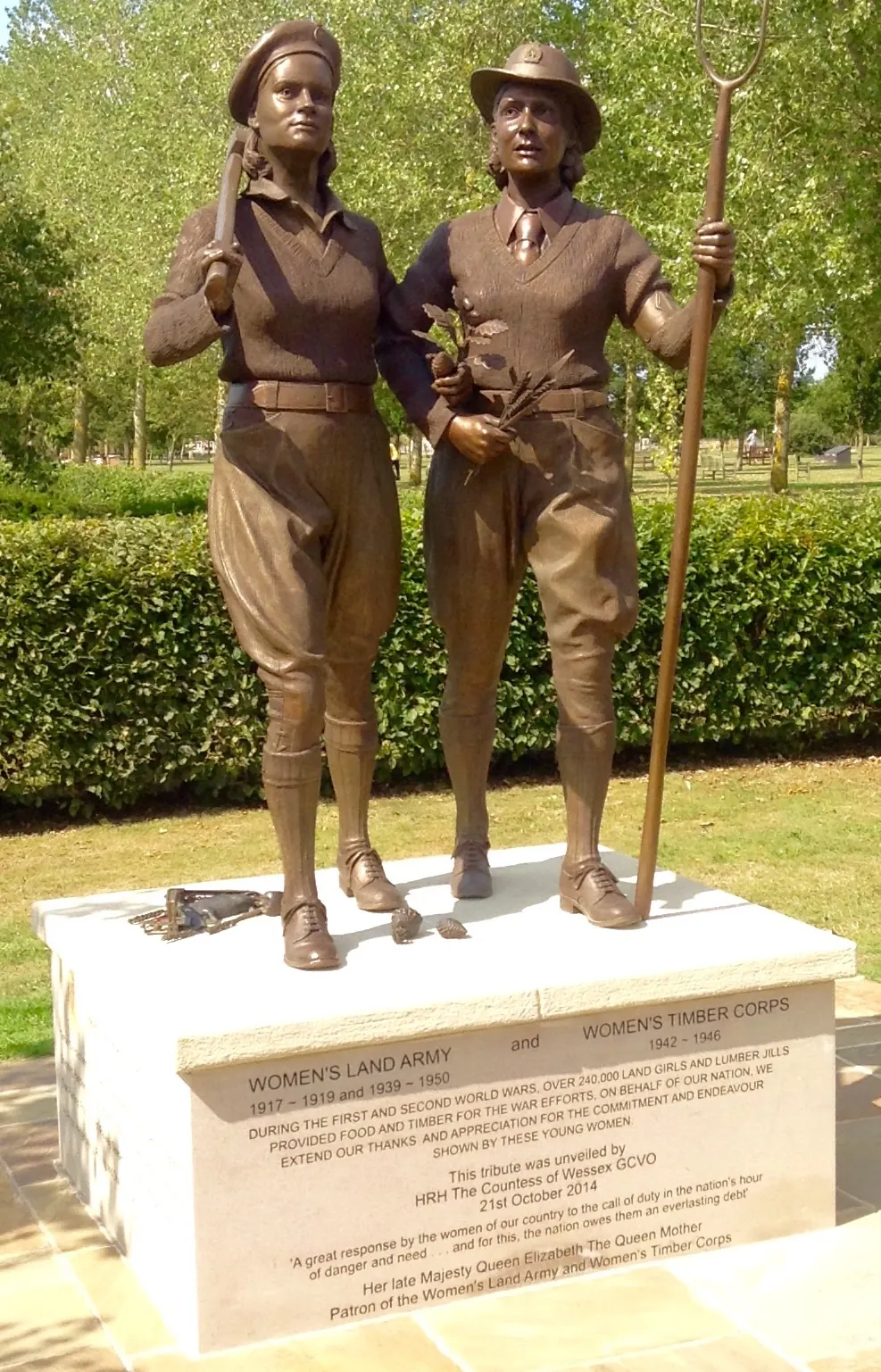
Key dates
- 1899The predecessor of the Women’s Farm and Garden Association is formed to support women’s work on the land.1
- 1917The Women’s Land Army is established; the first organisation lasts until November 1919.2
- June 1939The Women’s Land Army is relaunched before the outbreak of the Second World War.3
- 1942The Women’s Timber Corps is formed for forestry and timber production.43
- September–October 1943Amelia King’s rejection on racial grounds reaches Parliament; she is admitted to the organisation that autumn.91011
- November 1950The Women’s Land Army is disbanded after several years of postwar work.64
Women worked on the land before the Land Army
A story in which women suddenly discovered farming during wartime overlooks a much longer history. Women already worked in family agriculture, horticulture and animal husbandry. Organisations also campaigned for vocational training and recognition of their abilities. The predecessor of the Women’s Farm and Garden Association was founded in 1899. Its activities included professional networks, advice and examinations in practical gardening and poultry management. Wartime recruitment therefore drew upon earlier institutions rather than inventing an interest in women’s agricultural employment from nothing.
In 1917, government gave mobilisation a larger scale and an administrative framework. Earlier recruitment initiatives were incorporated into the Women’s Land Army. The first organisation ended in November 1919. Distinguishing an institution’s creation from the work that preceded it is essential: a uniform and official title made some workers more publicly visible, but did not encompass every woman doing similar tasks. The history of the organisation is consequently only part of the history of women’s rural labour. Its records should supplement, rather than replace, questions about workers who never appeared on its membership lists.12
Why war increased demand for agricultural workers
Farming faced the combined demands of feeding the population and losing part of its labour force to the armed services. Threats to maritime transport increased the importance of domestic production. In June 1939, the Women’s Land Army was relaunched before Britain entered the Second World War. This distinguished the second mobilisation from the first: preparations began earlier. Recruits came with different social backgrounds, previous occupations and levels of familiarity with agricultural work. Membership did not imply that everyone started with the same skills or expectations.
The problem could not be solved simply by accumulating a national total of volunteers. Labour had to be available in the right place at the right time. A harvest would not wait for a convenient moving date, while animals required continuing care. Recruitment therefore depended on training, transport and accommodation as well as farm demand. Numbers must also be read carefully: membership at one moment is different from the total number of women who passed through the organisation over several years. These measures describe different dimensions of mobilisation and cannot be substituted for one another when assessing its scale.36
Training and the skills concealed by the word help
Some recruits received several weeks of preparation at agricultural colleges or training farms; others learned directly at work. Surviving course material and testimony show that there was no identical pathway for every member. Milking, planting, handling horses and using tools required particular movements, judgement and awareness. Photographs of mechanical instruction and cereal work record a range of responsibilities extending beyond the familiar image of fruit picking. Training mattered because willingness to contribute did not itself provide the knowledge needed for an unfamiliar task.
The word help can obscure responsibility. Working with animals required attention to their routines, while harvesting depended on cooperation between workers. Skill involved more than physical strength: observation, care and the correct sequence of actions were also important. A short course could ease entry into a new occupation without instantly creating an experienced worker. Historical analysis should therefore ask both what formal instruction contained and who continued the teaching at a farm. Learning did not end with a placement. The transfer of practical knowledge between people was part of the organisation’s agricultural contribution.75
Accommodation, pay and the risks of everyday work
Land Girls could live in private billets associated with farms or in communal hostels, including converted houses and purpose-built huts. Recollections describe contrasting experiences, ranging from welcoming households to isolation and uncomfortable conditions. No single memoir should stand for every farm. Accommodation nevertheless affected rest, companionship and independence. For many women, employment also meant moving into an unfamiliar social setting away from relatives. The place where a worker slept and ate was therefore part of the conditions under which agricultural labour became possible.
Employment involved unequal pay and the possibility of illness or injury. In a parliamentary answer on 12 October 1943, the government described health insurance for employed members, compensation for workplace accidents and additional assistance through a benevolent fund. This establishes formal arrangements; it does not prove that every injured worker obtained adequate help without difficulty. Comparing rules with correspondence and memories distinguishes an entitlement on paper from an individual’s experience. Patriotic language did not remove the economic dimension of employment, nor did a uniform make the physical consequences of demanding work disappear.8105
Scotland and the Women’s Timber Corps
The Scottish Women’s Land Army had separate administrative arrangements connected with the Department of Agriculture for Scotland and local committees. Scottish records describe harvesting, haymaking, milking and sheep shearing among the jobs undertaken. In 1942, the Women’s Timber Corps was formed for forestry and timber work, its members becoming popularly known as Lumber Jills. Organisational links with the Land Army do not make forestry identical to food production, nor justify transferring every rule or experience from one branch to another.
These distinctions matter when interpreting evidence. A camp beside a forest and a billet at a dairy farm produced different living arrangements; seasonal tasks required different coordination from the daily care of animals. Figures also need an explicit geographical scope. A membership total for Scotland is not automatically a figure for Great Britain. What connected these arrangements was the mobilisation of civilian skills for a wartime economy. Regional administration, occupational specialisation and the duration of individual service still require their own explanations. Treating all participants as interchangeable would conceal the organisation of the work itself.43
Amelia King and the limits of a shared national effort
In 1943, Amelia King, a Black Londoner, applied to join the Women’s Land Army. The Essex branch rejected her, citing difficulties in finding employment and accommodation related to the colour of her skin. The case reached the House of Commons on 23 September. The debate exposed a gap between the stated rejection of racial discrimination and effective access to employment. The minister stressed that the organisation placed women with agricultural employers rather than directly employing them. Administrative arrangements thus became part of the argument over responsibility.
Following public protest, King obtained work at Frith Farm in Hampshire. In October, Parliament was told that her enrolment was expected and that she would receive the uniform once placed in employment. Her experience shows that labour shortages did not automatically remove prejudice. Change required action by the applicant, support from others and a specific employer willing to take her on. It was not an inevitable consequence of wartime appeals to unity. Keeping the parliamentary exchanges alongside the account of her eventual employment preserves both the obstacle and the effort needed to overcome it.91011
The work did not end in 1945
The end of hostilities did not immediately dissolve the Women’s Land Army. It continued until November 1950, and surviving collections document members who remained after 1945. Disputes about recognition had already emerged. Lady Gertrude Denman resigned in 1945 in protest at members’ exclusion from postwar benefits. Comparisons with women’s military services exposed the tension between the patriotic language used to recruit civilian workers and the rights available when their work ended. The institutional boundary between civilian and military service had consequences beyond the uniform.
Remembrance developed over subsequent decades. In 2008, the government began awarding a special badge recognising former members of the Land Army and Timber Corps. Later official application material identifies it as recognition tied to evidence of service. It should not be confused with proof that recipients had held military status. Commemoration is a separate phase of this history: it records both earlier labour and a later decision to acknowledge it publicly. The interval between contribution and recognition helps explain why collecting personal testimony became important to former members and their families.651213
What the surviving evidence can establish
Women’s Land Army archives preserve photographs, uniform items, correspondence, membership documents and recorded recollections. Collections at Reading include material associated with Doreen Thorp and other participants. Each type of evidence answers a different question. A document may establish a posting date, a photograph reveal equipment, and a memory describe fatigue, pride or loneliness. None by itself can calculate the organisation’s total share of food production. The limits of a source are part of its value: they indicate what needs to be checked against another kind of record.
The Land Girls’ contribution should consequently be described without reducing wartime farming to a single group. Other workers, farm owners and families continued to work, while outcomes also depended on land, equipment and supplies. The organisation mattered because it recruited and allocated additional labour and publicly challenged assumptions about women’s capabilities. Its history directs attention to the people who performed the recurring tasks that sustained production. Asking how they acquired skills, where they lived and what employment cost them gives substance to work that recruitment posters presented as a national duty. It makes agricultural history a history of labour as well as land and machinery.678
Questions and answers
Was the Women’s Land Army part of the armed forces?
No. Despite its name, uniforms and language of service, it was a civilian organisation placing women in agricultural work.29
Did Land Girls work only during the Second World War?
No. The first organisation operated in 1917–1919. Relaunched in June 1939, it continued beyond the war until November 1950.236
Were the Timber Corps and Land Army exactly the same?
No. They were connected, but the Timber Corps specialised in forestry and timber. Administrative arrangements and chronology also need to be considered regionally.4
Sources
- Museum of English Rural Life, University of Reading (n.d.). Women’s Farm and Garden Association: archive description
- Northumberland Archives (n.d.). Photographs of Women’s Land Army, about 1917–19
- The National Archives; Vicky Iglikowski-Broad, Cherish Watton and Chloe Lee (2023). On the Record: Women’s Land Army, transcript
- National Records of Scotland / Scotland’s People (n.d.). Scottish Women’s Land Army records
- Museum of English Rural Life, University of Reading (2020). Land Girls: The History of the Women’s Land Army
- Museum of English Rural Life, University of Reading (2017). Women’s Land Army collections
- Cherish Watton / Women’s Land Army public history project (n.d.). Training: testimony and a contemporary course letter
- Cherish Watton / Women’s Land Army public history project (n.d.). Accommodation: billets and hostels
- UK Parliament, House of Commons (1943). Women’s Land Army (Colour Discrimination), 23 September 1943
- UK Parliament, House of Commons (1943). Women’s Land Army: sickness, accidents and Amelia King, 12 October 1943
- Tamisan Latherow / Museum of English Rural Life (2020). Breaking the Colour Bar: Amelia King and the Women’s Land Army
- Bedford Borough Council, The Virtual Library (2014). Veterans Badge for former Land Girls
- Department for Environment, Food & Rural Affairs (2012; updated 2025). Women’s Land Army and Timber Corps: veteran’s badge application form
Approximate dates (c.) describe the nature of the evidence: archaeology dates settlements, layers and remains, not single moments of invention.