

Key dates
- 618–907During the Tang dynasty, tea acquires a broad market and an elaborate culture of consumption.7
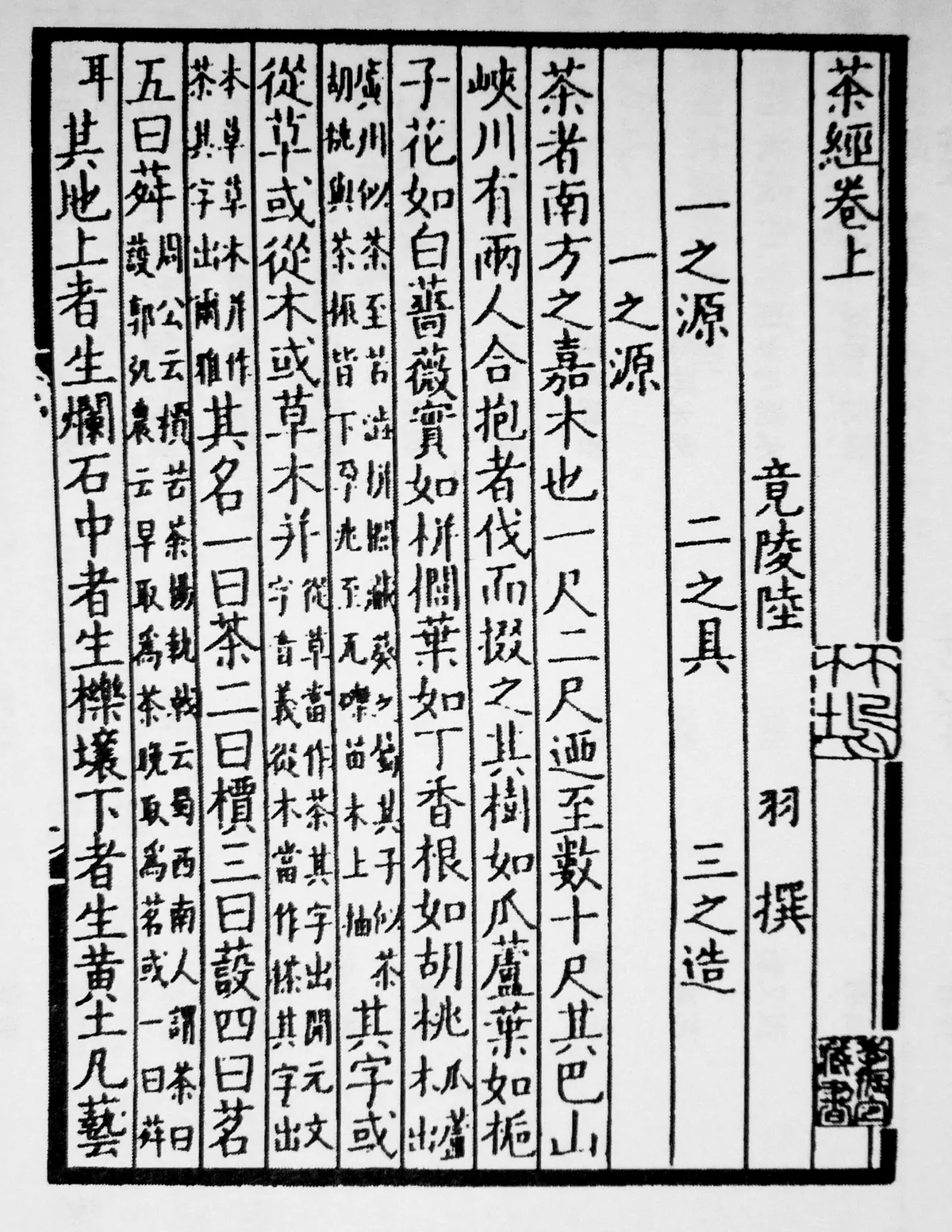
- c. 760–780Lu Yu composes the Chajing, bringing together the plant, production, utensils and preparation.156
- 793The establishment of regular tea taxation confirms the commodity’s fiscal significance.3
- c. 862Accounts concerning Qimen indicate strong local dependence on tea cultivation and trade.3
- 960–1279The Song period brings further changes in preparation; Tang practices should be distinguished from later ones.6
What changed under the Tang—and what did not begin then
The Tang dynasty ruled from 618 to 907. Its importance in tea history lies in the enlargement of markets and drinking practices, rather than the invention of cultivation. Analyses of plant remains from Han Yangling demonstrate that tea was known long before the Tang. In 2021, researchers also interpreted charred material from a tomb at Zoucheng as tea dating to the Warring States period. Such findings extend the documented record; they do not identify a first cup, a single domestication event or the farm where cultivation began.
The kind of evidence matters. Identifying remains cannot by itself reconstruct a recipe, the frequency of consumption or a production system. Stories connecting tea to the mythical Shennong reveal how later writers claimed antiquity for the beverage. In the Chajing, inherited traditions appear alongside practical observation. Reading the work historically requires separating legendary ancestry, archaeological identification and the more extensively documented expansion of tea’s market during the eighth and ninth centuries. These are related questions, but they do not have interchangeable answers.8917
A perennial crop and a commitment of labour
Lu Yu begins with a southern plant. He assesses growing sites, soils, shoots and leaves, and distinguishes wild-growing plants from those in gardens. These are a historical author’s categories, not a modern manual of crop management. They nevertheless demonstrate that the character of tea was already connected with a particular environment. His preferences should not be mistaken for a uniform standard followed by every producer. They record the qualities and distinctions that an informed evaluator wanted readers to recognise.
For a household, a tea shrub implied a different sequence of investment from an annual grain crop. Plants had to be established and maintained before harvesting, then revisited in subsequent seasons. The operations described in the Chajing also make the connection between fieldwork and processing unmistakable. Gathered material needed further treatment before storage. That sequence brings into view workers who are easily overlooked in a history of famous connoisseurs: people collecting leaves, preparing fuel, handling equipment and supervising drying. The celebrated beverage depended on their coordinated tasks, even when the surviving text does not preserve their names.1
Turning fresh leaves into a storable product
The Chajing describes plucking, steaming, pounding, shaping, drying and preparing tea for storage. It names heating vessels, mortars, moulds, woven supports and drying equipment. The order of operations is significant. Tea offered to a customer was the outcome of several connected transformations; gathering leaves was only the beginning. Processing belonged within the agricultural economy, and its execution could alter the evaluation of material collected from the same location. The distinction between crop and finished commodity was therefore a practical one.
Lu Yu discusses weather at harvesting and moisture during storage. He also examines the appearance of shaped tea, warning against judging quality by an overly simple reading of its surface. Economically, drying and shaping helped separate harvest time from consumption time. They also required labour and equipment beyond that needed to collect the crop. This relationship follows from the documented sequence itself. It does not require inventing output per worker, average costs or production volumes that the source cannot supply. A history of technique is strongest when the limits of its evidence remain visible.1
Production regions and the journey to consumers
The Chajing’s account of producing regions maps tea through assessments of origin and quality. It is not a survey of all land planted with tea in China. Its importance is that a place name could communicate information about a commodity: buyers were encouraged to distinguish products by where they came from. Such distinctions could support regional reputations, although the text does not provide a measurable price premium. The producer’s environment and the connoisseur’s judgement met in the finished batch.
Feng Yan describes supplies arriving from Jiang–Huai, transport by boat and cart, and shops selling prepared tea. His account connects southern production with northern consumption. It is the testimony of a contemporary observer, not a table of trade statistics: descriptions of abundant stocks cannot be converted into tonnage. For agricultural history, the chain of dependence is itself revealing. Growers, processors, carriers and retailers helped move the product towards customers who did not need to know the place where its leaves had been picked. Distance made preservation, handling and commercial trust consequential parts of the crop’s history.12
Monasteries, everyday drinking and social distinction
James A. Benn’s research identifies Buddhist institutions and individuals as important participants in popularising tea during the eighth and ninth centuries. Drinking tea also offered monks and literati opportunities to meet outside occasions organised around alcohol. This does not mean that every plantation belonged to a monastery or that religion alone explains the market’s growth. Custom, exchange, taste and availability could reinforce one another, with different combinations operating in different places.
Feng Yan presents tea both as something purchased in a shop and as the centre of an elaborate performance of expertise. In his anecdotes, preparation, clothing and an official’s response help determine the meaning of the encounter. The distinction is useful: wider availability did not erase social hierarchy. The same agricultural material could satisfy ordinary thirst or become an occasion for displaying cultivated taste. His stories therefore preserve more than brewing instructions. They reveal how a commodity could cross social settings while acquiring different meanings in each, and how judgements about a drink could also become judgements about the person serving it.42
The tax of 793 and the state’s interest in tea
Regular tea taxation was established in 793; Yi Zou’s account identifies a levy of one tenth of value. This is a clear indication of the commodity’s enduring fiscal importance. The stated rate should not be equated with the precise burden on every farm. Reconstructing actual costs would require local evidence about collection, intermediaries and prices. The tax helps explain a changing relationship between agricultural commerce and government, but it cannot by itself establish the profitability of cultivation or the distribution of its proceeds.
An account of Qimen around 862, discussed by Zou, describes a locality strongly dependent on tea growing and trade. Specialisation could connect a household with revenue from sales while also making distant purchasers important to its livelihood. Read beside Feng Yan’s description of transport and shops, this raises concrete questions about the division of gains: who arranged carriage, who evaluated quality, and who bore the risk of unsold stock? The surviving accounts do not supply one answer for all China. They do show why the history of tea cannot be reduced to a celebrated author’s biography or a sequence of changes in elite taste.32
Utensils and preparation as economic evidence
Lu Yu describes roasting prepared tea, reducing it to powder and cooking it in water. This should not automatically be pictured as the familiar practice of steeping loose leaves in a teapot. The National Palace Museum distinguishes Tang-associated boiling from later Song practices of whisking. Actions, equipment and consumer expectations changed. For producers, this meant that the finished product’s qualities were assessed in relation to a particular mode of preparation, rather than against a single timeless definition of good tea.
A ceramic tea grater in Wake Forest University’s museum makes the mechanical side of preparation tangible. One surviving object does not establish that every household owned the same equipment. A ninth-century white bowl in the Metropolitan Museum illustrates contemporary ceramic production, but its shape alone cannot establish what it contained on every occasion. Connecting objects and texts therefore requires care. The strongest comparison matches a described action with an implement’s possible function, rather than automatically assigning every elegant bowl to tea drinking. Material evidence can reveal skills and manufacturing choices without supplying a complete census of consumers.16510
Reading the Chajing as agricultural history
The Chajing is a practical guide, a classification and an argument about taste. Its author recommends some practices and criticises others. His disapproval of certain additions to tea indirectly shows that those preparations existed. A prescription cannot simply become a description of what everyone did. The distance between ideal and practice is one of the text’s historical strengths: it reveals arguments over quality, flavour and expertise, rather than a uniform tradition that never changed. Reading against its recommendations can therefore be as instructive as following them.
From an economic perspective, the work connects a plant with environment, manual labour, processing and consumption. It also leaves substantial gaps: it is neither a harvest balance sheet nor a comprehensive record of landholding. Archaeological finds, descriptions of shops and research on taxation answer different parts of the problem. The central Tang transformation was an expansion of these relationships. Tea became a commodity whose origin and manufacture could be evaluated, whose consumption attracted commentary, and whose trade the state could tax. Keeping the farm within that history restores the work behind the finished drink.1273
Questions and answers
Did Lu Yu invent tea?
No. Tea was known many centuries before him. The Chajing organised knowledge and ideals concerning the plant, production and drinking. The approximate date 760–780 refers to the work, not the beginning of cultivation.185
Was Tang tea prepared in the same way as tea today?
Practices varied. Lu Yu describes previously processed tea being ground and cooked in water. This should not be equated with every later method of steeping loose leaves.16
Why does the year 793 matter to agricultural history?
Regular taxation demonstrates tea’s importance as a traded commodity. It connects farms and merchants with state finance, while providing no date for the invention of cultivation.3
Sources
- Lu Yu (8th century; digital edition 2005). 茶經 / Chajing (The Classic of Tea), original Chinese text
- Feng Yan (Tang dynasty). 封氏聞見記 / Fengshi wenjian ji, volume 6: 飲茶 (Tea drinking)
- Yi Zou / International Institute for Asian Studies (2018). Tea production in southern China and its political implications during the Tang and Song Dynasties
- James A. Benn (2015). Buddhism and Tea during the Tang Dynasty, in Tea in China: A Religious and Cultural History (chapter abstract)
- Timothy S. Y. Lam Museum of Anthropology, Wake Forest University (2023). Tang Dynasty Tea Grater
- National Palace Museum, Southern Branch (n.d.). The Homeland of Tea: Chinese Tea Culture; The Taste of Tang and Song
- National Museum of Asian Art, Smithsonian Institution (n.d.). Tea Culture in China
- Houyuan Lu and colleagues (2016). Earliest tea as evidence for one branch of the Silk Road across the Tibetan Plateau
- Jianrong Jiang, Guoquan Lu, Qing Wang and Shuya Wei (2021). The analysis and identification of charred suspected tea remains unearthed from Warring State Period Tomb
- The Metropolitan Museum of Art (9th century; collection record). Bowl, China, ninth century; object 1980.365
Approximate dates (c.) describe the nature of the evidence: archaeology dates settlements, layers and remains, not single moments of invention.